zeptun

A userspace network engine for TUN devices, written in Zig with no dependencies. It turns the packets an operating system routes into a tunnel interface back into TCP, UDP and ICMP flows, and forwards them through a SOCKS5 proxy, directly, or to the embedding application.
Features
- IPv4 and IPv6, dual stack, fragment reassembly.
- TCP through a userspace terminator, through kernel NAT, or both at once.
- UDP with full-cone NAT by default, plus address and address-port modes.
- Segmentation offload in both directions: TSO, USO,
UDP_SEGMENTandUDP_GRO, through SOCKS5 as well. - Multi-queue TUN with elastic workers: queues are attached and detached under load, and live connections migrate between them without loss.
- SOCKS5 with a warm connection pool, pipelined handshakes, optimistic data, UDP ASSOCIATE and UDP over TCP.
- Fake-IP DNS, DNS hijacking, and DNS handover to systemd-resolved.
- Automatic routing: policy rules, prefix include and exclude lists, UID, interface and Android package rules, strict route, nftables auto-redirect.
- ICMP echo forwarding, ICMP time exceeded for expired packets, and upstream ICMP errors translated back to the client.
- The interface can live in its own network namespace while upstream sockets stay outside.
- io_uring or epoll on Linux, kqueue on BSD and macOS, IOCP on Windows.
- C ABI, TOML and JSON configuration, per-flow verdict callback.
- Linux, Android, Windows, macOS, iOS and FreeBSD.
Benchmarks
Measured by the benchmark workflow on a GitHub-hosted runner, against four other engines over the same SOCKS5 server.
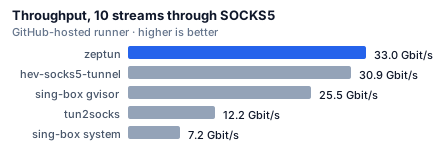
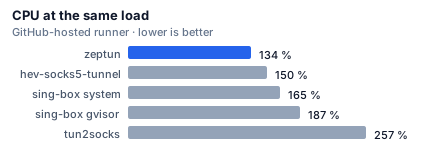
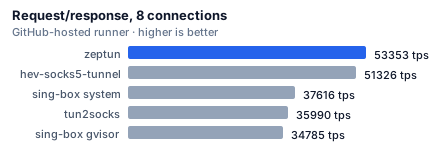
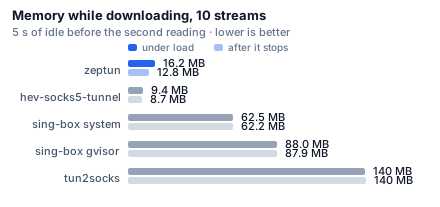
The second memory bar is read after the load stops: the packet pool hands idle pages back to the kernel instead of holding them for the life of the process.
Method, runner specification, latency, UDP, memory and the raw tables: docs/bench.
Build
Zig 0.17.1 is the only requirement.
Unix
git clone https://github.com/Noisemux/zeptun
cd zeptun
make
sudo make install
make install places zeptun in /usr/local/bin, libzeptun.a and zeptun.h beside it, conf/zeptun.toml in /etc/zeptun if no configuration exists yet, and a systemd unit in /usr/local/lib/systemd/system.
Android
ANDROID_NDK_HOME=/path/to/ndk sh scripts/build_android.sh
This builds libzeptun.so and libzeptun.a for armeabi-v7a, arm64-v8a, x86 and x86_64, then libzeptun-jni.so from src/jni/zeptun_jni.c. All load segments are aligned to 16 KB, as Android 15 and later require. Without the NDK the script stops after the Zig libraries.
iOS and macOS
sh scripts/make_xcframework.sh
This produces zig-out/Zeptun.xcframework with the iOS device, iOS simulator and macOS slices. Package.swift exposes it to SwiftPM. The slices target macOS 15.0 and iOS 18.0, the oldest versions Zig 0.17 supports.
Windows
zig build -Dtarget=x86_64-windows-gnu -Doptimize=fast
The tunnel uses Wintun, pinned in build.zig.zon as a lazy package dependency: the first build for a Windows target fetches the official distribution from wintun.net, checks it against the recorded hash, and installs the wintun.dll for that architecture (amd64 for x86_64, arm64 for arm64) next to the executable, with its licence as wintun-LICENSE.txt. zig build --fetch=all primes that download without building, and later builds work offline. The released Windows archives already contain both files.
Library
zig build -Doptimize=fast
This writes zig-out/lib/libzeptun.a, the shared library and zig-out/include/zeptun.h. Other targets: make TARGET=aarch64-linux-musl, or zig build cross for the whole matrix.
Use
Configuration
preset = "desktop"
log_level = "warn"
stats_interval_s = 0

[tun]
name = "zeptun0"
mtu = 8500
queues = 0
address = ["172.19.0.1/30", "fdfe:dcba:9876::1/126"]

[stack]
mode = "userspace"
udp_nat = "endpoint_independent"
icmp = "auto"

[handler]
kind = "socks5"

[handler.socks5]
server = "127.0.0.1:1080"
udp_mode = "udp"
pool_size = 4

[route]
auto_route = true
exclude = ["192.168.0.0/16"]

[dns]
fake_ip = false
hijack = false
systemd_resolved = true
conf/zeptun.toml carries every key with its default. The same document is accepted as JSON. Unknown keys are rejected instead of ignored.
| Section | Keys |
|---|---|
| top level | preset (desktop, server, mobile), log_level, log_file, pid_file, stats_interval_s, post_up_script, pre_down_script |
[tun] |
name, fd, mtu, queues, offload, multi_queue, persist, napi, jumbo, txqueuelen, configure, netns, guid, address |
[stack] |
mode (userspace, hybrid, system), tcp_rx_window, tcp_tx_buffer, tcp_mss_clamp, tcp_initial_cwnd, congestion, sack, timestamps, window_scaling, tcp_connect_timeout_ms, tcp_idle_timeout_ms, tcp_delayed_ack_ms, tcp_early_accept, udp_idle_timeout_ms, udp, udp_nat, icmp, max_tcp_sessions, max_udp_sessions, nat_port_base, nat_port_limit |
[handler] |
kind (socks5, direct, passthrough), tcp_fastopen, preserve_dscp |
[handler.socks5] |
server, username, password, udp, udp_mode (udp, tcp), udp_address, pipeline, optimistic_data, pool_size, pool_idle_ms |
[handler.direct] |
fwmark, bind_interface |
[route] |
auto_route, table, rule_priority, fwmark, include, exclude, include_file, exclude_file, strict, allow_app, auto_redirect, redirect_port, include_uid, exclude_uid, include_interface, exclude_interface, include_package, exclude_package, android_user |
[io] |
backend (auto, io_uring, epoll), workers, elastic (auto, on, off), rx_parallel, tx_slots, multishot_rx, busy_poll_us, pin_cpus, monitor_network |
[dns] |
fake_ip, fake_ranges, cache_size, ttl, address, hijack, upstream, systemd_resolved |
[memory] |
budget_bytes, buffers_per_worker |
Run
sudo zeptun run -c /etc/zeptun/zeptun.toml
Every key has a flag as well, so the file is optional:
sudo zeptun run --tun zeptun0 --mtu 8500 --socks5 127.0.0.1:1080 --auto-route
With --auto-route the engine installs the addresses, routes and policy rules itself and removes them when it stops, on Linux, macOS, FreeBSD and Windows. Upstream sockets carry a firewall mark, so proxy traffic never re-enters the tunnel. Without it nothing outside the interface is touched.
zeptun help lists every flag. The ones that matter most:
| Flag | Default | Meaning |
|---|---|---|
--stack |
userspace |
userspace, hybrid or system |
--queues |
CPUs | upper bound for TUN queues and worker threads |
--elastic |
auto |
attach and detach queues by load; off keeps them all attached |
--mtu |
1500 | use 8500 or more with offloads |
--socks5 ADDR:PORT |
proxy address; also --socks5-user, --socks5-pass, --socks5-udp-mode, --socks5-pool |
|
--handler |
socks5 |
socks5, direct or passthrough |
--auto-route |
off | install addresses, routes and policy rules |
--auto-redirect |
off | Linux: redirect TCP into a kernel socket with nftables |
--strict-route |
off | refuse traffic for an address family the tunnel does not carry |
--exclude CIDR |
keep a prefix off the tunnel; also --route, --route-file, --exclude-file |
|
--netns NAME |
create the interface inside a network namespace | |
--udp-nat MODE |
endpoint-independent |
address and address-port restrict the NAT |
--fake-ip |
off | answer A and AAAA from a private pool and dial by domain |
--dns-hijack |
off | capture DNS sent to any address |
--systemd-resolved |
auto |
hand DNS to the tunnel through resolvectl |
--icmp |
auto |
forward, local or drop echo requests |
--io |
auto |
io_uring or epoll |
--stats N |
0 | print counters every N seconds |
Container
docker run --rm --device /dev/net/tun --cap-add NET_ADMIN --cap-add NET_RAW \
  -e SOCKS5_ADDR=172.17.0.1 -e SOCKS5_PORT=1080 ghcr.io/noisemux/zeptun
services:
  tun:
    image: ghcr.io/noisemux/zeptun
    cap_add:
      - NET_ADMIN
      - NET_RAW
    devices:
      - /dev/net/tun:/dev/net/tun
    environment:
      TUN: zeptun0
      MTU: 8500
      IPV4: 172.19.0.1/30
      IPV6: fdfe:dcba:9876::1/126
      HANDLER: socks5
      SOCKS5_ADDR: a.b.c.d
      SOCKS5_PORT: 1080
      SOCKS5_USERNAME: user
      SOCKS5_PASSWORD: pass
      SOCKS5_UDP_MODE: udp
      AUTO_ROUTE: 1
      EXCLUDED_ROUTES: a.b.c.d/32
      LOG_LEVEL: warn

  client:
    image: alpine
    tty: true
    network_mode: "service:tun"
    depends_on:
      - tun
docker/entrypoint.sh turns the environment into /run/zeptun.toml. Set CONFIG to point at your own file instead, or pass arguments to run any subcommand.
API
C
#include <zeptun.h>

ZeptunConfig config;
zeptun_config_init(&config, ZEPTUN_PRESET_DESKTOP);
config.handler_kind = ZEPTUN_HANDLER_SOCKS5;
config.auto_route = 1;
snprintf(config.socks5_server, sizeof config.socks5_server, "127.0.0.1:1080");

Zeptun *tun = NULL;
if (zeptun_create(&config, &tun) != ZEPTUN_OK) return 1;
zeptun_start(tun);
...
zeptun_stop(tun);
zeptun_destroy(tun);
| Function | Purpose |
|---|---|
zeptun_config_init(config, preset) |
fill the configuration struct with the defaults of a preset |
zeptun_create(config, out) |
create an engine from the struct |
zeptun_create_from_toml(text, len, out) |
create an engine from a TOML document |
zeptun_create_from_json(text, len, out) |
the same document as JSON |
zeptun_start(tun) |
spawn the workers and return once the tunnel is up |
zeptun_run(tun) |
run one worker on the calling thread until zeptun_stop |
zeptun_stop(tun) |
stop the engine from any thread, including from a callback |
zeptun_destroy(tun) |
join the workers, remove routes and free the engine |
zeptun_set_device_fd(tun, fd) |
use an existing TUN file descriptor |
zeptun_set_adapter_guid(tun, guid) |
pin the Wintun adapter GUID on Windows, so the adapter keeps one identity across reinstalls |
zeptun_set_read_callback(tun, cb, ctx) |
receive the packets that leave the engine |
zeptun_write_packets(tun, packets, count) |
inject packets into the engine |
zeptun_set_protect_callback(tun, cb, ctx) |
approve every upstream socket before it connects |
zeptun_set_flow_callback(tun, cb, ctx) |
decide per flow: proxy, direct, drop or reject |
zeptun_stats(tun, stats) |
lock-free snapshot of the counters |
zeptun_memory(tun, memory) |
packet pool usage and how much memory has been returned to the kernel |
zeptun_network_changed(tun, index) |
tell the engine that the default route moved |
zeptun_strerror(code) |
message for an error code |
Callbacks run on worker threads and must not block. Every setter except zeptun_stop, zeptun_stats, zeptun_memory and the packet functions must be called before zeptun_start.
Kotlin
libzeptun-jni.so registers its methods on the class dev.zeptun.Zeptun:
package dev.zeptun

import android.net.VpnService

object Zeptun {
    external fun nativeStart(service: Any?, fd: Int, config: String?): Int
    external fun nativeStop()
    external fun nativeVersion(): String
    external fun nativeCounter(index: Int): Long

    init {
        System.loadLibrary("zeptun-jni")
    }
}

class ZeptunService : VpnService() {
    fun start(fd: Int, config: String) {
        val rc = Zeptun.nativeStart(this, fd, config)
        if (rc != 0) throw IllegalStateException("zeptun start failed: $rc")
    }

    override fun onDestroy() {
        Zeptun.nativeStop()
        super.onDestroy()
    }
}
nativeStart takes the descriptor from VpnService.Builder.establish() and an optional TOML document; null uses the mobile preset. The service object is held as a global reference and its protect(int) method is called for every upstream socket. Change ZEPTUN_JNI_CLASS in src/jni/zeptun_jni.c to register on another class.
Swift
import Zeptun

var config = ZeptunConfig()
zeptun_config_init(&config, UInt32(ZEPTUN_PRESET_MOBILE))
config.device_kind = UInt32(ZEPTUN_DEVICE_FD)
config.tun_fd = tunnelFileDescriptor
On iOS take the descriptor from NEPacketTunnelProvider, or use ZEPTUN_DEVICE_EXTERNAL with the packet callbacks to stay inside the NetworkExtension API.
Stacks
| Mode | TCP | UDP | Notes |
|---|---|---|---|
userspace |
own terminator | own sessions | works everywhere, keeps no kernel state, required for elastic queues |
system |
kernel sockets behind NAT | kernel sockets | Linux only, lowest CPU for bulk transfer |
hybrid |
kernel NAT with a userspace fallback | own sessions | default where the system stack exists |
Elastic queues start with a single worker and add a queue only while it raises throughput, then release it when the load drops. Connections and sessions move between workers without dropping a packet, so the idle footprint stays small on a busy machine.
Testing
| Command | Scope |
|---|---|
zig build test |
unit tests and the deterministic TCP simulation |
zig build test-netns |
unit tests inside a user and network namespace with real TUN devices |
zig build test-ffi |
tests/ffi_smoke.c compiled with -Wall -Wextra -Werror against libzeptun.a |
zig build test-integration |
189 end-to-end checks through a real TUN device between two namespaces |
zig build bench |
hot-path microbenchmarks with a regression gate |
Full documentation lives in the wiki: Building, Configuration, Command line, Routing, Stacks, C API, Android, Apple, Container, Benchmarks, Testing.
The integration suite covers every stack mode, both io backends, one and four queues, direct and SOCKS5, offloads on and off, UDP over TCP, fake-IP, strict routing, auto-redirect, elastic queue rotation under load, and the network namespace mode. The TCP simulation drives the real terminator against a model peer over lossy, reordering links and verifies every byte, leaving no buffers, timers or completions behind.
Platform support
| Platform | Device | Event loop | Routing |
|---|---|---|---|
| Linux | /dev/net/tun, multi-queue, vnet header |
io_uring or epoll | rtnetlink, policy rules, nftables |
| Android | VpnService descriptor, or /dev/tun with root |
epoll | package and UID rules with root |
| Windows | Wintun | IOCP | IP Helper, WFP filters |
| macOS, iOS | utun, NetworkExtension | kqueue | route socket |
| FreeBSD | tun | kqueue | route socket |
License
MIT