react-native-continued-task





Run user-initiated work that keeps going after the user leaves your app — a large export, an upload, a batch encode — behind one cross-platform API.
Overview
react-native-continued-task is a React Native and Expo library for long-running background tasks that survive the app being backgrounded. It wraps iOS 26's BGContinuedProcessingTask and Android's WorkManager foreground services behind a single typed API, so an upload, export, or batch encode the user started keeps running — with the progress UI each platform draws for it.
It is built on Nitro Modules with Swift on iOS and Kotlin on Android, ships an Expo config plugin, and is written for the constraints these APIs actually impose rather than hiding them.
| iOS 26 — Live Activity on the Lock Screen | Android — foreground-service notification |
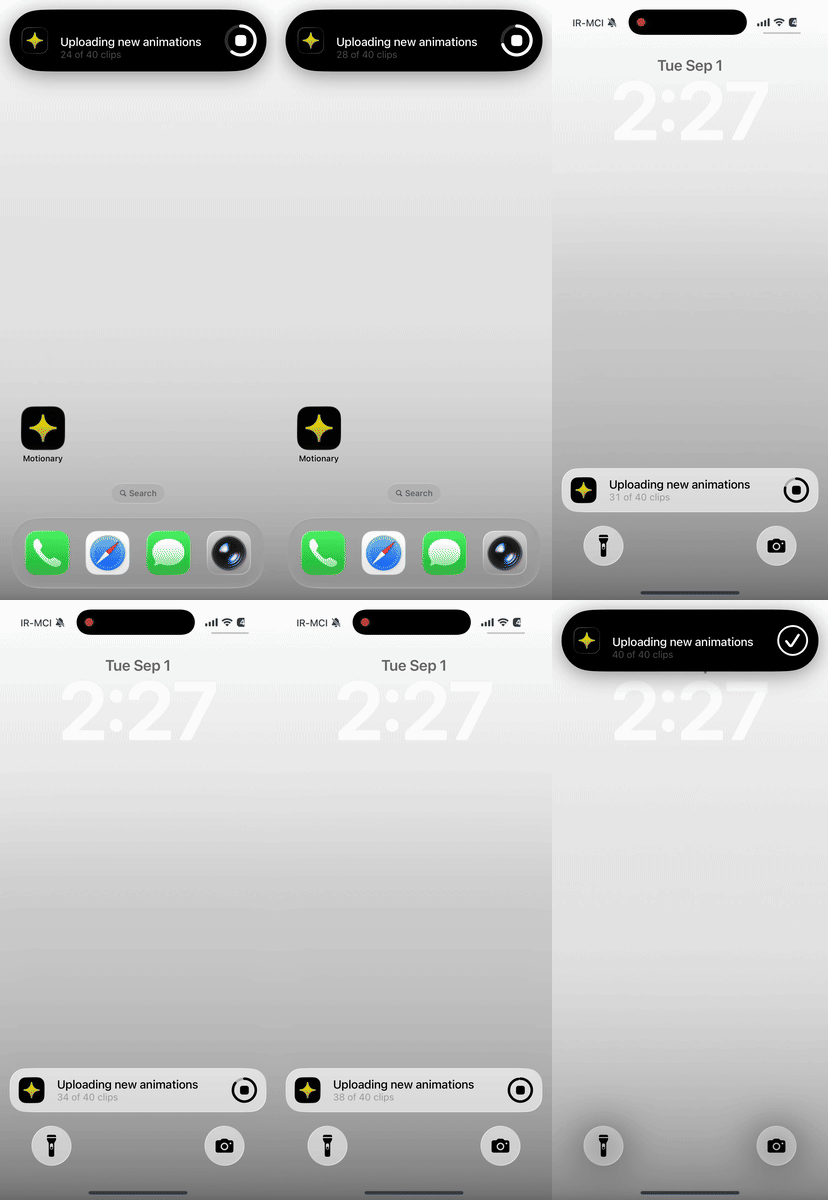 |
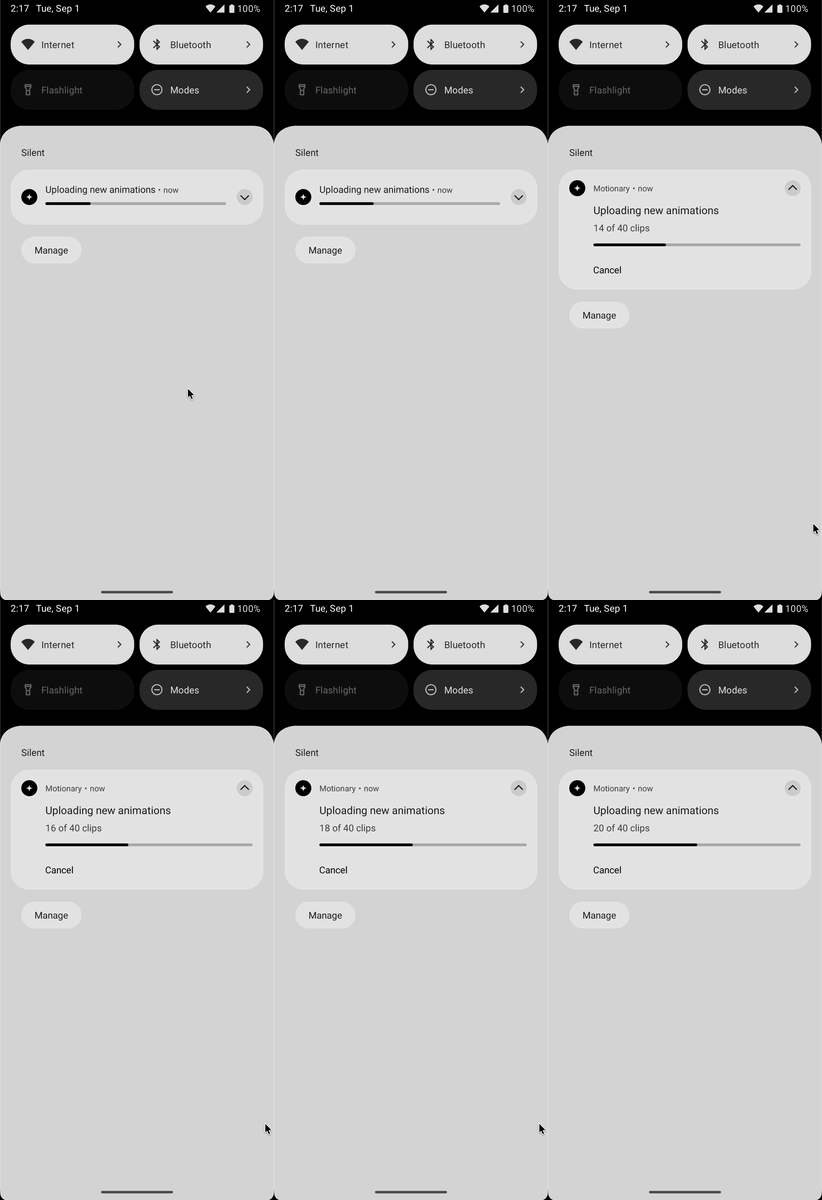 |
Both show the same task: a title and subtitle that update as it runs, live progress, and a control to cancel it. On iOS that cancel arrives as expired — the system routes it through the same handler as an expiry and gives the app no way to tell them apart. On Android the same tap arrives as user-cancelled.
Features
- 📱 One API over iOS 26's
BGContinuedProcessingTaskand Android's WorkManager foreground services - 🔔 System-drawn progress UI — a Live Activity on iOS, an ongoing notification on Android — that the user can cancel from
- 📊 Progress reporting that is load-bearing, not decoration: iOS expires tasks that report none
- ♻️
getKnownTasks()reconciles work lost when the app is swiped away — the only way to detect it on iOS, which reports it no other way - 🧭 Typed submit errors and stop reasons, each carrying the raw platform domain and code instead of one generic failure
- 🧩 Expo config plugin for the
Info.plist, entitlement andAndroidManifestwiring - ✅ Verified on a real device — 13/13 on iOS 26.6.1
- 🔥 Powered by Nitro Modules
This is not a general "run some code in the background" library. Both platforms only grant this runtime to work the user just asked for, both show UI they can cancel from, and both kill work that looks stalled. The API is shaped around those constraints rather than hiding them.
| Platform | Backed by |
|---|---|
| iOS 26+ | BGContinuedProcessingTask, with the system-provided Live Activity |
| Android (minSdk 24) | WorkManager CoroutineWorker running as a foreground service |
Installation
npm install react-native-continued-task react-native-nitro-modules
Requires a dev build. Nitro modules never work in Expo Go.
react-native-nitro-modules is an optional peer dependency, so npm and yarn resolve the single copy your app already has instead of nesting a second one. A nested second copy crashes at startup with Nitro was installed twice.
Expo
Add the config plugin and declare the identifier prefixes your app will submit under:
{
  "expo": {
    "plugins": [
      [
        "react-native-continued-task",
        {
          "identifierPrefixes": ["com.foo.MyApp.export"],
          "enableGPU": false
        }
      ]
    ]
  }
}
Then npx expo prebuild. The plugin writes BGTaskSchedulerPermittedIdentifiers on iOS (expanding each prefix to <prefix>.*), the GPU entitlement when enableGPU is set, and on Android the foreground-service permissions plus the merged SystemForegroundService block. See Config plugin for the full option list and the bare-workflow equivalents.
Usage
import {
  ContinuedTasks,
  getSubmitErrorCode,
} from 'react-native-continued-task';

async function exportLibrary(photos: Photo[]) {
  if (!ContinuedTasks.isSupported) return exportInForeground(photos);

  // Must be called from the foreground, in response to a user action.
  const task = await ContinuedTasks.submit({
    identifierPrefix: 'com.foo.MyApp.export',
    title: 'Exporting library',
    subtitle: `0 of ${photos.length} photos`,
    totalUnitCount: photos.length,
  });

  task.addOnStopListener(({ reason, native }) => {
    console.log(`export stopped: ${reason} (${native.domain} ${native.name})`);
    // The task is already gone. Save whatever partial state you have.
  });

  try {
    for (const [index, photo] of photos.entries()) {
      await exportOne(photo);
      // Report progress. This is what keeps the task alive.
      task.setProgress(index + 1, photos.length);
      task.updateTitle(
        'Exporting library',
        `${index + 1} of ${photos.length} photos`
      );
    }
    task.complete(true);
  } catch (error) {
    task.complete(false);
  }
}
API
ContinuedTasks
The entry point. A ContinuedTaskManager.
isSupported: boolean
true on iOS 26+ and on Android once the foreground-service permissions are granted. false on the iOS Simulator, which has no background task scheduler, and on web.
supportsGPU: boolean
Reads BGTaskScheduler.supportedResources — whether this device can grant background GPU access. Always false on Android. Check it before setting ios.requiresGPU; asking for a resource the device cannot provide makes submit reject with not-permitted.
supportsReattach: boolean
true on Android, where a WorkManager worker outlives the app process and attachToTask can hand you a live handle again. false on iOS, where the system cancels continued processing tasks when the app is terminated.
submit(options: ContinuedTaskOptions): Promise<ContinuedTask>
Submits a task and resolves once the platform scheduler accepts it. The returned task starts in the pending state.
Call this from the foreground, in direct response to a user action. iOS requires that submission "occur as a result of a person's action, such as tapping a button"; tasks submitted from a timer, from a push handler, or from the background get cancelled.
Rejects with an Error whose message is prefixed with a stable code. Read it with getSubmitErrorCode(error) instead of matching on the message:
SubmitErrorCode |
Cause |
|---|---|
not-permitted |
BGTaskScheduler.Error.notPermitted — identifier missing from BGTaskSchedulerPermittedIdentifiers, unentitled or unavailable GPU, or the user denied background launches |
too-many-pending-requests |
.tooManyPendingTaskRequests — cancel pending work and retry |
unavailable |
.unavailable — background refresh off in Settings, or running in the Simulator |
immediate-run-ineligible |
.immediateRunIneligible — only ever with the fail submission strategy |
unsupported-platform |
iOS older than 26, or web |
invalid-identifier |
The prefix is empty, already ends in .*, or is not prefixed with the bundle ID |
invalid-options |
Options failed validation before reaching the platform |
foreground-service-unavailable |
Android could not start the foreground service |
unknown |
Anything else — read the message |
The four BGTaskScheduler cases are kept distinct on purpose; they call for different fixes.
ContinuedTaskOptions
| Field | Type | Default | Notes |
|---|---|---|---|
identifierPrefix |
string |
— | Written without the trailing .*, e.g. com.foo.MyApp.export. Must start with the bundle ID on iOS and be listed in the plugin's identifierPrefixes. The library appends a UUID to build the concrete identifier. |
title |
string |
— | Shown in the Live Activity / notification |
subtitle |
string |
— | Shown under the title |
totalUnitCount |
number |
— | The size of the work, in any unit. Required, because progress is mandatory |
ios.submissionStrategy |
'queue' | 'fail' |
'queue' |
fail rejects with immediate-run-ineligible rather than waiting |
ios.requiresGPU |
boolean |
false |
Needs the GPU entitlement and supportsGPU |
android.notificationChannelId |
string |
'continued-task' |
Created if absent |
android.notificationChannelName |
string |
'Background tasks' |
Only used when creating the channel |
android.notificationIcon |
string |
app icon | Drawable resource name |
android.showCancelAction |
boolean |
true |
Wired to WorkManager's createCancelPendingIntent |
android.cancelActionLabel |
string |
'Cancel' |
|
android.foregroundServiceType |
'dataSync' | 'mediaProcessing' | 'specialUse' |
'dataSync' |
Must match what the plugin declared |
getKnownTasks(): Promise<KnownTask[]>
Every task this app has submitted that the library still holds a record for, newest first. Call it on launch — see Reconciling after a silent kill.
interface KnownTask {
  id: string;
  identifierPrefix: string;
  title: string;
  subtitle: string;
  submittedAt: number; // ms since epoch
  state: ContinuedTaskState;
  completedUnitCount: number;
  totalUnitCount: number;
  stopReason?: TaskStopReason;
}
attachToTask(id: string): Promise<ContinuedTask | undefined>
Re-attaches to a task still running natively after the process restarted. Resolves to undefined when there is nothing live — always the case on iOS. Gate on supportsReattach.
forgetTasks(ids: string[]): Promise<void>
Drops persisted records once you have reconciled them. Unknown ids are ignored. Records are never dropped for you, so you decide when reconciliation is done.
ContinuedTask
A live handle to one piece of work. It owns the native task, so there are no ids to thread through your own code and no way to address a task that no longer exists.
| Member | Notes |
|---|---|
id: string |
'<identifierPrefix>.<uuid>' |
title, subtitle: string |
As currently shown to the user |
state: ContinuedTaskState |
'pending' | 'running' | 'finished' | 'stopped' |
completedUnitCount, totalUnitCount: number |
Last reported progress |
updateTitle(title, subtitle): void |
Replaces both; iOS has no API for changing one alone |
setProgress(completed, total): void |
Clamped to [0, total]. See below |
complete(success): void |
Idempotent. Not calling it is a bug |
cancel(): void |
Stops with reason app-cancelled |
addOnStartListener(cb): ListenerSubscription |
Fires immediately if already running, so there is no subscribe race |
addOnStopListener(cb): ListenerSubscription |
See Stop reasons |
Both listener methods return { remove: () => void }. Removing stops future emissions; it does not un-deliver an event already dispatched to the JS thread.
Progress is load-bearing
"Tasks that do not report any progress will be expired." — Apple
Progress is not decoration on iOS. The scheduler deprioritizes and then kills tasks that look stalled, so setProgress is the call that keeps your task alive. This is why totalUnitCount is a required submit option rather than an optional one: the task starts at a defined 0 / total and the shape of the API pushes you toward reporting as you go.
Stop reasons
addOnStopListener fires when a task stops without complete(). Every event carries a normalized reason and the raw platform detail, because a mapped enum on its own makes these APIs undebuggable on a real device:
interface TaskStopEvent {
  taskId: string;
  reason: TaskStopReason;
  native: {
    domain: string; // 'BGTaskScheduler' | 'WorkManager'
    code?: number; // Android's WorkInfo stop reason; absent for an iOS expiration
    name: string; // e.g. 'STOP_REASON_FOREGROUND_SERVICE_TIMEOUT'
  };
}
TaskStopReason |
Platform | Means |
|---|---|---|
user-cancelled |
both | Cancelled from the iOS Live Activity or the Android notification action |
app-cancelled |
both | Your own task.cancel() |
expired |
both | System expiration. On iOS this is where a stalled task ends up |
fgs-timeout |
Android 15+ | The 6-hour dataSync budget ran out (STOP_REASON_FOREGROUND_SERVICE_TIMEOUT) |
quota |
Android 16+ | JobScheduler quota exhausted (STOP_REASON_QUOTA = 10) |
app-terminated |
both | Reconstructed on next launch; only ever seen on KnownTask.stopReason |
unknown |
both | Read native |
iOS cannot tell you the user cancelled
BGContinuedProcessingTask delivers user cancellation and system expiration through the same expirationHandler, which takes no arguments. There is nothing in the shipping SDK that distinguishes them, so this library reports 'expired' with native.name of 'expirationHandler' rather than guessing at 'user-cancelled'. Treat the two as one case on iOS. Android can distinguish them, and does.
This is confirmed on hardware, not just read out of the header: cancelling from the Live Activity on iOS 26.6.1 reported expired. See the run log.
Platform behavior you have to design around
Submission must be foreground and user-initiated
iOS: "Submission needs to occur as a result of a person's action, such as tapping a button." Submitting automatically — on a timer, from a push, during launch — gets the task cancelled. Wire submit() to a button, not to an effect.
Reconciling after a silent kill
When the user swipes your app out of the app switcher, iOS cancels its continued processing tasks and, verbatim, "the app doesn't receive an indication of cancellation in that case." No stop listener, no expiration handler, nothing. The same is true for requests still queued.
So the library persists a record natively at submit time and reads it back on the next launch:
useEffect(() => {
  ContinuedTasks.getKnownTasks().then(async (tasks) => {
    const orphans = tasks.filter((t) => t.stopReason === 'app-terminated');
    for (const orphan of orphans) {
      await rollBackPartialExport(orphan.id, orphan.completedUnitCount);
    }
    await ContinuedTasks.forgetTasks(orphans.map((t) => t.id));
  });
}, []);
On Android the worker can outlive the process, so a KnownTask may still be genuinely running — check supportsReattach and use attachToTask(id) to get the handle back rather than treating it as an orphan.
Android 13+ needs the notification permission at runtime
The library declares POST_NOTIFICATIONS in its manifest, but on Android 13 (API 33) and newer that is only half the story: without a runtime grant, the foreground service still starts and your work still runs — the notification is just silently suppressed. The task looks like it did nothing.
The library cannot ask on your behalf, because a permission prompt needs an Activity. Request it from your app before the first submit:
import { PermissionsAndroid, Platform } from 'react-native';

if (Platform.OS === 'android' && Number(Platform.Version) >= 33) {
  await PermissionsAndroid.request(
    PermissionsAndroid.PERMISSIONS.POST_NOTIFICATIONS
  );
}
If the user declines, submitting still works and the task still runs — they simply cannot see or cancel it. The example app does this in ensureNotificationPermission.ts.
Android's 6-hour dataSync cap
Targeting API 35+, all of an app's dataSync foreground services share 6 hours per 24-hour period. At the limit the system calls Service.onTimeout and you have seconds before a RemoteServiceException; the library surfaces it as fgs-timeout and completes the worker. The budget resets when the user next foregrounds the app.
On Android 16+, JobScheduler quota also applies to jobs running alongside a foreground service, surfaced as quota.
If your work genuinely needs to escape both, the real semantic match for BGContinuedProcessingTask is a user-initiated data transfer job (JobInfo.Builder.setUserInitiated(true), Android 14+). WorkManager exposes no UIDT API, so it would be a separate native path; this library defaults to WorkManager and documents UIDT as the escalation.
BGTaskScheduler.submit and iOS 27
BGTaskScheduler.submit(_:) is reported as deprecated in iOS 27 in favor of submitTaskRequest(_:completionHandler:). See SDK verification for what the shipping SDK actually exposes today and how this library is structured for it.
Duration and concurrency limits
Apple does not publish the maximum duration of a continued processing task or how many can run at once, so this README does not quote figures. The "1 refresh + 10 processing tasks" limit in BGTaskScheduler's own documentation is about a different task type and does not apply.
Config plugin
[
  'react-native-continued-task',
  {
    identifierPrefixes: ['com.foo.MyApp.export'],
    enableGPU: false,
    androidForegroundServiceTypes: ['dataSync'],
  },
];
| Option | Default | Writes |
|---|---|---|
identifierPrefixes |
[] |
iOS BGTaskSchedulerPermittedIdentifiers, each expanded to <prefix>.* |
enableGPU |
false |
iOS entitlement com.apple.developer.background-tasks.continued-processing.gpu |
androidForegroundServiceTypes |
['dataSync'] |
Android permissions and the tools:node="merge" SystemForegroundService block |
Bare workflow
Without Expo, do the same by hand. Info.plist:
<key>BGTaskSchedulerPermittedIdentifiers</key>
<array>
  <string>com.foo.MyApp.export.*</string>
</array>
No UIBackgroundModes value is needed — see SDK verification.
AndroidManifest.xml:
<uses-permission android:name="android.permission.FOREGROUND_SERVICE"/>
<uses-permission android:name="android.permission.FOREGROUND_SERVICE_DATA_SYNC"/>
<uses-permission android:name="android.permission.POST_NOTIFICATIONS"/>

<service
    android:name="androidx.work.impl.foreground.SystemForegroundService"
    android:foregroundServiceType="dataSync"
    tools:node="merge" />
WorkManager declares SystemForegroundService but not your foregroundServiceType, which is why the tools:node="merge" entry is required.
Testing
BGContinuedProcessingTask cannot be tested in CI and does not work in the Simulator — BGTaskScheduler returns .unavailable there, and Apple's debug SPI for triggering tasks is device-only and grounds for App Store rejection in a shipping build. Everything else is automated.
| Layer | Runs on | Covers | Command |
|---|---|---|---|
| Jest | CI | getSubmitErrorCode, the unsupported-platform manager, and the config plugin's mods against a real AndroidManifest.xml fixture |
yarn test |
| Kotlin JUnit | CI | The WorkManager stop-reason mapping and the persisted record's JS spellings | ./gradlew :react-native-continued-task:testDebugUnitTest |
| Android instrumented | emulator | The reconciliation store and the foreground-service notification against a real Android runtime | ./gradlew :react-native-continued-task:connectedDebugAndroidTest |
| React Native Harness | emulator | The real HybridObjects inside the real app — task lifecycle, progress clamping, stop events, listener removal | yarn harness:android — see the caveat below |
| Native compile | CI | That the Swift and Kotlin satisfy the generated specs | yarn turbo run build:ios build:android |
| Manual device QA | iPhone, iOS 26 | Everything about BGContinuedProcessingTask — 13/13 passing on iOS 26.6.1, 2026-09-01 |
the example app |
Two choices worth explaining:
The stop-reason mapping is a pure function (TaskStopReasons) so it can be unit-tested directly. Provoking a real six-hour dataSync timeout or a genuine STOP_REASON_QUOTA is not something a test can arrange, and the constants are easy to get wrong — STOP_REASON_FOREGROUND_SERVICE_TIMEOUT is -128, not a positive value, and STOP_REASON_UNKNOWN is -512. The mapping references them symbolically and the test asserts they are still negative.
The config plugin's mods are pure and tested against fixtures. They are the part most likely to silently break someone else's build — a dropped .*, a misspelled entitlement key, a missing tools:node="merge" — and they need no device to check.
Harness: wired, not yet green
The Harness suite in harness/ is written and its runner starts, installs the app, boots it and bundles each test file on the emulator — but the tests do not execute yet. They fail with ReferenceError: Property 'describe' doesn't exist.
The cause is the Expo entry point. Harness serves an Expo manifest at / whose launchAsset points at its own entry bundle, which is the expo-dev-client / expo-updates protocol. This example's Expo native project instead bakes its entry to Metro's virtual entry (.expo/.virtual-metro-entry.bundle), so the app never evaluates Harness's entry and never installs the describe/it/expect globals. Harness's bridge is injected into every bundle it serves, which is why the runner reports ready and the test files bundle successfully — the failure is only that the runtime module is missing from the bundle the app actually loads.
Making this work means getting the dev-launcher to load Harness's manifest URL on launch. Everything else about the setup — config, runner, entry, tests, the CI job — is in place and rooted correctly. Until then the native surface is covered by the Android instrumented tests and the iOS device checklist.
iOS device QA checklist
See docs/DEVICE-QA.md for the full walkthrough — signing, the bundle-identifier trap, and what each result means.
The example app is a QA instrument, not a demo. It records results to disk so the checks that require backgrounding or force-quitting survive the very thing they test, grades the automatic ones itself, and hands you a markdown report at the end. You do not need Apple's debug SPI — unlike BGAppRefreshTask, a continued processing task begins immediately after submission, so tapping the button is enough.
Thirteen checks: eight automatic, two you confirm by looking at the Live Activity, three armed before the app goes away and resolved when it comes back.
- Double submit — tap twice quickly. Two tasks, no crash. This is the one that kills the app if the native registration guard is wrong, so it goes first.
- Submit without progress — background the app and wait. Expect a stop with reason
expired. - Cancel from the Live Activity — background, then cancel. Expect
expired(iOS cannot distinguish this from an expiry). - Swipe the app away — relaunch and check the reconcile lines. Expect one
app-terminatedrecord and no stop listener having fired. This cannot be automated; nothing on the device can simulate the swipe. - GPU-gated work — check
supportsGPU, then submit withrequiresGPU. - Unpermitted identifier — expect
not-permitted, not a crash. - Cancel from the app — expect
app-cancelled.
Requirements
| React Native | 0.75+ (0.85–0.87 best tested) |
| iOS | 26.0+ for continued tasks; the library builds against iOS 15+ and reports isSupported: false below 26 |
| Xcode | 16.4+ (26.x to build against the iOS 26 SDK) |
| Android | minSdk 24, compileSdk 34+, NDK 27+ |
| Nitro | react-native-nitro-modules 0.37.1 |
Who made this
Built and maintained by Mehdi (@mehdi_made on X), the developer behind Motionary, a library of premium, production-ready React Native animations and interactions hand-crafted with Reanimated, Skia, Gesture Handler and Expo. This library came out of the far end of that work. A long export with a beautifully animated progress screen in front of it is still a broken feature if the work dies the second someone switches apps, and the progress bar nobody is looking at is the one that has to keep moving. iOS 26 finally has a real answer for that, Android has had one for years under a different name, and the two disagree about almost every detail, so the disagreements are written down here instead of smoothed over.
If you're here for the visual half of the same problem:
- React Native animations: the drops, copy-paste animation components with the interaction already tuned
- Builds: real React Native apps shipped end to end, with the drops inside
- Free React Native components: a copy-paste reference set
- The Motionary blog, including the best React Native UI libraries in 2026 and why shape beats shimmer in skeleton loading
Contributing
Issues and PRs welcome, especially reports from hardware this has not run on yet: a non-iPhone iOS 26
device, an Android 15 or 16 handset that can actually reach the six-hour dataSync cap, or a
STOP_REASON_QUOTA seen in the wild. See CONTRIBUTING.md for the dev loop, and
docs/DEVICE-QA.md if you want to re-run the iOS checklist and add a run log.
FAQ
Does it work in Expo Go?
No. Nitro modules need native code, so Expo Go can never load them. Use a development build (npx expo prebuild then expo run:ios / run:android).
Can I test this on the iOS Simulator?
No. BGTaskScheduler returns .unavailable on the Simulator — Apple documents this in the SDK header. isSupported reports false there and every submission rejects. iOS behaviour has to be verified on a physical device running iOS 26+; see docs/DEVICE-QA.md.
How long can a continued processing task run on iOS?
Apple does not publish a maximum duration or a concurrent-task ceiling, so this library does not quote figures. The "1 refresh + 10 processing tasks" limit in BGTaskScheduler's documentation is about a different task type and does not apply here.
What happens when the user swipes my app out of the app switcher?
iOS cancels the task and — verbatim from Apple — "the app doesn't receive an indication of cancellation in that case." No stop listener, no expiration handler. Call getKnownTasks() on your next launch; work interrupted that way comes back with the app-terminated stop reason.
Why does cancelling from the Live Activity report expired instead of user-cancelled?
Because iOS routes user cancellation and system expiry through the same zero-argument expirationHandler, with nothing to distinguish them. This library reports what it can justify rather than guessing. Android can tell them apart, and reports user-cancelled.
My Android notification never appears. Is the task running?
Almost certainly yes. On Android 13+ you must request POST_NOTIFICATIONS at runtime — without the grant the foreground service still starts and the work still runs, but the notification is suppressed. See Android 13+ needs the notification permission at runtime.
How is this different from expo-background-task or BGProcessingTask?
Those schedule deferrable work the system runs later, when conditions are favourable — you do not control when, and the user sees nothing. A continued processing task starts immediately, because the user just asked for it, and the system shows them progress they can cancel. Different tool for a different job.
Do I need the background GPU entitlement?
Only for tasks submitted with ios.requiresGPU. Non-GPU work needs no entitlement. Note that com.apple.developer.background-tasks.continued-processing.gpu is valid only for paid Apple Developer Program teams — a free personal team cannot sign it.
Does it work without Expo?
Yes. The Expo config plugin is a convenience; the Bare workflow section lists the Info.plist and AndroidManifest.xml entries to add by hand.
Related resources
- React Native background tasks that survive the user leaving — the long-form write-up behind this library
- motionary.dev — React Native components, animations and guides
- Apple: Finish tasks in the background (WWDC25 session 227) — the iOS behaviour this library wraps
BGContinuedProcessingTaskdocumentation- Android: long-running workers
- Nitro Modules — the native module framework this is built on
Sponsor
Built and maintained by motionary.dev — free, and free to use.
If this saved you a week of reading Apple's background-task documentation, take a look at what else is over there.
License
MIT