sharing
Instantly move files, folders, and clipboard text between your computer and any phone — no app, no account, no cloud. Just run a command and scan the QR code.
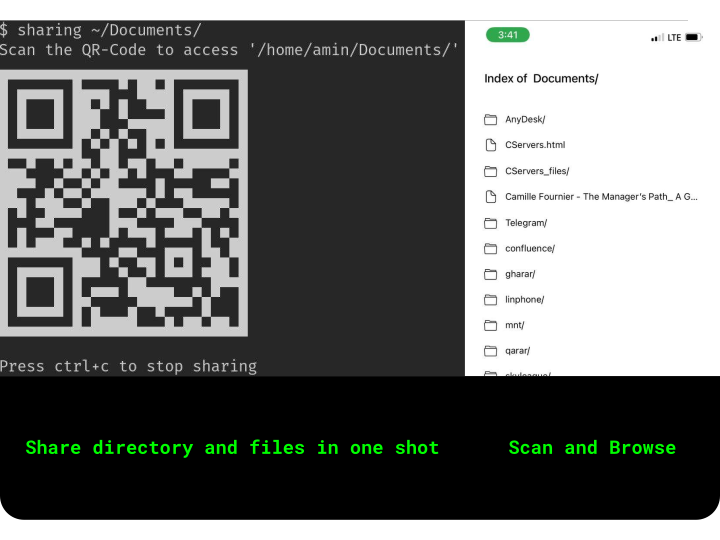
npx easy-sharing ~/Photos # share a folder — scan the QR on your phone — done
That's the whole idea. Your phone opens a normal web page over your own Wi-Fi. Nothing to install on the other device, nothing leaves your network.
Why sharing?
If you've ever tried to get a file from your laptop to your phone, you know the options are all a little painful: cloud uploads are slow and nosy, AirDrop is Apple-only, and "real" tools want an app installed on both ends. sharing takes the simplest path that always works: a tiny web server and a QR code. Any phone with a browser can use it.
| sharing | python -m http.server |
npx serve |
qrcp | AirDrop / LocalSend | |
|---|---|---|---|---|---|
| No app on the phone | ✅ | ✅ | ✅ | ✅ | ❌ (app both ends) |
| QR code to connect | ✅ | ❌ | ❌ | ✅ | ❌ |
| Receive files from the phone | ✅ | ❌ | ❌ | ✅ | ✅ |
| Receive multiple files / drag-drop | ✅ | ❌ | ❌ | ➖ | ✅ |
| Download a whole folder as .zip | ✅ | ❌ | ❌ | ✅ | ➖ |
| Share clipboard text and receive text back | ✅ | ❌ | ❌ | ➖ | ✅ |
| Built-in auth and HTTPS | ✅ | ❌ | ➖ | ➖ | ✅ |
One-flag private share (--secure) |
✅ | ❌ | ❌ | ❌ | ✅ |
| Picks the right network address automatically | ✅ | ❌ | ➖ | ✅ | ✅ |
sharing is the one that does all of it from a single command, in a browser, with nothing to install on the device in your hand.
Getting Started
Requirements: Node.js v14.17 or later.
Try it without installing
npx easy-sharing /path/to/file-or-directory
Install globally
npm install -g easy-sharing
macOS users: macOS already ships a built-in
/usr/sbin/sharingcommand, so useeasy-sharinginstead ofsharing. Example:easy-sharing /path/to/file
Quick Start
# Share a file or directory
sharing /path/to/file-or-directory

# Share clipboard content
sharing -c

# Receive files from another device
sharing /destination/directory --receive

# Share privately — secret link + password + HTTPS, in one flag
sharing /path/to/file-or-directory --secure
Scan the QR code shown in your terminal with your phone. Both devices just need to be on the same Wi-Fi.
QR code won't scan? (Some Windows terminals and unicode paths can't draw it.) Open the link the terminal prints, or run with --open to pop the QR up in a browser window on your computer — then scan that.
Features
📤 Share anything
- Files and directories over your local network, with a clean browsable listing.
- Download a whole folder as a single
.zip— one tap on the phone instead of saving files one by one. - Clipboard text (
-c) opens on the phone with a one-tap Copy button.
📥 Receive just as easily
- Turn your machine into a drop target with
--receive. - Multiple files at once, with drag-and-drop and a live progress bar.
- Send a note or link back from the phone straight to your terminal (and your clipboard).
🔒 Private when you need it
--secure— the easy button: a secret unguessable link + an auto-generated password + HTTPS, all at once.- Or mix and match:
-U/-Pfor a password,--tokenfor a secret link,-Sfor HTTPS. - Auto HTTPS:
-Snow generates a certificate for you — no more fiddling with OpenSSL. (Bring your own with-C/-Kif you prefer.)
⏱️ Ephemeral by choice
--once— stop sharing automatically after the first transfer.--timeout 10m— auto-stop after a set time (30s,10m,1h).
🎯 It just works
- Smart network detection:
sharingadvertises your real Wi-Fi address and skips Docker/VPN/WSL adapters — the #1 reason "the QR scans but the page won't load." Pin one explicitly with--interface en0or--ip. - QR fallback:
--openshows the QR as an image in a browser for terminals that can't render it. - Internet sharing:
--tunnelwalks you through exposing a share beyond your LAN.
Usage examples
# Receive a batch of photos from your phone (multi-file + drag & drop)
sharing ~/Downloads --receive

# Share a folder and let the recipient grab it all as one zip
sharing ~/project        # the listing shows a "Download as .zip" button

# Copy a snippet to your phone, or send a link from the phone to your terminal
sharing -c               # then use the Copy button on the page
sharing ~/x --receive    # the upload page also has a "Send text" box

# A private, self-destructing share
sharing report.pdf --secure --once

# Pick a specific network interface (multi-homed / VPN machines)
sharing ~/x --interface en0

# Share over HTTPS with your own certificate
sharing ~/x -S -C cert.pem -K key.pem
Options
$ sharing --help

sharing — quickly share files, directories, and clipboard content from your
terminal to any device with a browser.

Examples:

  Share file or directory
  $ sharing /path/to/file-or-directory

  Share clipboard content
  $ sharing -c

  Receive files from another device
  $ sharing /destination/directory --receive

  Share with basic authentication
  $ sharing /path/to/file-or-directory -U user -P password

  Share privately (secret link + password + HTTPS)
  $ sharing /path/to/file-or-directory --secure

  Share over HTTPS
  $ sharing /path/to/file-or-directory -S -C cert.pem -K key.pem

Options:
      --version                     Show version number                [boolean]
      --debug                       Enable debug logging  [boolean] [default: false]
  -p, --port                        Set the server port (default: auto-assigned) [number]
      --ip                          Specify your machine's public IP address [string]
  -i, --interface                   Network interface/adapter name to advertise
                                    (e.g. en0, eth0)                    [string]
  -c, --clipboard                   Share clipboard content            [boolean]
  -w, --on-windows-native-terminal  Enable QR code rendering in Windows native terminal [boolean]
      --open                        Open the QR code in a browser window on this computer [boolean]
  -r, --receive                     Receive files from another device  [boolean]
  -q, --receive-port                Set the port for receiving files    [number]
  -U, --username                    Set username for basic authentication
                                                      [string] [default: "user"]
  -P, --password                    Set password for basic authentication [string]
  -S, --ssl                         Enable HTTPS (auto self-signed cert when
                                    -C/-K are not given)               [boolean]
  -C, --cert                        Path to SSL certificate file        [string]
  -K, --key                         Path to SSL private key file        [string]
      --token                       Add a secret token to the share URL so it is
                                    unguessable                        [boolean]
      --secure                      Private share preset: secret link +
                                    generated password + HTTPS         [boolean]
      --once                        Stop sharing after the first completed transfer [boolean]
      --timeout                     Auto-stop the share after a duration (e.g.
                                    30s, 10m, 1h)                       [string]
      --tunnel                      Show guide for sharing over the internet via
                                    tunnel services                    [boolean]
      --help                        Show help                          [boolean]
A note on security
By default a share is open to everyone on your Wi-Fi — perfect for your own devices at home, less so on a café or office network. sharing reminds you of this on startup and gives you one-flag protection:
sharing ~/private --secure
This generates a secret link (so the share isn't browsable by IP alone), a random password, and turns on HTTPS — printed for you when the server starts.
Sharing Over the Internet (Tunneling)
To share with someone who is not on your local network, pair sharing with a tunnel service — no public IP required.
Run sharing --tunnel for a quick setup guide, or:
- Start sharing as usual:
sharing /path/to/files - In a separate terminal, run one of the tunnel commands below
- Share the public URL the tunnel gives you
| Service | Command | Documentation |
|---|---|---|
| ngrok | ngrok http 7478 |
Getting started |
| localtunnel | npx localtunnel --port 7478 |
Docs |
| cloudflared | cloudflared tunnel --url http://localhost:7478 |
Docs |
| SSH | ssh -R 80:localhost:7478 your-server |
— |
Replace
7478with the port shown when you start sharing.
Development
npm test # runs the test suite (no external test framework)