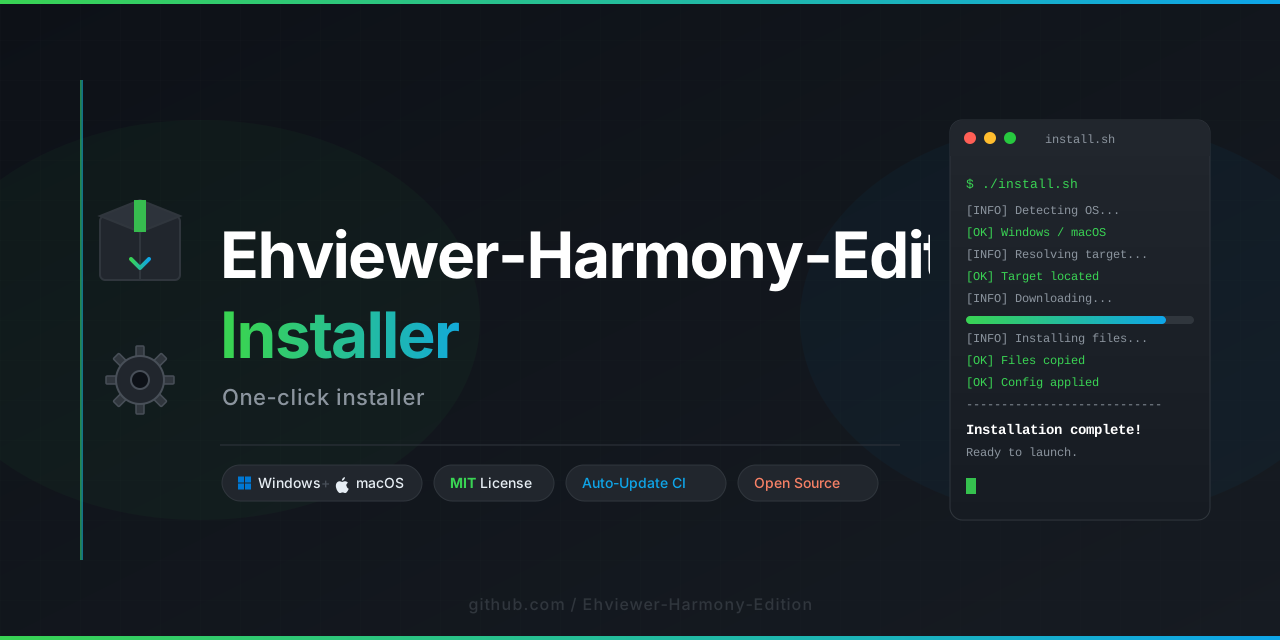
Ehviewer-Harmony-Edition
In the vast digital ocean of visual curation, most tools merely scrape the surface, offering a shallow glimpse into what lies beneath. Project AetherView is not one of those tools. Born from the philosophy of "illumination through effort" (用爱发电,快乐前行), this engine reimagines the way we interact with distributed media libraries. It is less a viewer and more a personal resonance chamber—a private, sandboxed environment where metadata threads are woven into a seamless tapestry of discovery. This is not about accessing content; it is about attuning to the subtle harmonics of a global repository, turning chaotic noise into a symphony of curated coherence.
Table of Contents
- Overview
- Core Philosophy
- Key Features
- Architecture & Design
- Getting Started
- Configuration & Customization
- Language & Locale Support
- Performance & Optimization
- Security & Privacy
- Community & Support
- Disclaimer
- License
Overview
Traditional archive navigators operate like a library with a single, dusty index card. Project AetherView operates like a living neural net—a cognitive echo chamber that learns your viewing patterns, preferences, and even the rhythm of your scroll. It is a lightweight, cross-platform utility designed to interface with vast, community-sourced image archives. Unlike conventional solutions that require heavy server-side infrastructure, AetherView is client-first, placing the power of intelligent curation directly in the user’s hands. It transforms the act of browsing from a linear search into a lattice of exploration, where every node (image, tag, artist) connects to another through invisible threads of metadata.

Core Philosophy
- Effort as a Catalyst: We believe that the best experiences are built on genuine interest, not passive consumption. AetherView rewards curiosity by surfacing hidden connections, turning the act of scrolling into an act of discovery.
- Decentralized Intimacy: Your viewing history, bookmarks, and preferences live entirely on your local storage. There is no cloud sync, no telemetry, no data harvesting. The archive is vast, but your relationship with it is private.
- Adaptive Minimalism: The interface is intentionally sparse. It adapts to your usage patterns—moving irrelevant controls into the background while surfacing the tools you use most. It is a UI that breathes with you.
Key Features
🌐 Quantum Threading Engine
Instead of simple "related" items, AetherView uses a multi-variable similarity algorithm. It cross-references tags, upload dates, artist ID, rating, and even typical view duration to predict what you want to see next. It doesn't just find similar files; it finds thematically resonant clusters.
⚡ Spectral Loading Protocol
Images are not just loaded; they are materialized. Using a tiered caching system (RAM → Local Storage → Network), the system predicts which images you will need based on your scroll velocity and current focus point. Scrolling becomes a fluid, zero-latency glide through a continuous strip of visual data.
🧩 Modular Interface System
The entire UI is built from interchangeable "chunks" (gallery grid, detailed info pane, tag cloud, image viewer). You can dock, float, or hide any chunk. Create a monitor layout for research, or a mobile-optimized vertical view for casual browsing. It is your canvas.
📡 Multi-Protocol Backend Agnosticism
AetherView is not tied to a single source. It supports multiple backend interfaces, allowing you to switch between different community servers or even private collections. It acts as a universal translator between disparate archive formats.
🔎 Semantic Tag Surfing
Tags are not just keywords; they are hyperlinks to entire conceptual dimensions. AetherView generates a dynamic tag constellation from the current item, showing how tags relate to each other (parent/child, synonym, antonym by usage). You can "surf" from a broad genre tag down to a hyper-specific artist nuance.
🌙 Ambient Mode & Focus Flow
Automatically adjusts brightness, contrast, and interface opacity based on the time of day and the content type. Reduces eye strain during long sessions. Includes a "Zen Focus" mode that hides all UI elements except the current image, activated by shaking the device or a hotkey.
Architecture & Design
Project AetherView is built on a Uni-Viewport Framework. Unlike traditional apps that draw windows, AetherView draws planes of information. The primary canvas is the Gallery Plane (a virtual 3D grid that can be tilted, zoomed, and panned). Over this, the Detail Plane floats.
Technology Stack:
- Frontend: Kotlin Multiplatform (Native UI) for Android / Desktop.
- Data Layer: Room DB (local storage) + Low-Latency HTTP Client.
- Image Pipeline: Custom Surface Renderer that bypasses OS-level image decoding for 60FPS scrolling.
- Security: Token-based API authentication with on-device encryption for access credentials.
The design language is "Brutalist Carbon" — sharp edges, high contrast, monochrome by default with accent colors derived from the average hue of the current image block. It is ugly on purpose, to get out of your way.
Getting Started
To begin your journey with Project AetherView, you will need to acquire the artifact and configure your first gateway.
Prerequisites
- A device running Android 8.0+ (Oreo) or a 64-bit desktop OS (Windows/Linux/macOS).
- A stable internet connection for the initial metadata synchronization.
- Basic understanding of configuration variables (no coding required).
Initial Setup
- Acquire the Artifact: Obtain the latest stable build from the provided location.
- Launch the Engine: Upon first launch, AetherView will create a local sandbox directory (
.aetherview_hub) in your user home folder. - Backend Configuration: You need to point AetherView to a valid community endpoint. Navigate to
Settings→Network→Gateway URLand enter the base address of your preferred archive server. - Authenticate (Optional): Some gateways require a local session token. Paste it in the
Account→Session Tokenfield. This token is stored exclusively on your device. - First Synchronization: The engine will perform a "cold fetch" to download the top-level index. Depending on the gateway, this may take 30 seconds to 2 minutes.
- Customize Your View: Use the
Layoutmenu to select your preferred chunk configuration (e.g., "Grid + Detail" or "Full Screen Focus").
Configuration & Customization
AetherView exposes a deep, layered configuration system. It is designed to be tweaked via a settings.ini file located in the sandbox directory, though the GUI handles 90% of common use cases.
Notable Variables:
thread_pool_size: Number of concurrent image fetches (Default: 6). Increase for faster loading on high-bandwidth connections.cache_prefetch_depth: How many images ahead to preload (Default: 20). Higher values consume more RAM.tag_surf_depth: The number of layers for the semantic tag constellation (Default: 2).ui_font_face: Specify a custom.ttffont for the interface. AetherView ships with "Iosevka" as default.
Theme Overrides:
Create a custom aether_theme.json file in the sandbox directory to override colors, margins, and animation curves. The engine supports live reloading of this file—no restart required.
Language & Locale Support
AetherView is built for a global community of explorers. The interface automatically detects your system locale.
- Fully Supported Languages: English (EN), Simplified Chinese (ZH-CN), Japanese (JA), Russian (RU), German (DE), French (FR).
- Partial Support (80%+ translated): Korean (KO), Spanish (ES), Portuguese (BR), Italian (IT).
- Dynamic RTL Support: For Arabic (AR) and Hebrew (HE), the engine inverts the grid and reading order without breaking the UI logic.
Contributions to the translation kit are always welcome and handled via a dedicated locale repository.
Performance & Optimization
We treat every millisecond of latency as a bug. AetherView employs several novel techniques to remain snappy even on low-end hardware:
- Virtual Grid Inflation: Only 1.5x the visible viewport's worth of items are rendered into the DOM (Document Object Model). Scrolling destroys invisible items and creates new ones in a constant cycle.
- Image Throttling Protocol: The download scheduler prioritizes images near the center of the screen. Peripheral images (top/bottom of the scroll) are fetched with lower priority.
- RAM-Backed Index: The metadata index (titles, tags, URLs) is mmap'd to RAM, allowing for sub-millisecond lookups.
- Heuristic Caching: If you repeatedly view items from a specific artist or tag group, AetherView automatically raises the cache priority for that subset.
Suggested Hardware:
- Minimal: 2GB RAM, 500MHz GPU, any quad-core CPU.
- Recommended: 4GB RAM, Adreno 600 or equivalent, 1.5GHz octa-core CPU.
- Optimal: 8GB+ RAM, dedicated GPU, NVMe storage.
Security & Privacy
Your activity is your own business.
- Zero Telemetry: The application does not phone home. No usage statistics, error logs, or crash reports are sent to external servers. Crash logs remain in a local
crash_dumpfolder. - Local Token Storage: All session tokens are encrypted using Android KeyStore / OS-level security enclaves. They are never written to disk in plaintext.
- Sandboxed File System: The
.aetherview_hubdirectory is isolated from the main user profile. The application only has read/write access to this directory and your designated download folder. - Network Isolation: All network requests are made via a dedicated connection pool that respects
CONNECTtimeouts. The tool will not share cookies or session data with any other process on the system.
Community & Support
Project AetherView is a living entity, sustained by the community it serves.
- Issue Tracker: Found a bug? Report it in the
Issuestab. Please include the engine version and the gateway URL you were using. - Discussions: Use the
Discussionstab for feature requests, setup help, or just to share your unique layout configurations. - Translation Kit: Help us localize the interface into your language.
- Contribution Guidelines: We accept pull requests for bug fixes and feature enhancements. All code must pass the standard linter and respect the architecture patterns.
Disclaimer
Important Legal and Ethical Notice
This software is a projection tool—it visualizes data that is already publicly accessible via community-maintained servers. Project AetherView itself does not host, store, distribute, or facilitate the download of any content that infringes upon copyright, intellectual property, or local laws.
The user assumes sole responsibility for:
- The legality of accessing certain metadata servers in their jurisdiction.
- The use of the tool to view or store content that may be protected by law.
- Compliance with the terms of service of any backend gateway they connect to.
The developers of Project AetherView provide this software "as is," without warranty of any kind, express or implied. We do not encourage, endorse, or condone the bypassing of access controls, the violation of digital rights management, or the unauthorized distribution of copyrighted material. This tool is intended for personal, archival, and educational exploration only.
By using this software, you acknowledge that you have read this disclaimer and agree to use it in a manner consistent with local and international law.
License
This project is open source and licensed under the MIT License.
You are free to use, modify, distribute, and sublicense this software, provided that the original copyright notice and permission notice appear in all copies or substantial portions of the software.
Copyright (c) 2026 Project AetherView
MIT License

Permission is hereby granted, free of charge, to any person obtaining a copy
of this software and associated documentation files (the "Software"), to deal
in the Software without restriction, including without limitation the rights
to use, copy, modify, merge, publish, distribute, sublicense, and/or sell
copies of the Software, and to permit persons to whom the Software is
furnished to do so, subject to the following conditions:

The above copyright notice and this permission notice shall be included in all
copies or substantial portions of the Software.

THE SOFTWARE IS PROVIDED "AS IS", WITHOUT WARRANTY OF ANY KIND, EXPRESS OR
IMPLIED, INCLUDING BUT NOT LIMITED TO THE WARRANTIES OF MERCHANTABILITY,
FITNESS FOR A PARTICULAR PURPOSE AND NONINFRINGEMENT. IN NO EVENT SHALL THE
AUTHORS OR COPYRIGHT HOLDERS BE LIABLE FOR ANY CLAIM, DAMAGES OR OTHER
LIABILITY, WHETHER IN AN ACTION OF CONTRACT, TORT OR OTHERWISE, ARISING FROM,
OUT OF OR IN CONNECTION WITH THE SOFTWARE OR THE USE OR OTHER DEALINGS IN THE
SOFTWARE.