ClaraVerse

Your Private AI Workspace
Built by the community, for the community. Private AI that respects your freedom.




Website · Documentation · Quick Start · vs Open WebUI · Community · Contributing
What is ClaraVerse?
ClaraVerse is a private AI workspace built around three things most AI chat UIs treat as an afterthought: agents that work as an actual team, memory that behaves like a real memory system instead of a flat list of notes, and a license that does not start charging you once people notice your project.
Chat, Crew (multi-agent teams with human review), a visual workflow builder, and Telegram integration all live in one app, on your own infrastructure. Use OpenAI, Claude, Gemini, or local models like Ollama and llama.cpp. Chats are stored locally on your device by default, with optional encrypted sync if you want them on more than one machine.
If you have Ollama or LM Studio running on your machine, ClaraVerse detects them automatically and imports all your models. Zero configuration.
Quick Start
One-line install (Linux / macOS)
curl -fsSL https://raw.githubusercontent.com/claraverse-space/ClaraVerse/main/cli/install.sh | bash && claraverse init
Docker Compose
git clone https://github.com/claraverse-space/ClaraVerse.git
cd ClaraVerse
docker compose -f docker-compose.production.yml up -d
Open http://localhost:3000, register your account (first user becomes admin), and start chatting.
Have Ollama running? ClaraVerse auto-detects it and imports all your models. No setup needed. Make sure Ollama is listening on
0.0.0.0(setOLLAMA_HOST=0.0.0.0in your Ollama config).
Want it in your terminal too?
claraverse agent install   # builds Clara Agent, puts `claracli` on your PATH
claracli                   # then run /login claraverse to connect it
See Clara Agent below.
Docker run (single command)
docker run -d \
  --name claraverse \
  -p 3000:3000 \
  -v claraverse-data:/app/data \
  -v claraverse-uploads:/app/uploads \
  --add-host=host.docker.internal:host-gateway \
  ghcr.io/claraverse-space/claraverse:latest
This runs ClaraVerse with a single container. For the full stack with MySQL, MongoDB, Redis, SearXNG, Qdrant and the embeddings sidecar (required for Knowledge bases / RAG), use the Docker Compose setup above. Single-container mode boots fine, but the Knowledge tab and search_knowledge tool need the sidecars and will surface "embeddings service unreachable" without them.
Advanced configuration
Prerequisites
- Docker & Docker Compose v2+
- 4 GB RAM minimum (8 GB recommended)
- Ollama, LM Studio, or any OpenAI-compatible API
Environment variables
Override defaults by creating a .env file next to docker-compose.production.yml:
# Port (default 3000)
CLARAVERSE_PORT=8080

# Point to a custom Ollama or LM Studio URL
OLLAMA_BASE_URL=http://host.docker.internal:11434
LMSTUDIO_BASE_URL=http://host.docker.internal:1234
Local AI auto-detection
ClaraVerse automatically discovers local AI providers running on your host machine:
| Provider | Default URL | What happens |
|---|---|---|
| Ollama | http://host.docker.internal:11434 |
Models imported, provider created, visibility set |
| LM Studio | http://host.docker.internal:1234 |
Models imported via OpenAI-compatible API |
The discovery runs every 2 minutes. When a provider goes offline, it's automatically disabled. When it comes back, models are re-imported.
Ollama setup tip: Ollama defaults to 127.0.0.1, which Docker containers can't reach. Set OLLAMA_HOST=0.0.0.0:
# If using systemd:
sudo systemctl edit ollama
# Add under [Service]:
# Environment="OLLAMA_HOST=0.0.0.0"
sudo systemctl restart ollama
Troubleshooting
# View logs
docker compose -f docker-compose.production.yml logs -f claraverse

# Restart
docker compose -f docker-compose.production.yml restart

# Fresh start (removes all data)
docker compose -f docker-compose.production.yml down -v && docker compose -f docker-compose.production.yml up -d
Core Capabilities
Crew: Agent Teams With Human Review
Give a project a brief, hire a team of agents, and work the card pipeline. Every card comes back for your review before it ships, so you always know what's being worked on and why. No black box.
Memory: Layered, Encrypted, and Actually Used
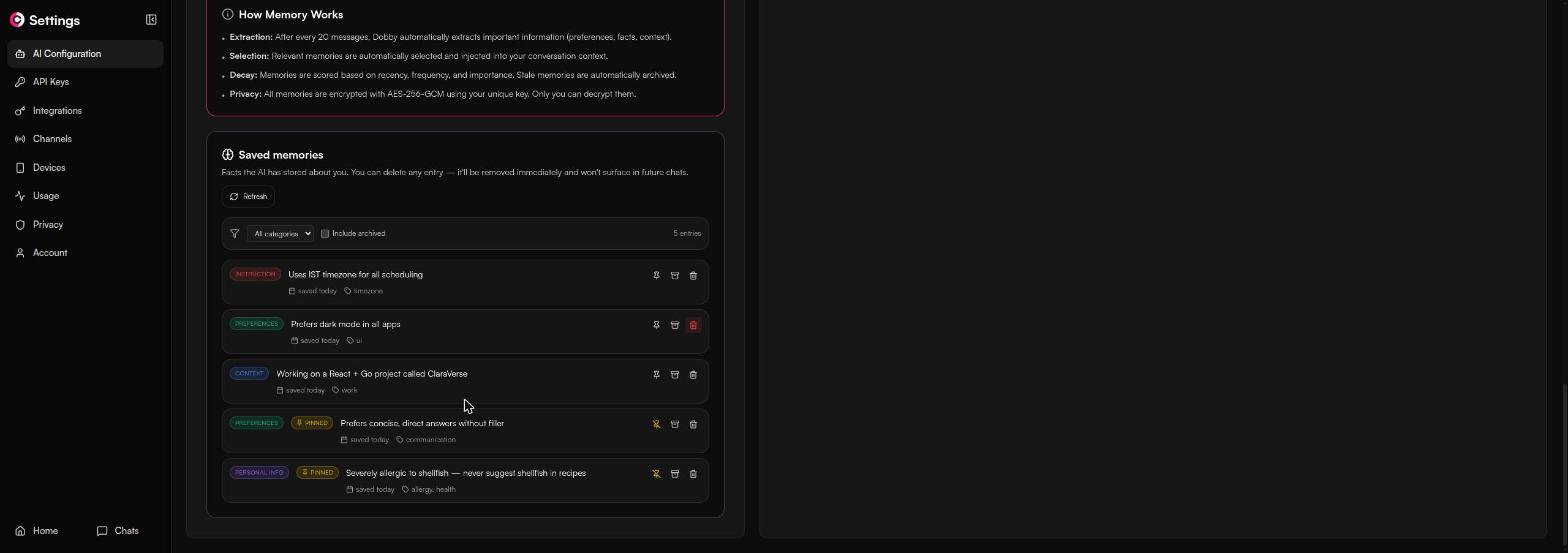
Clara remembers you across conversations without being told twice. Facts are extracted automatically in the background, pulled back in only when relevant to the current conversation, and every entry is visible and editable in Settings. Nothing is stored that you can't see or delete.
- Pinned tier: mark a fact as always-inject (allergies, hard constraints, how you want to be addressed). Pinned memories skip relevance scoring and never decay.
- Recall tier: everything else, retrieved by embedding similarity against the current conversation so only what's relevant gets injected.
- Decay: unused memories lose relevance over time and archive themselves automatically.
- Model-driven: Clara calls
search_memoryandadd_memorymid-conversation, the same way it calls any other tool. - Encrypted at rest: AES-256-GCM with a key derived per user via HKDF. Not even a ClaraVerse admin can read your memories.
Clara Agent: The Same Assistant, In Your Terminal
Clara Agent is a coding agent that runs in your terminal and ships in this repo. It reads, writes, and edits files and runs commands on your machine, using the same model and account as the web app.
claraverse agent install   # builds it and puts `claracli` on your PATH
claracli                   # start it in any project directory
Then run /login claraverse inside the agent. You get a short code to confirm in the browser, and it picks up whichever model your account is configured with. The machine then shows up under Settings → Devices, where you can revoke it at any time.
It talks directly to your configured model provider, so it keeps working even when the ClaraVerse server is down, and it makes no network calls to anything except your own instance and your own model provider.
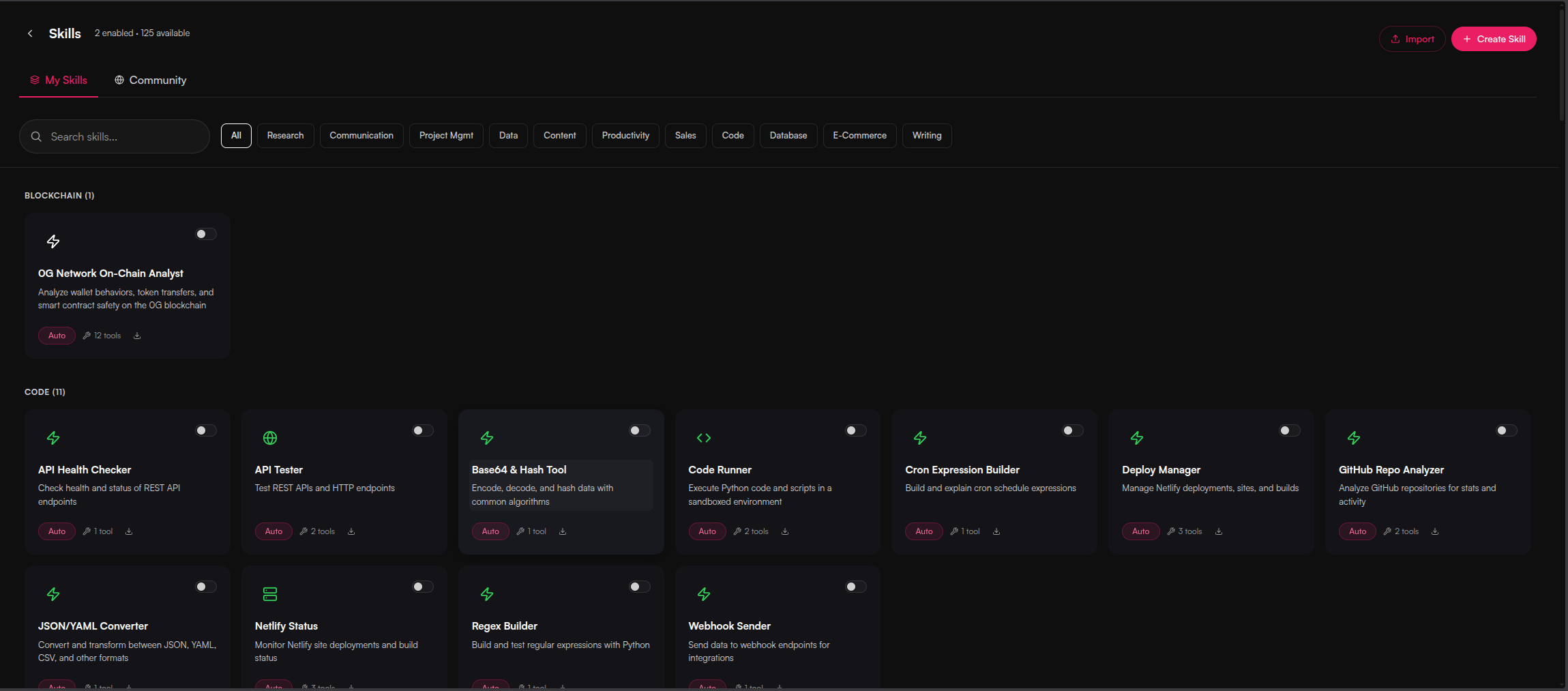
Skills in Chat
Clara uses skills mid-conversation: context-aware tools that activate when needed. Search the web, generate images, analyze data, all without leaving the chat.
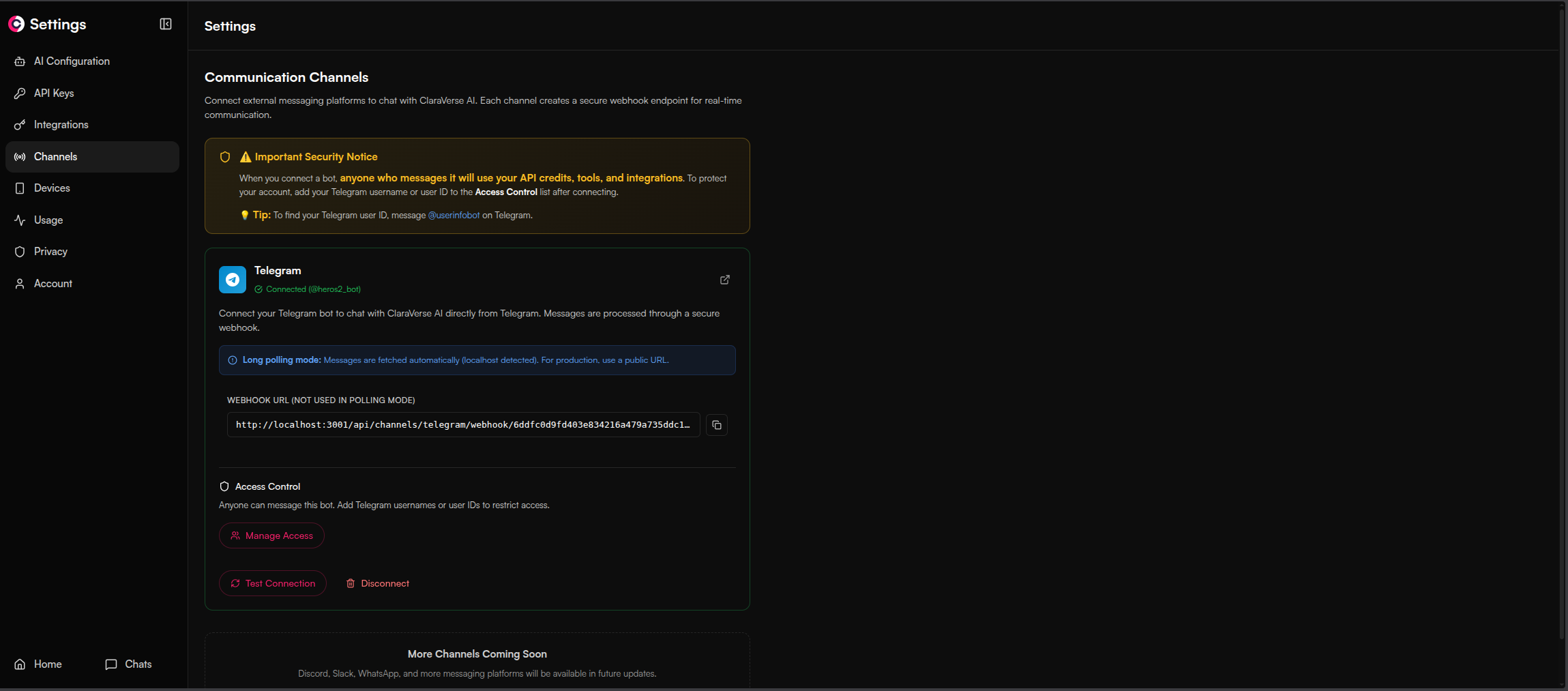
Channels: Telegram Integration
Talk to Clara from Telegram when you're away from the app. Set up routines that run on a schedule and report back to your phone.
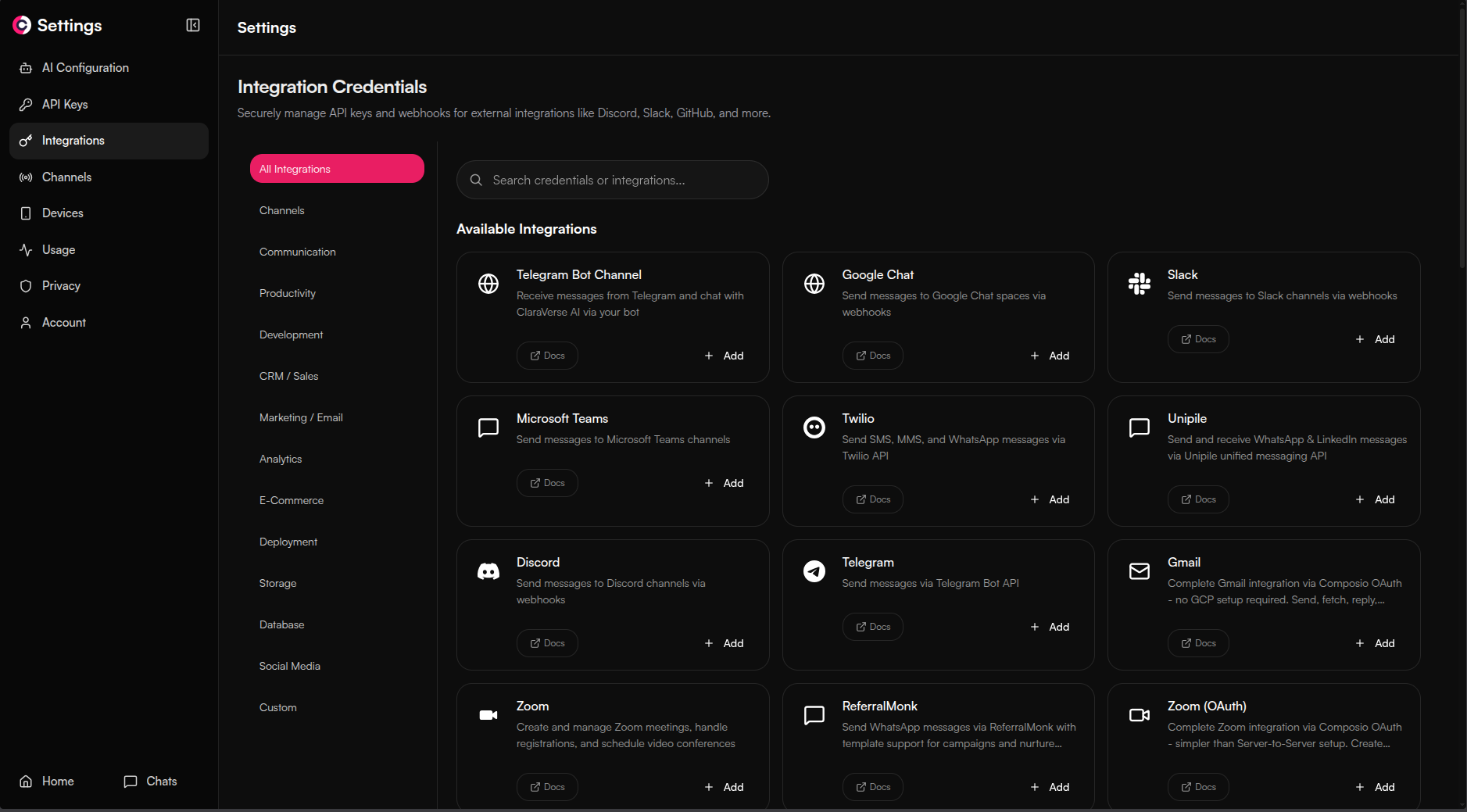
150+ Integrations & Tools Out of the Box
Slack, GitHub, Jira, Google Sheets, Notion, Discord, Telegram, HubSpot, and many more, built in, no MCP required. All integrations are shared across Chat, Workflows, Crew, and Routines. Connect once, use everywhere.
Interactive Artifacts
Have all your creations in one place: images, charts, games, apps, and more.
AI Docs
Built-in tools for PPT, PDF, CSV, and much more.
Interactive Chat UI (Human in the Loop)
The AI asks you visual questions when it needs your input.
Workflows: Visual Automation
Drag-and-drop workflow builder with parallel execution, scheduling, and 200+ integrations. Describe what you need and let the LLM build the automation for you.
Schedule, API and Automate
Use workflows with your web apps, schedule daily messages, automate repetitive tasks.
ClaraVerse vs Open WebUI
Open WebUI is the biggest self-hosted AI chat UI, and a good one. It has a bigger community, more vector database integrations, and a deeper document extraction pipeline than we do. We're not pretending otherwise. But it is a chat UI with tools bolted on. ClaraVerse is built differently, and it shows in three places.
| ClaraVerse | Open WebUI | |
|---|---|---|
| License | AGPL-3.0. Host it, white-label it, sell access to it. The only condition is that your modifications to the code stay open source. | BSD-3 with a branding clause added in v0.6.6. Once you pass 50 users in any 30-day window, you're required to keep "Open WebUI" branding visible unless you buy an enterprise license. |
| Multi-agent teams | Crew ships in the box: hire a team of agents, work moves through a Kanban pipeline (Drafts, Queued, Working, Review, Done), and every card comes back to a human before it ships. | No equivalent. "Agents" are per-model system prompt and tool presets. Kanban-style multi-agent orchestration isn't part of the product. |
| Memory | Layered by default. A pinned tier that never decays and always gets injected, a recall tier retrieved by embedding similarity, automatic decay and archival for stale entries, AES-256-GCM encryption per user. The model calls it as a tool, same as any other tool. | Manual notes, or an optional background job that extracts facts every few turns. The tiering and relevance logic you'd actually want exists as a third-party community Function you install yourself. No documented encryption model. |
| Workflow automation | Visual drag-and-drop builder with parallel branches and scheduling. Describe what you want and the builder generates it for you. | Scheduled prompt runs and structured task lists. No visual node-based builder. |
| Local model support | Auto-detects Ollama, LM Studio, and any OpenAI-compatible endpoint, including llama.cpp, on a 2-minute poll. | Auto-detects Ollama. |
| Terminal agent | Clara Agent ships in the repo. One command installs claracli, which shares your account, model, and device list with the web app. |
No first-party terminal coding agent. |
If you need enterprise SSO, SCIM provisioning, and a large plugin marketplace today, Open WebUI is more mature there. If you want agents that act like a team, memory that behaves like an actual memory system, and a license that doesn't ask you to pay once you succeed, that's what ClaraVerse is for.
Key Features
| Feature | Description |
|---|---|
| Crew | Agent teams with a card pipeline and human review |
| Clara Agent | Terminal coding agent (claracli) sharing your account and model, ships in-repo |
| Memory System | Layered pinned/recall memory, AES-256-GCM encrypted, model-driven retrieval, automatic decay |
| Knowledge bases | Upload PDFs / MD / TXT / HTML to a project, search via hybrid vector + BM25 + reranker. Available in Chat and Workflows |
| Skills | Context-aware tools that activate mid-conversation when needed |
| Channels | Telegram integration, talk to Clara from your phone |
| Routines | Scheduled task sequences that report back via Telegram |
| Workflows | Drag-and-drop builder with parallel execution, scheduling, 200+ integrations |
| 150+ Integrations | Slack, GitHub, Jira, Notion, and more, shared across Chat, Workflows, Crew, and Routines |
| Devices | Connect all your machines, Clara reaches MCP on any of them remotely |
| Local-First Storage | Conversations live in IndexedDB by default, with optional encrypted cloud sync |
| Local AI Auto-Detection | Ollama and LM Studio discovered and imported automatically |
| Multi-Provider | OpenAI, Anthropic, Google, Ollama, llama.cpp, any OpenAI-compatible endpoint |
| MCP Bridge | Native Model Context Protocol support for tool connections |
| Interactive Prompts | AI asks clarifying questions mid-conversation with typed forms |
| BYOK | Bring your own API keys or use free local models |
Try It Out
| Option | Description |
|---|---|
| Cloud | Free hosted version, no setup required |
| Self-Hosted | Docker deployment (this repo), full control on your infrastructure |
| Desktop | Standalone Electron app for Windows, macOS, Linux |
Tech Stack
| Layer | Technology |
|---|---|
| Frontend | React 19, TypeScript, Vite 7, Tailwind CSS 4, Zustand |
| Backend | Go 1.24, Fiber, WebSocket streaming |
| Database | MySQL, MongoDB, Redis (all bundled in Docker Compose) |
| Search | SearXNG (private, self-hosted) |
| Auth | Local JWT with Argon2id password hashing |
Development Setup
For contributors working on the codebase:
# Prerequisites: Go 1.24+, Node.js 20+, Docker

# Clone the repo
git clone https://github.com/claraverse-space/ClaraVerse.git
cd ClaraVerse

# Start backing services (MySQL, MongoDB, Redis, SearXNG)
docker compose -f docker-compose.dev.yml up -d

# Backend
cd backend
cp .env.example .env
go run cmd/server/main.go

# Frontend (separate terminal)
cd frontend
cp .env.example .env
npm install
npm run dev
Frontend runs at http://localhost:5173, backend at http://localhost:3001.
See CONTRIBUTING.md for coding standards and PR guidelines.
Documentation
| Resource | Description |
|---|---|
| Architecture | System architecture and design decisions |
| API Reference | REST and WebSocket API |
| Admin Guide | System administration and provider setup |
| Developer Guide | Contributing and local development |
| Quick Reference | Common commands and shortcuts |
Contributing
- Fork the repository
- Create a feature branch:
git checkout -b feature/amazing-feature - Make changes and test
- Run
cd frontend && npm run lint && npm run type-check - Commit and open a Pull Request
Areas we need help:
- Bug fixes (open issues)
- New tool integrations and model providers
- Documentation improvements
- Translations
See CONTRIBUTING.md for the full guide.
Community
- Discord: Chat and support
- Twitter/X: Updates
- GitHub Issues: Bug reports
- GitHub Discussions: Feature requests
License
AGPL-3.0: free to use, modify, and host commercially. Modifications must be open-sourced. No branding clause, no user cap, no enterprise tier required to remove our name from your product. See LICENSE for details.
Built with love by the ClaraVerse Community