nature-skills




在线网站 · 立即安装 · 快速开始 · 技能索引 · 其他安装 · 贡献方式 · English
Nature Skills 网页版:内置 Nature Polishing(论文润色)与 Nature Figure(科研绘图)核心功能,访问地址 https://natureskills.cn
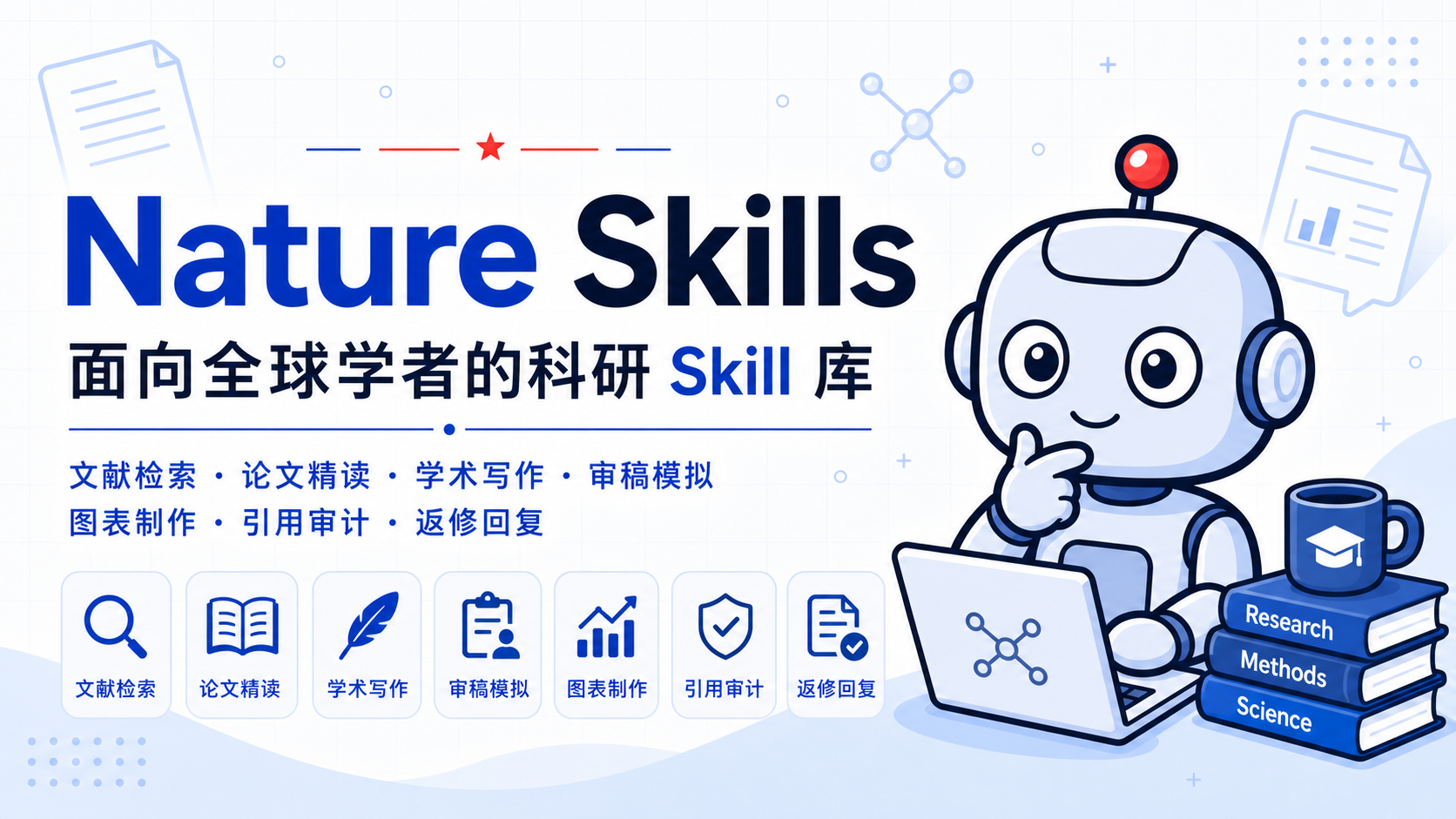
nature-skills 面向全球 AI 学者收录可复用科研技能,强调真实问题解决、可验证工作流与可直接使用的科研产物。
1. 项目发起人与运营信息
1.1 创始人介绍
大家好,我是 nature-skills 的创立者袁一哲。感谢大家持续关注本项目。我们在抖音更新了许多视频教程,大家可以根据名称检索查看,希望能够真正帮助到科研工作。
1.2 自营 GPT / Claude 代充与成品号
严格筛选渠道商,提供完全正规的充值渠道与服务。欢迎访问 Nature AI 充值卡网(已上线 plus 一年代充,Pro5x,20x 等等):

Nature AI 充值卡网 https://apiciyuan.top/ |
|
1.3 知识星球
知识星球名称:Nature Skills 以及背后的哲学,以加入知识星球代替打赏。
1.4 商务合作
如有商务合作意向,欢迎发送邮件至 natureskills2026@outlook.com。
2. Skills 主要开发者
| 开发者 | 项目角色 | 主要方向与贡献 | 主页与联系 |
|---|---|---|---|
| 袁一哲 | 创始人 / 维护者 | 项目发起、技能体系设计与社区运营 | — |
| 马昕瑞 | 核心开发者 | 核心开发、架构维护 | Gmail |
| 胡彬 | 主要贡献者 | Agentic Agent |
3. 项目理念与社区
3.1 自己的一些浅薄观点
- 最近发现,我设计的 Nature Skills 被谷歌 DeepMind 关注并借鉴,他们参考了其中的引用体系、脚本思路以及技能设计哲学,推出了 Science Skills。说实话,这让我挺欣慰的——当国外的顶尖 AI 机构开始从我们的工作中汲取灵感时,说明中国开发者的原创思想正在被世界看见。这不是被复制的失落,而是中国力量在开源土壤里生根后,自然向外生长出的影响力。
- 我们设计 Skills 的重心,从来不是要求每个人都来啃透这套思想,而是这套思想本身就具备被机器理解并复用的能力。你如果想创立一个全新的 Skill,或者把它适配到自己的专属领域,根本不需要从头学起——直接把 Nature Skills 的 GitHub 地址发给 Codex,它就能自动学习其中的设计精髓,帮你完成新 Skill 的创建和修改。这才是思想的真正解放:它不再依赖口口相传,而是通过 AI 直接流淌进每一个需要它的角落。
- Nature Skills 真正的价值,或许并不在于那些具体的技能模块,而在于它悄悄推开了一扇新的大门——它让很多人第一次意识到,原来可以借助 Codex 或智能体来操控本地电脑做科研。我有幸见证并陪伴了许多人完成科研范式的转变。当他们惊叹“原来科研还可以这样去做”的那一刻,这种认知上的破壁和解放,远比 Skills 本身更让我觉得有意义。它不是一个工具的成功,而是一种新的思考方式开始在人群中蔓延。
- 在当下,几乎所有实用的工具都可以被提炼为标准化流程,而标准化流程恰好可以封装成可复用技能。
3.2 视频教程与社区
|
视频教程请关注抖音 |
Agent 科研交流群 |
添加个人微信请备注来意 |
4. 快速开始
安装完成后,可以直接把论文、段落、审稿意见或任务描述交给 Agent。下面这些提示词可以直接复制使用:
| 想做什么 | 直接这样说 |
|---|---|
| 读论文 / 中英文对照 | 把这篇 PDF 做成图文对应的中英文对照 Markdown reader。 |
| 生成文献汇报 PPT | 把这篇论文做成中文组会汇报 PPT,保留关键图件和来源标注。 |
| 润色或翻译论文段落 | 把这段中文改写成 Nature 风格英文,保持学术含义不变。 |
| 写摘要、引言或讨论 | 根据这些结果和图件,帮我起草 Nature 风格的摘要和引言。 |
| 预投稿审稿模拟 | 从 Nature 审稿人视角评估这篇稿件,给出三份互盲 reviewer reports;全部定稿后再综合。 |
| 回复审稿意见 | 根据这封返修邮件,为每位互盲审稿人分别写逐点回复和 cover letter,并标出修改稿需要标红的位置。 |
| 查文献、他引和引用者画像 | 整理这篇文章的引用数、严格他引数、DOI,并看引用者里有没有院士、Fellow 或领域大牛。 |
| 做科研图或论文示意图 | 根据这段方法和结果,帮我生成投稿级科研图或论文示意图草稿。 |
如果你不确定该用哪个技能,直接描述任务即可;如果已经知道技能名,可以在提示词中明确写“使用 nature-reader”或“使用 nature-response”。
5. 安装
nature-skills 是一组围绕 SKILL.md 组织的可复用技能包。skills/ 下的每个顶层技能目录都是一个可安装单元,例如 nature-*;nature-shared 是供其他技能读取的共享支持包,默认不作为独立触发技能计入技能索引。
5.1 npx skills 安装方式
需要先安装 Node.js 18 或更高版本。无需全局安装 CLI;先查看仓库中可安装的技能名:
npx skills add Yuan1z0825/nature-skills --list
优先按当前任务选择需要的技能,并保留其共享依赖。只为当前项目安装时,省略 --global;需要跨项目使用时再加上它。例如:
npx skills add Yuan1z0825/nature-skills --agent codex --skill nature-figure --yes --copy
单独安装 nature-reader、nature-paper2ppt、nature-polishing 或 nature-writing 时,同时选择共享支持包:
npx skills add Yuan1z0825/nature-skills --global --agent codex \
  --skill nature-reader --skill nature-shared --yes --copy
如果确实需要完整技能集,也可以全局安装到 Codex。全量选择包含 nature-shared:
npx skills add Yuan1z0825/nature-skills --global --agent codex --skill '*' --yes --copy
需要把全部技能安装到 CLI 支持的所有 agent 时,使用:
npx skills add Yuan1z0825/nature-skills --all
检查全局安装结果并更新:
npx skills list --global --agent codex --json
npx skills update --global --yes
只更新一个技能,或只更新当前项目中的技能:
npx skills update nature-reader --global --yes
npx skills update --project --yes
技能选择参数使用 --list 显示的 frontmatter 名称;例如目录 nature-proposal-writer 当前显示为 researchwrite。npx skills 管理的是技能文件,Python、R、浏览器或 MCP 等可选运行依赖仍需按下文说明单独配置。
5.2 Claude Code 安装方式
Claude Code 不能直接使用 scripts/update-codex-skills.sh,因为这个脚本只负责同步到 Codex 的 ~/.codex/skills/。用于 Claude Code 时,推荐保留一个稳定的本地 clone,再用 subagent 或 slash command 指向真实的 skills/*/SKILL.md。这样不会破坏技能目录结构,也能继续读取 references/、static/、manifest.yaml、脚本、资产和 skills/nature-shared/。
如果还没有安装 Claude Code:
npm install -g @anthropic-ai/claude-code
claude
先把仓库 clone 到一个稳定路径:
mkdir -p ~/ai-skills
cd ~/ai-skills
git clone https://github.com/Yuan1z0825/nature-skills.git
推荐方式:为常用技能创建 Claude Code subagent wrapper。以 nature-reader 为例:
mkdir -p ~/.claude/agents
cat > ~/.claude/agents/nature-reader.md <<'EOF'
---
name: nature-reader
description: Use for Chinese-English paper reading, figure-aware translation, and source-grounded paper notes.
---

When invoked, first read `~/ai-skills/nature-skills/skills/nature-reader/SKILL.md` and follow it as the governing workflow.
Read supporting files from `~/ai-skills/nature-skills/skills/nature-reader/` and `~/ai-skills/nature-skills/skills/nature-shared/` only when needed.
Do not replace this skill with a generic paper-reading response.
EOF
然后开启新的 Claude Code 会话,直接请求使用这个 subagent:
Use the nature-reader subagent to turn this paper into a Chinese-English Markdown reader.
如果你更喜欢 slash command,也可以创建命令 wrapper:
mkdir -p ~/.claude/commands
cat > ~/.claude/commands/nature-reader.md <<'EOF'
Read `~/ai-skills/nature-skills/skills/nature-reader/SKILL.md` first and follow it strictly.
Read directly needed supporting files from `~/ai-skills/nature-skills/skills/nature-reader/` and `~/ai-skills/nature-skills/skills/nature-shared/`.

$ARGUMENTS
EOF
在 Claude Code 中使用:
/nature-reader 把这篇论文做成中英文对照的完整 Markdown reader。
安装其他技能时,把示例中的 nature-reader 换成对应目录名即可,例如 nature-polishing、nature-writing、nature-reviewer、nature-response 或 nature-figure。后续更新只需要:
cd ~/ai-skills/nature-skills
git pull
只要 wrapper 仍然指向这个稳定 clone 路径,就不需要重复复制技能文件。
自动更新(可选)
如果你希望 Claude Code 每次开启会话时自动拉取上游更新,可以用 scripts/autoupdate-skills.sh 配合一个 SessionStart 钩子。
这套方式把技能直接复制进 ~/.claude/skills/(Claude Code 会自动发现该目录,技能以目录名直接加载),而不是使用上面的 wrapper。两种方式二选一即可。
先保留一个专用的稳定 clone(只用于同步技能,请不要在里面做开发提交):
mkdir -p ~/ai-skills
git clone https://github.com/Yuan1z0825/nature-skills.git ~/ai-skills/nature-skills
首次安装,把技能复制进 Claude Code 的技能目录:
~/ai-skills/nature-skills/scripts/autoupdate-skills.sh --force
然后在 ~/.claude/settings.json 里加一个 SessionStart 钩子(若已有 hooks,把这一项合并进去,不要整体覆盖):
{
  "hooks": {
    "SessionStart": [
      {
        "hooks": [
          {
            "type": "command",
            "command": "$HOME/ai-skills/nature-skills/scripts/autoupdate-skills.sh",
            "async": true,
            "timeout": 120
          }
        ]
      }
    ]
  }
}
async: true 让它在后台运行、不阻塞启动。脚本自带保护:默认 1 小时内不重复联网检查、断网或拉取失败自动跳过(exit 0,绝不卡住会话)、上游变化或安装目录发生漂移时重新同步、并且拒绝在有未提交改动的 clone 上强行前进。拉到的新版会在下一次开启会话时生效(当前会话的技能已经加载完毕)。每个安装目标使用独立日志,路径为 ~/.local/state/nature-skills/<目标目录编号>/autoupdate.log。
目标目录与检查频率都可配置:
# 默认同步到 ~/.claude/skills;用 --dest 指到别处,例如 Codex:
~/ai-skills/nature-skills/scripts/autoupdate-skills.sh --dest ~/.codex/skills
# 最多每小时联网检查一次;每次运行仍会校验本地安装:
~/ai-skills/nature-skills/scripts/autoupdate-skills.sh --throttle 3600
5.3 Codex 安装方式
需要安装或更新完整技能集时,可以使用仓库自带脚本。脚本会同步 skills/ 下所有顶层技能目录,并在复制后做 diff 验证;它不会覆盖其他无关 Codex skills。只需要部分技能时,使用上面的 npx skills 按需安装方式。
git clone https://github.com/Yuan1z0825/nature-skills.git
cd nature-skills
scripts/update-codex-skills.sh --pull
如果已经 clone 过仓库:
cd nature-skills
scripts/update-codex-skills.sh --pull
验证当前 Codex 安装是否和这个 checkout 一致:
scripts/update-codex-skills.sh --check
如果你长期用这个脚本更新,并希望清理上游已经删除的旧技能目录:
scripts/update-codex-skills.sh --pull --prune
--prune 只会删除以前由这个脚本记录过、但当前仓库已经不再包含的目录。第一次运行没有历史记录时,它不会猜测删除旧目录。
也可以把仓库链接交给 Codex,让 Codex 执行安装脚本。推荐提示词:
请从这个仓库安装 Codex skills:
https://github.com/Yuan1z0825/nature-skills.git

请 clone 仓库后运行 scripts/update-codex-skills.sh --pull。
安装后再运行 scripts/update-codex-skills.sh --check 验证。
请保留 skills/ 下的完整技能目录,不要只复制 SKILL.md。
如果只安装单个技能,请明确说明技能名:
只安装这个仓库里的 nature-reader:
https://github.com/Yuan1z0825/nature-skills.git

如果该技能需要共享文件,也请一并安装 skills/nature-shared。
关键规则:保留完整目录结构。请复制或引用整个技能文件夹,而不是只复制 SKILL.md,因为许多技能依赖 references/、static/、manifest.yaml、脚本、资产或共享文件。
安装脚本不会自动安装 Python 依赖。需要使用相关脚本或 MCP 服务时,再按需安装:
python -m pip install -r skills/nature-paper-to-patent/requirements.txt
python -m pip install -r skills/nature-paper-to-patent/scripts/disclosure/requirements-cnipa.txt  # 可选:国知局公布公告检索
python -m pip install -r skills/nature-academic-search/mcp-server/requirements.txt
如果启用 nature-paper-to-patent 的国知局公布公告检索,还需要执行 python -m playwright install chromium。
nature-academic-search 的 MCP 服务还需要单独配置 PUBMED_EMAIL,Scopus / ScienceDirect 等可选 provider 需要使用本机凭据配置,不要把 API key 写入仓库文件。
安装后,请开启一个新的 Codex 会话,然后自然描述任务,例如:
把这篇论文做成中英文对照的完整 Markdown reader。
把这篇论文做成中文 PPT。
如果你使用 OpenClaw、OpenCode、Hermes 等开源 agent / 编程框架,请看 OpenClaw / OpenCode / Hermes 接入教程。
自动更新(可选)
Codex 支持全局 SessionStart hook。保留一个专用 clone 后,可以在每次启动或恢复 Codex 会话时检查更新,并把新版同步到 ~/.codex/skills/。
先创建专用 clone 并完成首次同步:
mkdir -p ~/.codex
git clone https://github.com/Yuan1z0825/nature-skills.git ~/.codex/.nature-skills-src
~/.codex/.nature-skills-src/scripts/autoupdate-skills.sh \
  --dest ~/.codex/skills --force
然后创建或合并 ~/.codex/hooks.json:
{
  "hooks": {
    "SessionStart": [
      {
        "matcher": "startup|resume",
        "hooks": [
          {
            "type": "command",
            "command": "/bin/bash \"$HOME/.codex/.nature-skills-src/scripts/autoupdate-skills.sh\" --dest \"$HOME/.codex/skills\"",
            "timeout": 120,
            "statusMessage": "Checking Nature Skills updates"
          }
        ]
      }
    ]
  }
}
若 hooks.json 中已有其他 hook,请合并 SessionStart 项,不要整体覆盖。首次启用或修改 hook 后,在 Codex 中运行 /hooks 检查并信任它。Codex 当前按同步方式执行 command hook,因此这里依靠脚本自带的 1 小时节流、60 秒网络保护和断网自动跳过,避免每次会话都重复联网或因更新失败阻断启动。即使上游版本未变化,脚本也会验证安装目录并在发现漂移时重新同步。
每个安装目标使用独立日志,路径为 ~/.local/state/nature-skills/<目标目录编号>/autoupdate.log。拉取到的新技能通常在下一次会话中完整生效。
5.4 Chatbox 安装与使用
Chatbox 桌面版提供图形化 Skills 管理界面。请使用带有「设置 → 技能(Skills)」入口的版本;本节适用于桌面端。
从 GitHub 安装
- 打开 Chatbox 的「设置 → 技能」,点击「从 GitHub 安装」。
- 粘贴
https://github.com/Yuan1z0825/nature-skills,点击「扫描」。 - 勾选需要的技能,点击「安装已选」。初次体验可选择
nature-polishing和nature-shared;需要整套技能时可以「全选」。 - 在「已安装技能」中确认安装结果,并确认需要使用的技能已启用。
nature-shared 是共享支持包。使用 nature-polishing、nature-writing、nature-response、nature-reader 或 nature-paper2ppt 等引用它的技能时,需要一并安装;它不作为独立任务调用。安装单个技能不会自动补齐其他技能依赖。列表可能显示技能的 frontmatter 名称,例如 nature-proposal-writer 显示为 researchwrite。
开始使用
新建对话,选择支持工具调用的模型,开启「智能体模式(Agent Mode)」。把待处理文本粘贴到对话中,并明确写出技能名。例如:
请使用 nature-polishing,把下面这段中文改写为 Nature 风格英文。
保持原有学术含义、数值和结论边界,列出主要修改及理由:

[在这里粘贴论文段落]
需要读论文时,可安装 nature-reader 和 nature-shared,提供论文文件或可访问的本地路径,再请求:
请使用 nature-reader,把这篇论文做成图文对应的中英文对照 Markdown reader,
保留公式和来源锚点,并将产物保存到我指定的输出目录。
检查对话中的技能加载和工具执行记录,确认实际加载了所需技能。若未触发,先检查技能开关、智能体模式以及当前模型是否支持工具调用。
运行依赖与更新
Skills 安装的是指令和配套文件。Python/R、PDF/PPTX 工具、浏览器和 MCP 服务等运行依赖仍需按具体技能说明配置;涉及本地文件或脚本时,按 Chatbox 提示授权所需目录和命令。生成图片等外部服务需要对应服务的凭据。安装成功不代表这些外部能力已配置完成。
在技能的操作菜单中可「检查更新」并按提示更新;有共享依赖时也要检查 nature-shared。如果 GitHub 扫描或下载失败,可从本仓库的「Code → Download ZIP」下载并解压,点击 Chatbox 的「打开技能文件夹」,将所需的完整技能目录及 nature-shared 放到该文件夹的同一级,然后刷新技能列表并启用。保留 references/、static/、脚本和资产;不要只复制 SKILL.md。手动复制时,目录名应与 SKILL.md 中的 name 一致(例如将 nature-proposal-writer 目录命名为 researchwrite)。手动复制的技能需要手动更新。
5.5 其他 Agent 场景
OpenClaw、OpenCode、Hermes 的具体接入方式见 OpenClaw / OpenCode / Hermes 接入教程。
用于其他 agent 时,建议保留一个稳定的仓库 clone,再创建轻量 subagent、slash command 或 custom prompt wrapper,指向真实的 skills/*/SKILL.md,并保留 skills/nature-shared/。
手动或其他 agent 使用时:
- 将完整技能目录复制到你的 prompt library 或项目中。
- 保留
SKILL.md、manifest.yaml、static/、references/、脚本、资产和需要的skills/nature-shared/文件。 - 如目标 agent 有自己的格式要求,可调整 frontmatter 和正文结构。
6. 技能索引
当前 skills/ 下包含以下可触发技能;skills/nature-shared/ 是共享内容目录,不计入技能索引。点击技能名或“详情页”可以进入每个 skill 的单独说明页面。
| 技能 | 状态 | 用途 | 触发词 | 详情页 |
|---|---|---|---|---|
nature-figure |
Stable | 面向 Nature / 高影响力期刊的 Python 或 R 投稿级科研图工作流,包含 Results 级多面板证据架构、渲染时子图对齐门、最终 PDF 自动文字/图形碰撞审计、第三方 figures4papers 参考示例、原创模板和 OpenRouter GPT Image 2 论文示意图草稿 | “Nature figure”, “投稿级图片”, “publication plot”, “scientific figure”, “figures4papers”, “论文示意图”, “GPT Image 2” | 详情 |
nature-polishing |
Stable | 将学术文本润色、重构或翻译为 Nature 风格英文,并扫描全文术语、单位、数值精度和声称漂移 | “Nature style”, “润色”, “academic writing”, “论文英文” | 详情 |
nature-writing |
Draft | 起草 Nature 风格手稿章节,并重建论文论证 | “Nature writing”, “写摘要”, “写引言”, “manuscript draft”, “论文写作” | 详情 |
nature-reviewer |
Draft | 从审稿人视角模拟 Nature 风格评审,输出三份互盲 reviewer reports、分级 Major/Minor 意见,并检查手稿内部一致性 | “Nature reviewer”, “预投稿评审”, “reviewer report”, “审稿人视角评估” | 详情 |
nature-citation |
Beta | 检索严格限定在 Nature / CNS 系列的支撑文献,并导出 ENW、RIS 或 Zotero RDF | “Nature citation”, “CNS citation”, “分段引用”, “支撑文献”, “Zotero RDF” | 详情 |
nature-data |
Draft | 准备 Data Availability statement、数据仓储方案和 FAIR 检查 | “Data Availability”, “数据可用性”, “repository”, “FAIR metadata” | 详情 |
nature-statistics |
Draft | 审查、改写或起草统计报告,覆盖实验单位、重复数、p 值、多重比较、效应量、置信区间、图注统计和跨章节数值一致性 | “Nature statistics”, “统计审查”, “statistical analysis”, “p value”, “sample size”, “replicates”, “multiple comparisons”, “图注统计”, “统计分析小节” | 详情 |
nature-reader |
Beta | 生成带来源锚点、图文对应、公式渲染和中英文对照的全文 Markdown reader | “nature reader”, “全文 Markdown”, “原文对照”, “图文对应”, “公式渲染”, “全文翻译” | 详情 |
nature-paper-xray |
Beta | 把一篇论文读到能复述作者的推理:还原真实的出发点、分清承重设计与装饰、公式落到能手算的例子、核对证据边界 | “精读论文”, “讲透这篇论文”, “作者为什么这么设计”, “这个公式怎么推出来的”, “paper x-ray” | 详情 |
nature-paper-trans |
Beta | 将英文论文 PDF 的全文或指定页逐页生图翻译为简体中文 A4 图片型 PDF,并提供逐页检查说明 | “论文翻译”, “翻译论文 PDF”, “nature paper trans” | 详情 |
nature-paper-card |
Beta | 精读单篇论文并生成有来源约束的 01–16 节 Paper Card,覆盖方法逻辑、实验—结论证据链、结论边界、批判性分析和可检验研究想法 | “nature paper card”, “论文精读”, “Paper Card”, “证据链”, “结论边界” | 详情 |
nature-response |
Beta | 解析返修邮件,为互盲审稿人分别生成独立回复,并提供 cover letter、标红稿、LaTeX 模板和返修包一致性检查 | “response to reviewers”, “rebuttal letter”, “cover letter”, “major revision”, “返修邮件”, “审稿意见回复”, “修回信”, “LaTeX 模板” | 详情 |
nature-paper2ppt |
Beta | 从科研论文生成中文 PPTX 文献汇报 deck | “paper PPT”, “journal club”, “paper to slides”, “论文汇报” | 详情 |
nature-image2ppt |
Beta | 将幻灯片图片、扫描 PDF 和图片型 PPTX 重建为对象级可编辑 PowerPoint,并执行渲染 QA | “图片转可编辑 PPT”, “截图还原 PPT”, “扫描 PDF 转 PPTX”, “image to editable PowerPoint” | 详情 |
nature-paper-to-patent |
Beta | 从论文、技术报告或项目材料生成有证据约束的中国发明专利草稿,并支持专利点挖掘、查新和技术交底书迭代 | “paper to patent”, “Chinese patent”, “论文转专利”, “权利要求书”, “技术交底书”, “专利点” | 详情 |
nature-ref-verifier |
Stable | 参考文献多源交叉验证:逐字段对比作者/标题/年份/卷期/页码,标记卷年冲突、作者编造、页码偏差等 | “verify refs”, “校验文献”, “check references”, “文献验证”, “ref check” | 详情 |
nature-academic-search |
Beta | 多源文献检索、引用核验、严格他引审计、文章引用指标表、高影响力引用者画像和参考文献管理 | “search papers”, “find articles”, “literature search”, “查文献”, “verify DOI”, “严格他引”, “文章引用表”, “引用我的文章的人有没有大牛” | 详情 |
nature-downloader |
Beta | 通过图书馆资源入口、Chrome 登录态和开放获取路径合法获取学术全文/PDF | “download papers”, “图书馆下载文献”, “CARSI”, “Web of Science”, “PDF 下载” | 详情 |
nature-literature-pipeline |
Stable | 自动化文献发现管线:多源检索、六维评分、精读推送和本地归档 | “literature pipeline”, “每日文献”, “文献推送”, “daily literature push”, “cron” | 详情 |
nature-experiment-log |
Draft | 标准化记录实验图片、语音和文字材料,生成带 YAML frontmatter 的 Obsidian 实验日志并归档原始材料 | “实验日志”, “记录实验”, “experiment log”, “Obsidian vault”, “飞书科研群” | 详情 |
nature-proposal-writer |
Beta | proposal-first 科研写作状态机,先建立证据、论证和章节契约,再起草或审查文本 | “researchwrite”, “proposal”, “开题报告”, “研究方案”, “科研写作 QA” | 详情 |
nature-social-science |
Draft | 社科及相邻学科学术写作与选题论证工作台:选题构思、文献版图、证据路线与主张上限、新颖性审计、可行性评估、诚实表述自检 | “社科论文”, “选题”, “research question”, “文献综述”, “开题”, “过度断言” | 详情 |
7. 贡献与开发
7.1 共享设计原则
所有技能都遵守以下原则:
- 优先使用一手来源:规则基于已发表 Nature 内容、官方期刊指南或明确的本地来源,而不是泛泛审美偏好。
- 显式胜过隐式:每条规则都应说明理由,而不是只给断言。
- 感知章节与任务上下文:学术写作、图件、引用和回复都依赖上下文;不同论文部分使用不同逻辑。
- 输出优先:每个技能都应返回能直接使用的产物,例如可粘贴文本、
.svg、.pptx、.docx或具体建议。 - 可扩展:每个技能自包含在自己的目录中,新增技能不应要求修改既有技能。
7.2 仓库目录结构
skills/
├── nature-shared/              # 当技能引用 ../nature-shared 时需要保留
├── nature-<topic>/
│   ├── README.md
│   ├── README_EN.md
│   ├── SKILL.md
│   ├── manifest.yaml     # router-style 技能会包含
│   ├── static/           # router-style 技能会包含
│   └── references/...
└── nature-proposal-writer/
    ├── README.md
    ├── README_EN.md
    ├── SKILL.md
    ├── scripts/...
    ├── templates/...
    └── references/...
7.3 新增技能流程
向本仓库添加技能时,请按以下流程:
1. 创建技能目录
skills/nature-<topic>/
2. 添加必需文件
| 文件 | 是否必需 | 用途 |
|---|---|---|
SKILL.md |
必需 | frontmatter(name、description)+ 规则 + 工作流;触发后由 agent 加载 |
README.md |
必需 | 面向人的中文说明文档 |
README_EN.md |
必需 | 与中文详情页配套的英文说明文档 |
references/*.md |
复杂技能推荐 | 模块化规则文件,例如 API、设计理论、教程、图表类型等 |
3. 编写中英文 README
每个新增技能都必须同时提供 README.md 和 README_EN.md。README 是面向人的技能入口页,不是 SKILL.md 的重复版,也不是安装手册。它的目标是让用户在 30 秒内判断:这个 skill 能不能解决我的问题、我要给它什么、它会产出什么、边界在哪里。
基本规则:
- 中文 README 和英文 README 必须一一镜像:标题数量一致、顺序一致、信息点一致;英文页不要写成另一套独立模板。
- 顶部固定为技能名、语言切换链接和一句定位说明。
- 默认使用下面的基础结构;只有确实需要时才插入可选章节。
- 不要在单个 skill README 中重复仓库安装教程、作者信息、变更日志、开发过程、完整文件树或大段内部实现细节。
- 复杂规则、API 参数、长教程、脚本说明和模板索引应放进
references/、static/、scripts/或SKILL.md,README 只保留路标。 - 如果技能有视觉资产,可以放一个小型预览表;不要把 README 变成大型图库或长篇技术手册。
中文 README 基础结构:
# `nature-<topic>` 技能

[English](README_EN.md)

一句话说明这个技能的定位、主要任务和使用边界。

## 适合用它做什么
## 典型请求
## 你需要提供
## 产出
## 边界
## 相关技能
英文 README 必须对应为:
# `nature-<topic>` Skill

[中文说明](README.md)

One sentence describing the skill's role, main task, and usage boundary.

## What To Use It For
## Typical Requests
## What You Need To Provide
## Outputs
## Boundaries
## Related Skills
可选章节必须中英文同步插入,并保持相同顺序。常见可选章节包括:
| 中文章节 | 英文章节 | 使用场景 |
|---|---|---|
## 工作方式 |
## Workflow |
需要解释核心流程或路由方式 |
## 运行和依赖 |
## Runtime and Dependencies |
有脚本、MCP、API key、本地配置或外部依赖 |
## 示例预览 |
## Example Preview |
有少量图件、截图或可视化资产值得展示 |
## 内置参考 |
## Built-In References |
需要指向 references/、assets/ 或 demo |
## 方法来源 |
## Method Sources |
写作、审查或分析规则来自特定来源 |
## 三种模式 |
## Three Modes |
技能有清晰的 compose/revise/hybrid 等模式 |
## 与 ... 的关系 |
## Relationship With ... |
容易和另一个技能混淆,需要说明分工 |
提交前至少做这些 README 检查:
python scripts/validate-readmes.py
git diff --check
for d in skills/nature-*; do
  [ -f "$d/README.md" ] && [ -f "$d/README_EN.md" ] || continue
  rg -q '^\[English\]\(README_EN\.md\)$' "$d/README.md"
  rg -q '^\[中文说明\]\(README\.md\)$' "$d/README_EN.md"
  test "$(rg -c '^## ' "$d/README.md")" = "$(rg -c '^## ' "$d/README_EN.md")"
done
4. 录制使用教程
提交 PR 时,请同时录制一个简短的使用教程,说明这个 skill 解决什么问题、如何触发、需要什么输入,以及会产出什么结果。可以在 PR 描述中附上视频、录屏链接或可公开访问的教程地址。
5. 配置 SKILL.md frontmatter
---
name: nature-<topic>
description: >-
  用一句话说明这个技能做什么、什么时候触发、主要输出格式和核心使用场景。
---
6. 更新技能索引
在上方 技能索引 表格中添加一行:
| [`nature-<topic>`](skills/nature-<topic>/README.md) | Draft / Stable | 一句话用途 | 触发词 | [详情](skills/nature-<topic>/README.md) |
7. 设置状态标签
| 标签 | 含义 |
|---|---|
Draft |
规则已定义,但尚未在真实案例上测试 |
Beta |
已在示例上测试,仍可能存在边界问题 |
Stable |
已在真实学术内容上验证,规则相对稳定 |
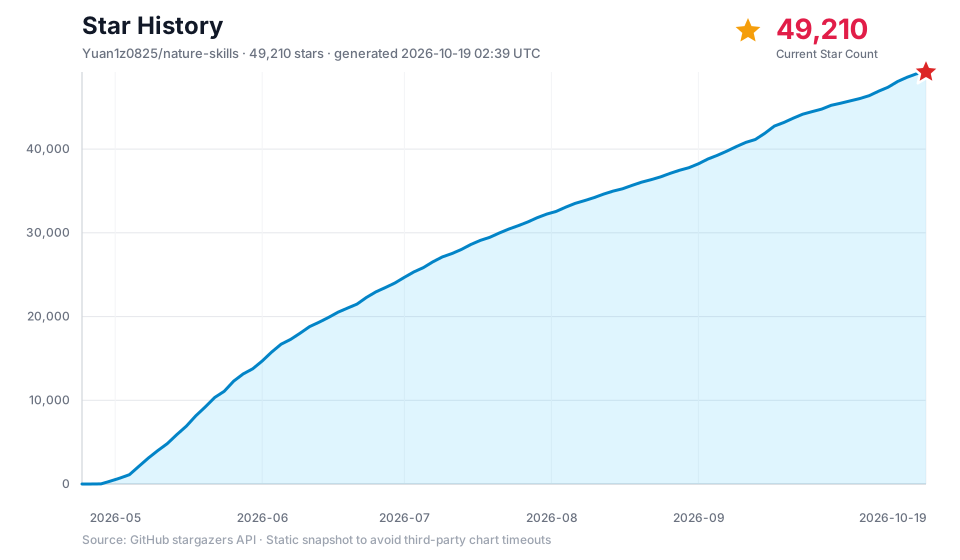
8. Star 历史