AssistantAgent





✨ Technical Features
- 🚀 Code-as-Action: Agent generates and executes code to complete tasks, rather than just calling predefined tools
- 🔒 Secure Sandbox: AI-generated code runs safely in GraalVM polyglot sandbox with resource isolation
- 📊 Multi-dimensional Evaluation: Multi-layer intent recognition through Evaluation Graph, precisely guiding Agent behavior
- 🔄 Dynamic Prompt Builder: Dynamically inject runtime context, prefetched experience candidates, and stable guidance into prompts based on scenarios and evaluation results
- 🧠 Unified Experience System: Manage COMMON / REACT / TOOL experiences in one model, support conversion to and from the Skills model, and improve experience efficiency and quality through progressive disclosure
- 🗂️ Management Console: Provide a dedicated management module for experience search, CRUD, statistics, and SKILL preview / import / export, so reusable experience and skill assets can be maintained in one place
- ⚡ Fast Response: For familiar scenarios, skip LLM reasoning process and respond quickly based on experience
📖 Introduction
Assistant Agent is an enterprise-grade intelligent assistant framework built on Spring AI Alibaba, adopting the Code-as-Action paradigm to orchestrate tools and complete tasks by generating and executing code. It's an intelligent assistant solution that understands, acts, and learns.
What Can Assistant Agent Do?
Assistant Agent is a fully-featured intelligent assistant with the following core capabilities:
- 🔍 Intelligent Q&A: Supports unified retrieval architecture across multiple data sources (extensible via SPI for knowledge base, Web, etc.), providing accurate, traceable answers
- 🛠️ Tool Invocation: Supports MCP, HTTP API (OpenAPI) and other protocols, can invoke tools directly in the React loop or orchestrate multiple tools in generated code for more complex workflows
- ⏰ Proactive Service: Supports scheduled tasks, delayed execution, event callbacks, letting the assistant proactively serve you
- 📬 Multi-channel Delivery: Built-in IDE reply, extensible to DingTalk, Feishu, WeCom, Webhook and other channels via SPI
- 🧩 Experience and Operations Management: Supports experience management, tenant-aware retrieval, and bidirectional conversion between the experience model and SKILL packages, making it easier to accumulate and reuse business capabilities
Why Choose Assistant Agent?
| Value | Description |
|---|---|
| Cost Reduction | 24/7 intelligent customer service, significantly reducing manual support costs |
| Quick Integration | Business platforms can integrate with simple configuration, no extensive development required |
| Flexible Customization | Configure knowledge base, integrate enterprise tools, build your exclusive business assistant |
| Continuous Optimization | Automatically learns and accumulates experience, the assistant gets smarter with use |
Use Cases
- Intelligent Customer Service: Connect to enterprise knowledge base, intelligently answer user inquiries
- Operations Assistant: Connect to monitoring and ticketing systems, automatically handle alerts, query status, execute operations
- Business Assistant: Connect to CRM, ERP and other business systems, assist employees in daily work
💡 The above are just typical scenario examples. By configuring knowledge base and integrating tools, Assistant Agent can adapt to more business scenarios. Feel free to explore.
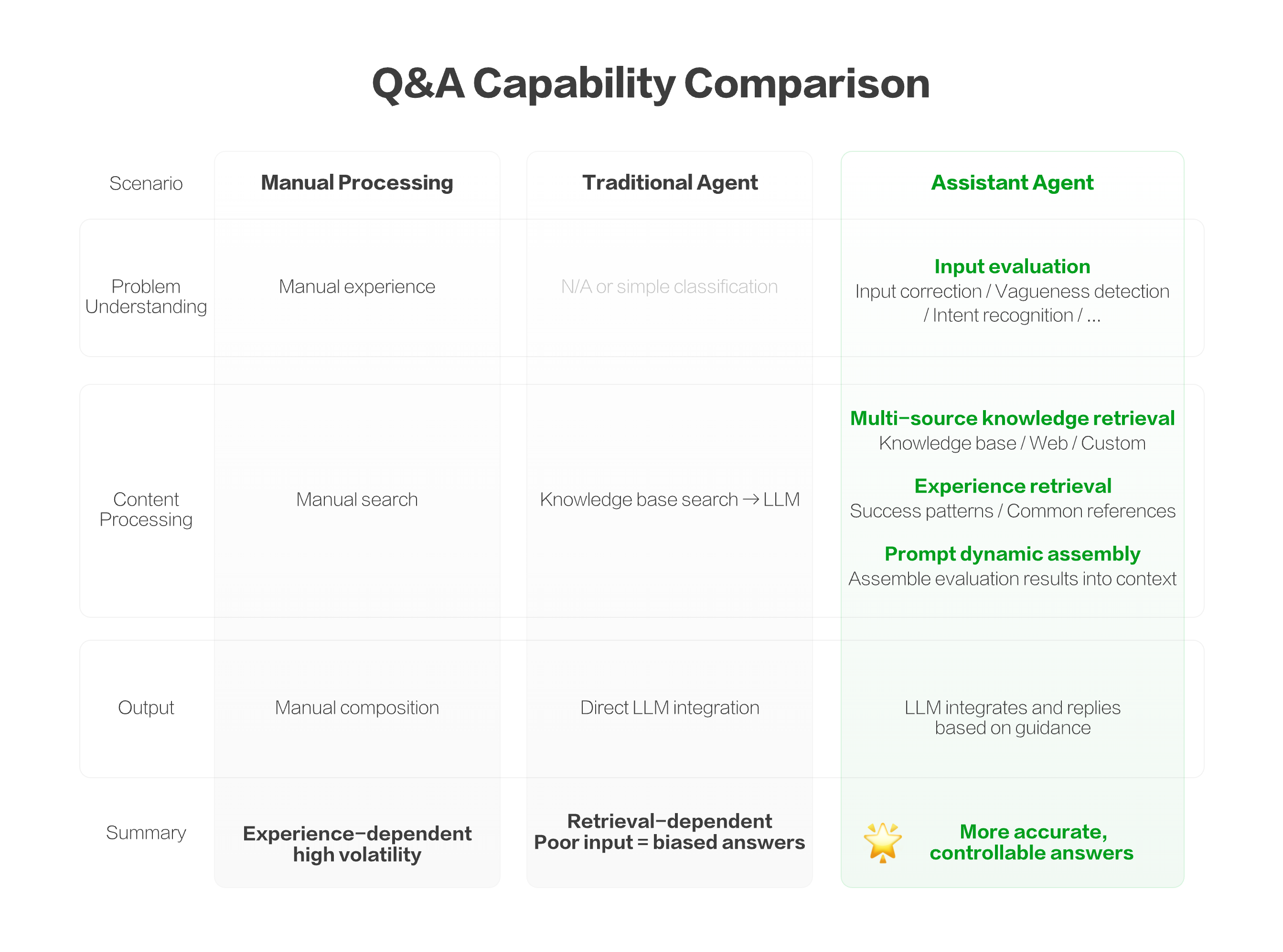
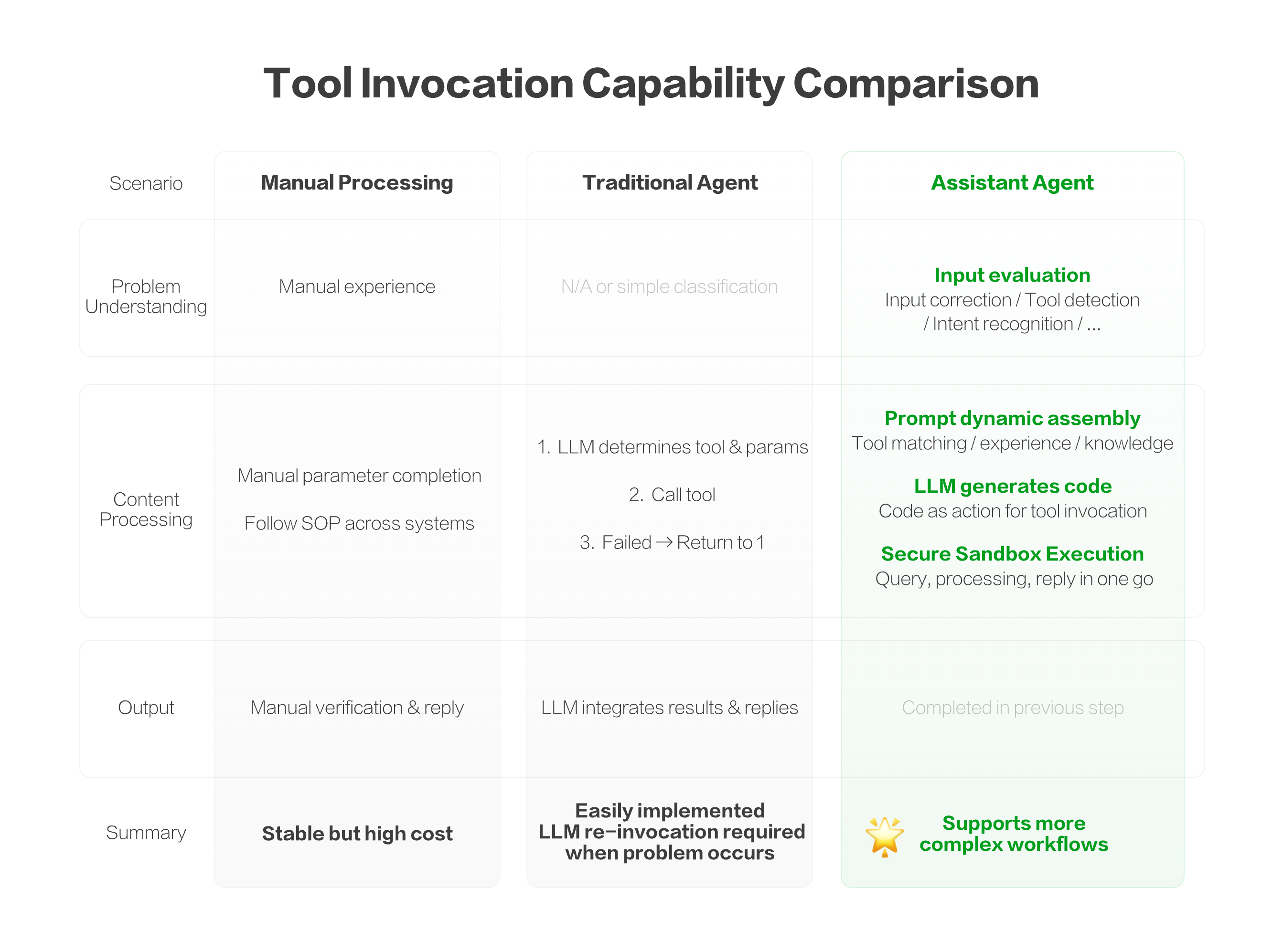
Overall Working Principle
Below is an end-to-end flow example of how Assistant Agent processes a complete request:
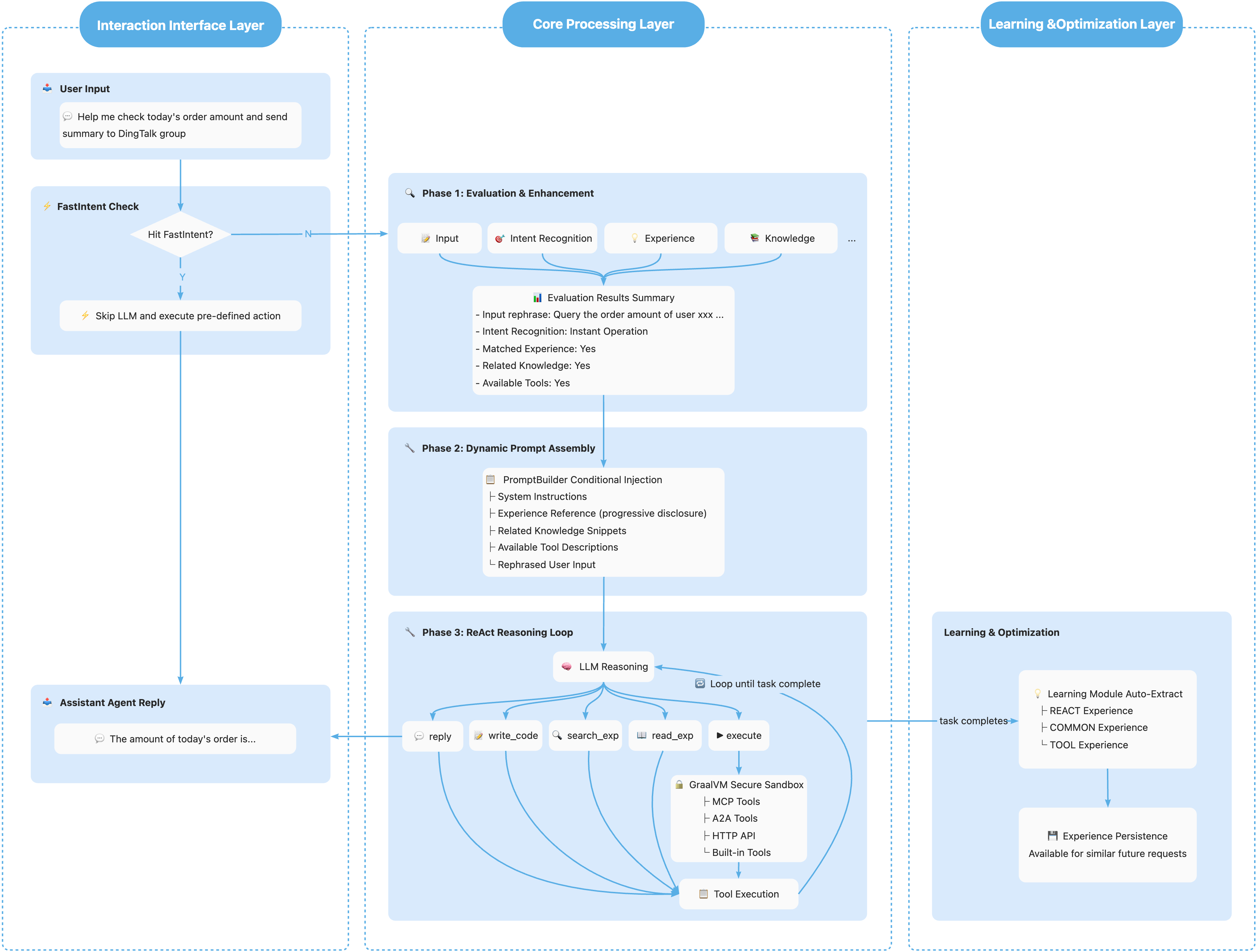
Project Structure
AssistantAgent/
├── assistant-agent-common          # Common tools, enums, constants
├── assistant-agent-core            # Core engine: GraalVM executor, tool registry
├── assistant-agent-extensions      # Extension modules:
│   ├── dynamic/               #   - Dynamic tools (MCP, HTTP API)
│   ├── experience/            #   - Unified experience runtime, disclosure, and FastIntent configuration
│   ├── learning/              #   - Learning extraction and storage
│   ├── search/                #   - Unified search capability
│   ├── reply/                 #   - Multi-channel reply
│   ├── trigger/               #   - Trigger mechanism
│   └── evaluation/            #   - Evaluation integration
├── assistant-agent-prompt-builder  # Prompt dynamic assembly
├── assistant-agent-evaluation      # Evaluation engine
├── assistant-agent-management      # Experience management and SKILL conversion APIs
├── assistant-agent-autoconfigure   # Spring Boot auto-configuration
└── assistant-agent-start           # Startup module
🚀 Quick Start
Prerequisites
- Java 17+
- Maven 3.8+
- DashScope API Key
1. Clone and Build
git clone https://github.com/spring-ai-alibaba/AssistantAgent.git
cd AssistantAgent
mvn clean install -DskipTests
2. Configure API Key
export DASHSCOPE_API_KEY=your-api-key-here
3. Minimal Configuration
The project has built-in default configuration, just ensure the API Key is correct. For customization, edit assistant-agent-start/src/main/resources/application.yml:
spring:
  ai:
    dashscope:
      api-key: ${DASHSCOPE_API_KEY}
      chat:
        options:
          model: qwen-max
4. Start the Application
cd assistant-agent-start
mvn spring-boot:run
All extension modules are enabled by default with sensible configurations; no additional configuration is required for a quick start.
5. Configure Knowledge Base (Connect to Business Knowledge)
💡 The framework provides a Mock knowledge base implementation by default for demonstration and testing. Production environments need to connect to real knowledge sources (such as vector databases, Elasticsearch, enterprise knowledge base APIs, etc.) so that the Agent can retrieve and answer business-related questions.
Option 1: Quick Experience (Using Built-in Mock Implementation)
The default configuration has knowledge base search enabled, you can experience it directly:
spring:
  ai:
    alibaba:
      codeact:
        extension:
          search:
            enabled: true
            knowledge-search-enabled: true  # Enabled by default
Option 2: Connect to Real Knowledge Base (Recommended)
Implement the SearchProvider SPI interface to connect to your business knowledge sources:
package com.example.knowledge;

import com.alibaba.assistant.agent.extension.search.spi.SearchProvider;
import com.alibaba.assistant.agent.extension.search.model.*;
import org.springframework.stereotype.Component;
import java.util.*;

@Component  // Add this annotation, Provider will be auto-registered
public class MyKnowledgeSearchProvider implements SearchProvider {

    @Override
    public boolean supports(SearchSourceType type) {
        return SearchSourceType.KNOWLEDGE == type;
    }

    @Override
    public List<SearchResultItem> search(SearchRequest request) {
        List<SearchResultItem> results = new ArrayList<>();

        // 1. Query from your knowledge source (vector database, ES, API, etc.)
        // Example: List<Doc> docs = vectorStore.similaritySearch(request.getQuery());

        // 2. Convert to SearchResultItem
        // for (Doc doc : docs) {
        //     SearchResultItem item = new SearchResultItem();
        //     item.setId(doc.getId());
        //     item.setSourceType(SearchSourceType.KNOWLEDGE);
        //     item.setTitle(doc.getTitle());
        //     item.setSnippet(doc.getSummary());
        //     item.setContent(doc.getContent());
        //     item.setScore(doc.getScore());
        //     results.add(item);
        // }

        return results;
    }

    @Override
    public String getName() {
        return "MyKnowledgeSearchProvider";
    }
}
Common Knowledge Source Integration Examples
| Knowledge Source Type | Integration Method |
|---|---|
| Vector Database (Alibaba Cloud AnalyticDB, Milvus, Pinecone) | Call vector similarity search API in search() method |
| Elasticsearch | Use ES client for full-text or vector search |
| Enterprise Knowledge Base API | Call internal knowledge base REST API |
| Local Documents | Read and index local Markdown/PDF files |
📖 For more details, refer to: Knowledge Search Module Documentation
🧩 Core Modules
For detailed documentation on each module, please visit our Documentation Site.
Core Modules
| Module | Description | Documentation |
|---|---|---|
| Evaluation | Multi-dimensional intent recognition through Evaluation Graph with LLM and rule-based engines | Quick Start | Advanced |
| Prompt Builder | Dynamic prompt assembly based on evaluation results and runtime context | Quick Start | Advanced |
Tool Extensions
| Module | Description | Documentation |
|---|---|---|
| MCP Tools | Integration with Model Context Protocol servers for tool ecosystem reuse | Quick Start | Advanced |
| Dynamic HTTP Tools | REST API integration through OpenAPI specification | Quick Start | Advanced |
| Custom CodeAct Tools | Build custom tools using the CodeactTool interface | Quick Start | Advanced |
Intelligence Capabilities
| Module | Description | Documentation |
|---|---|---|
| Experience | Unified COMMON / REACT / TOOL experience model with FastIntent support, conversion to and from Skills, progressive disclosure, and runtime retrieval via search_exp / read_exp |
Quick Start | Advanced |
| Learning | Automatically extract valuable COMMON / REACT / TOOL experiences from Agent execution history | Quick Start | Advanced |
| Search | Multi-source unified search engine for knowledge-based Q&A | Quick Start | Advanced |
Interaction Capabilities
| Module | Description | Documentation |
|---|---|---|
| Reply Channel | Multi-channel message reply with routing support | Quick Start | Advanced |
| Trigger | Scheduled tasks, delayed execution, and event callback triggers | Quick Start | Advanced |
Management Capabilities
| Capability | Description | Entry |
|---|---|---|
| Experience Management API | Tenant-aware listing, search, stats, and CRUD for runtime experiences | ExperienceManagementController |
| SKILL Conversion API | Convert to and from SKILL content, enabling bidirectional conversion between the Skills model and the unified experience model | SkillExchangeController |
Additional Resources
| Resource | Link |
|---|---|
| Quick Start Guide | AssistantAgent Quick Start |
| Secondary Development Guide | Development Guide |
📚 Reference Documentation
🤝 Contributing
We welcome contributions! Please see CONTRIBUTING.md for guidelines.
📄 License
This project is licensed under the Apache License 2.0 - see the LICENSE file for details.