Rive-CMP





-orange)
-blueviolet)
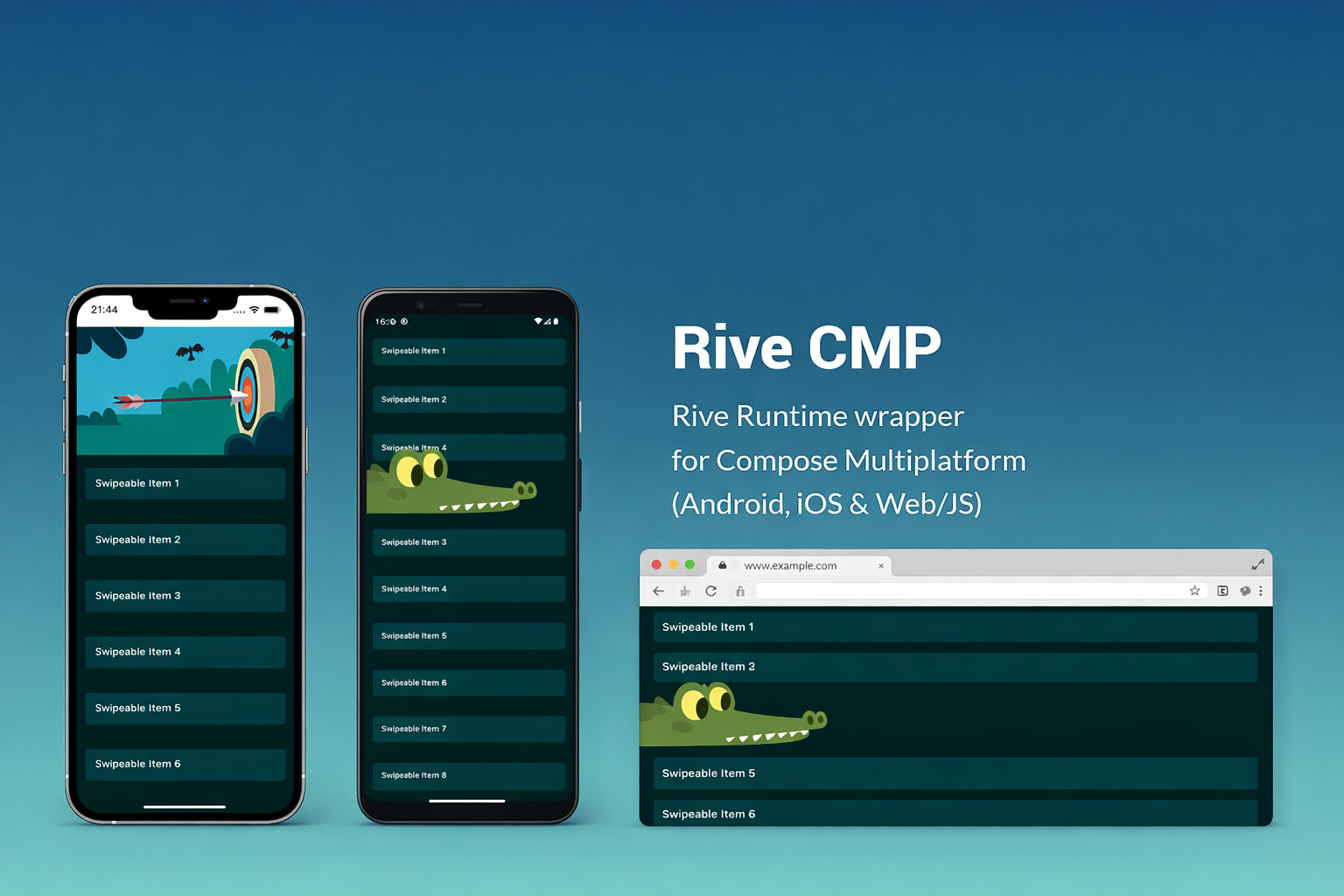
A Compose Multiplatform wrapper library for integrating Rive animations, providing a unified API to use rive-android, rive-ios, @rive-app/canvas, and a JNI bridge to rive-runtime seamlessly across Android, iOS, Web, and Desktop platforms.
[!IMPORTANT] This project is built and maintained by the open-source community, and is not an official Rive product or supported by Rive.
⚠️ EXPERIMENTAL STATUS
This library is currently in an experimental state.
- Features, APIs, and implementation details may change significantly
- Not all features and properties from the native Rive libraries are supported yet
- Some advanced Rive features may not be available across all platforms
Features
- Unified API: Single
CustomRiveAnimationcomposable that works across Android, iOS, Web and Desktop - Multiple Loading Options: Load animations from URLs, ByteArrays, or pre-composed specifications
- Native Performance: Uses platform-specific Rive implementations for optimal performance
- Easy Integration: Simple Compose-style API with familiar modifier patterns
- State Machine Support: Support for Rive state machines on every supported platform
- Data Binding: Read, write and observe view model properties on every supported platform
- Flexible Configuration: Customizable alignment, fit, artboard selection, and playback options
- Memory Efficient: Value classes and immutable specifications for optimal performance
Platform Support
| Platform | Implementation | Dependency |
|---|---|---|
| Android | Native rive-android | app.rive.runtime.kotlin |
| iOS | Swift Package Manager | rive-ios via spm4kmp |
| Web (JS/Wasm) | NPM package | @rive-app/canvas |
| Desktop (JVM) | Custom JNI bridge to rive-runtime (C++) | none (bundled native library) |
[!IMPORTANT] The iOS simulator on Intel Macs is not supported as of 0.4.1. Compose Multiplatform stopped publishing an
iosX64variant in 1.11. Stay on0.4.0if you need the Intel simulator.
Desktop (JVM) is currently macOS arm64 only. There is no official Rive SDK for JVM/Desktop,
so this bridges directly to the C++ rive-runtime via
JNI, rendering through Skia's CPU rasterizer. Linux, Windows, and macOS x64 have the CMake build
logic in place (native/rive-desktop/) but aren't built/verified yet - contributions welcome.
Installation
Gradle (Kotlin Multiplatform)
Add the dependency to your build.gradle.kts:
commonMain.dependencies {
    implementation("dev.muazkadan:rive-cmp:0.6.0")
}
Android-only projects
dependencies {
    implementation("dev.muazkadan:rive-cmp:0.6.0")
}
Version Catalog
Add to your libs.versions.toml:
[versions]
rive-cmp = "0.6.0"

[libraries]
rive-cmp = { module = "dev.muazkadan:rive-cmp", version.ref = "rive-cmp" }
Android Initialization
Rive needs to initialize its runtime when your app starts. You can do this in one of the following ways:
Using the Initialization Provider
Add this to your app's manifest file:
<provider android:name="androidx.startup.InitializationProvider"
    android:authorities="${applicationId}.androidx-startup" android:exported="false"
    tools:node="merge">
    <meta-data android:name="app.rive.runtime.kotlin.RiveInitializer"
        android:value="androidx.startup" />
</provider>
Using the AppInitializer
Call the initializer in your application code:
AppInitializer.getInstance(applicationContext)
    .initializeComponent(RiveInitializer::class.java)
Manual Initialization
Initialize Rive yourself in your code:
Rive.init(context)
Desktop (JVM) Initialization
Unlike Android (which can auto-initialize via androidx.startup) or iOS/JS/Wasm (which need no
initialization at all), the JVM/Desktop target has no automatic startup hook, so you must
initialize Rive explicitly once, before the first CustomRiveAnimation or RiveComposition is
used - typically at the top of your main():
import dev.muazkadan.rivecmp.RiveDesktop

fun main() {
    RiveDesktop.init()
    application {
        Window(onCloseRequest = ::exitApplication) {
            // your Compose Desktop app
        }
    }
}
Safe to call more than once - only the first call does any work.
iOS Setup
If you encounter undefined symbols errors for Swift classes when building for iOS, manually add the rive-ios dependency to your Xcode project:
In Xcode, go to File > Add Package Dependencies...
Enter the package URL: https://github.com/rive-app/rive-ios.git
Select version 6.27.0 (exact match to the library's dependency).
Add the package to your project.
In the target settings, add RiveRuntime to the Frameworks, Libraries, and Embedded Content.
This resolves linking issues with the Rive runtime on iOS.
Alternatively, for advanced users, the library generates a local Swift package at
library/SPM/spmKmpPlugin/nativeIosShared. You can add this local package to your Xcode project if
you have the source cloned. See spm4kmp documentation for
details.
Note: The library uses spm4kmp to integrate rive-ios, but manual addition may be required in some setups.
Basic Usage
Direct Animation Loading
import dev.muazkadan.rivecmp.CustomRiveAnimation
import dev.muazkadan.rivecmp.utils.ExperimentalRiveCmpApi

@OptIn(ExperimentalRiveCmpApi::class)
@Composable
fun MyScreen() {
    CustomRiveAnimation(
        modifier = Modifier.size(200.dp),
        url = "https://your-rive-animation-url.riv"
    )
}
[!NOTE] On Desktop (JVM), a
CustomRiveAnimationwithout a size modifier takes its artboard's size, one artboard unit per dp (per pixel withRiveFit.NONE), fitted into the space its parent allows. An explicit size modifier always wins.
Composition-based Loading (Recommended)
import dev.muazkadan.rivecmp.CustomRiveAnimation
import dev.muazkadan.rivecmp.RiveCompositionSpec
import dev.muazkadan.rivecmp.rememberRiveComposition
import dev.muazkadan.rivecmp.utils.ExperimentalRiveCmpApi

@OptIn(ExperimentalRiveCmpApi::class)
@Composable
fun MyScreen() {
    // URL-based composition
    val urlAnimation by rememberRiveComposition {
        RiveCompositionSpec.url("https://cdn.rive.app/animations/your_animation.riv")
    }

    // Resource-based composition
    val resourceAnimation by rememberRiveComposition {
        RiveCompositionSpec.byteArray(Res.readBytes("files/your_animation.riv"))
    }

    Column {
        CustomRiveAnimation(
            modifier = Modifier.size(200.dp),
            composition = urlAnimation
        )

        CustomRiveAnimation(
            modifier = Modifier.size(200.dp),
            composition = resourceAnimation
        )
    }
}
API Reference
CustomRiveAnimation (Direct URL)
@ExperimentalRiveCmpApi
@Composable
fun CustomRiveAnimation(
    modifier: Modifier = Modifier,
    url: String,
    alignment: RiveAlignment = RiveAlignment.CENTER,
    autoPlay: Boolean = true,
    artboardName: String? = null,
    fit: RiveFit = RiveFit.CONTAIN,
    stateMachineName: String? = null,
    overlay: Boolean = true,
    onViewModelInstance: ((RiveViewModelInstance) -> Unit)? = null,
)
CustomRiveAnimation (Direct ByteArray)
@ExperimentalRiveCmpApi
@Composable
fun CustomRiveAnimation(
    modifier: Modifier = Modifier,
    byteArray: ByteArray,
    alignment: RiveAlignment = RiveAlignment.CENTER,
    autoPlay: Boolean = true,
    artboardName: String? = null,
    fit: RiveFit = RiveFit.CONTAIN,
    stateMachineName: String? = null,
    overlay: Boolean = true,
    onViewModelInstance: ((RiveViewModelInstance) -> Unit)? = null,
)
CustomRiveAnimation (Composition-based)
@ExperimentalRiveCmpApi
@Composable
fun CustomRiveAnimation(
    modifier: Modifier = Modifier,
    composition: RiveComposition?,
    alignment: RiveAlignment = RiveAlignment.CENTER,
    autoPlay: Boolean = true,
    artboardName: String? = null,
    fit: RiveFit = RiveFit.CONTAIN,
    stateMachineName: String? = null,
    overlay: Boolean = true,
    onViewModelInstance: ((RiveViewModelInstance) -> Unit)? = null,
)
RiveCompositionSpec Factory Methods
// Create URL-based composition spec
RiveCompositionSpec.url(url: String): RiveCompositionSpec

// Create ByteArray-based composition spec
RiveCompositionSpec.byteArray(byteArray: ByteArray): RiveCompositionSpec
rememberRiveComposition
@Composable
fun rememberRiveComposition(
    vararg keys: Any?,
    spec: suspend () -> RiveCompositionSpec,
): RiveCompositionResult
RiveCompositionResult is a State<RiveComposition?>, so by delegation works as in the examples
above. It also exposes the loading state:
val result = rememberRiveComposition { RiveCompositionSpec.url(url) }

when {
    result.isLoading -> CircularProgressIndicator()
    result.error != null -> Text("Couldn't load the animation")
    else -> CustomRiveAnimation(modifier = Modifier.size(200.dp), composition = result.value)
}
Parameters
modifier: Compose modifier for styling and layouturl: URL to the Rive animation file (direct loading)byteArray: ByteArray containing the Rive animation data (direct loading)composition: Pre-loadedRiveCompositionfromrememberRiveComposition(recommended)alignment: How the animation should be aligned within its container (default:RiveAlignment.CENTER)autoPlay: Whether the animation should start playing automatically (default:true)artboardName: Optional name of the specific artboard to usefit: How the animation should fit within its container (default:RiveFit.CONTAIN)stateMachineName: Optional name of the state machine to useoverlay: Whether the animation is drawn above (true) or beneath (false) the Compose content at the same place. Used on iOS, where it controls how the native view is placed, and on Desktop; it has no effect on Android or the web (default:true)onViewModelInstance: Called with the bound view model instance; see Data Binding (default:null, no binding)
Data Binding
Pass onViewModelInstance to bind the artboard's default view model instance and receive it once
the file has loaded. Look properties up by path, then read, write or observe them:
var rating by remember { mutableStateOf<RiveProperty<Float>?>(null) }

CustomRiveAnimation(
    composition = composition,
    stateMachineName = "State Machine 1",
    onViewModelInstance = { viewModel -> rating = viewModel.number("rating") },
)

LaunchedEffect(rating) {
    rating?.valueFlow?.collect { println("rating is $it") }
}
number,string,boolean,color(ARGBInt),enum(the selected value's name) andtriggerare supported. Nested view models are reached with a path such as"card/title".- A lookup returns
nullwhen the path does not exist or names a property of another type. - The callback is not called for a file without a view model.
- The instance is valid while the animation is in the composition.
composition.reset()(and on iOS alsocomposition.stop()) binds a new instance and calls the callback again; take the properties from that one. - The data binding types are
@ExperimentalRiveCmpApi, likeCustomRiveAnimation, so opt in with@OptIn(ExperimentalRiveCmpApi::class).
[!NOTE] Platform differences
- Writing a property or firing a trigger resumes playback that has stopped, including after
composition.pause(), on Android, iOS and Desktop, as setting a state machine input does. On the web a paused animation stays paused.triggersreports the graphic firing a trigger on every platform. Atrigger()call from your own code is reported immediately on Desktop and the web, on iOS once the view next redraws, and on Android not while the graphic is idle.
Requirements
Android
- Minimum SDK: 24
- Compile/Target SDK: 37
- Kotlin: 2.4+
- Compose Multiplatform: 1.12+
- AGP: 9.3.2+ (Gradle 9.7+)
Kotlin 2.4+ is a hard floor, not a recommendation: the published artifacts are built with Kotlin 2.4.20, and consumers on 2.3.x will hit Kotlin metadata incompatibilities.
iOS
- Minimum iOS: 14.0
- Xcode: 26.3+ (required by the Kotlin 2.4 toolchain)
- Swift: 5.9+
- Apple Silicon required for simulator builds (see the
iosX64note above)
Web (JS/Wasm)
- Compose Multiplatform: 1.12+
- Kotlin/JS with IR compiler
- Browser environment
Desktop (JVM)
- macOS arm64 only
- JDK 11+
Building
The project has four Gradle modules:
library– The Rive CMP library (KMP: Android, iOS, JS, Wasm, JVM/Desktop)sample– Shared sample UI and logic (KMP library; also the Desktop, JS and Wasm entry point)androidSample– Android app entry point (run this for the Android sample)runtime-macos-arm64– Ships the prebuiltlibrive-desktoparm64.dylibfor JVM/Desktop
plus native/rive-desktop/, a CMake project for the JNI bridge. It is not part of the default
Gradle build - :library:jvmMain consumes the prebuilt binary instead. See
native/rive-desktop/README.md for how to build it, the pinned
rive-runtime commit, and the provenance of the shipped binary.
The library uses Kotlin Multiplatform with the following plugins:
kotlinMultiplatformandroidMultiplatformLibrary(AGP 9–compatible Android-KMP library plugin)composeMultiplatformcomposeCompilerspmForKmp(for iOS Swift Package Manager integration)
# Build and run the Android sample app
./gradlew :androidSample:installDebug

# Run the Desktop (JVM) sample
./gradlew :sample:run

# Run the Wasm sample in a browser (http://localhost:8080)
./gradlew :sample:wasmJsBrowserDevelopmentRun

# Run the JS sample in a browser (http://localhost:8080)
./gradlew :sample:jsBrowserDevelopmentRun

# Build Android AAR
./gradlew :library:assembleRelease

# Build iOS Framework
./gradlew :library:linkReleaseFrameworkIosArm64
[!NOTE]
./gradlew buildcurrently fails oncheckComposeUiTestConfigurationForJs/...ForWasmJs, a Compose Multiplatform 1.12 check (CMP-4906) whose suggested fix conflicts with thebinaries.library()output this project publishes. Assembling, publishing and running the samples are unaffected - use the per-target tasks above.
To run the sample in Android Studio, use the androidSample run configuration (not sample).
Contributing
- Fork the repository
- Create a feature branch (
git checkout -b feature/amazing-feature) - Commit your changes (
git commit -m 'Add amazing feature') - Push to the branch (
git push origin feature/amazing-feature) - Open a Pull Request
Development Setup
Clone the repository
Open in Android Studio or IntelliJ IDEA
Sync Gradle dependencies
For iOS development, ensure Xcode is installed
Only if you intend to build the native desktop bridge, fetch the pinned Rive runtime:
git submodule update --init --recursive submodules/rive-runtimeThis is not needed for normal development - the JVM target uses the prebuilt binary in
runtime-macos-arm64. The checkout and its Skia build are large (several GB).
Tests
The desktop (JVM) tests exercise the JNI bridge, layout, rendering and data binding against the committed native binary, so they need an Apple Silicon Mac:
./gradlew :library:jvmTest
The JVM tests workflow runs them on every pull request.
License
Copyright 2025 Muaz KADAN

Licensed under the Apache License, Version 2.0 (the "License");
you may not use this file except in compliance with the License.
You may obtain a copy of the License at

    http://www.apache.org/licenses/LICENSE-2.0

Unless required by applicable law or agreed to in writing, software
distributed under the License is distributed on an "AS IS" BASIS,
WITHOUT WARRANTIES OR CONDITIONS OF ANY KIND, either express or implied.
See the License for the specific language governing permissions and
limitations under the License.
Author
Muaz KADAN
- Website: muazkadan.dev
- Email: muaz.kadan@gmail.com
- GitHub: @muazkadan
Acknowledgments
- Rive for the amazing animation platform
- rive-android for Android implementation
- rive-ios for iOS implementation
- @rive-app/canvas for Web implementation
- rive-runtime for the C++ runtime behind Desktop (JVM)
- spm4kmp for Swift Package Manager integration