RxRedux
We've stopped maintaining this library because we are moving from RxJava to Kotlin Coroutines and Flow. Take a look at FlowRedux for a spiritual successor to this library.
RxRedux


A Redux store implementation entirely based on RxJava (inspired by redux-observable)
that helps to isolate side effects. RxRedux is (kind of) a replacement for RxJava's .scan() operator.
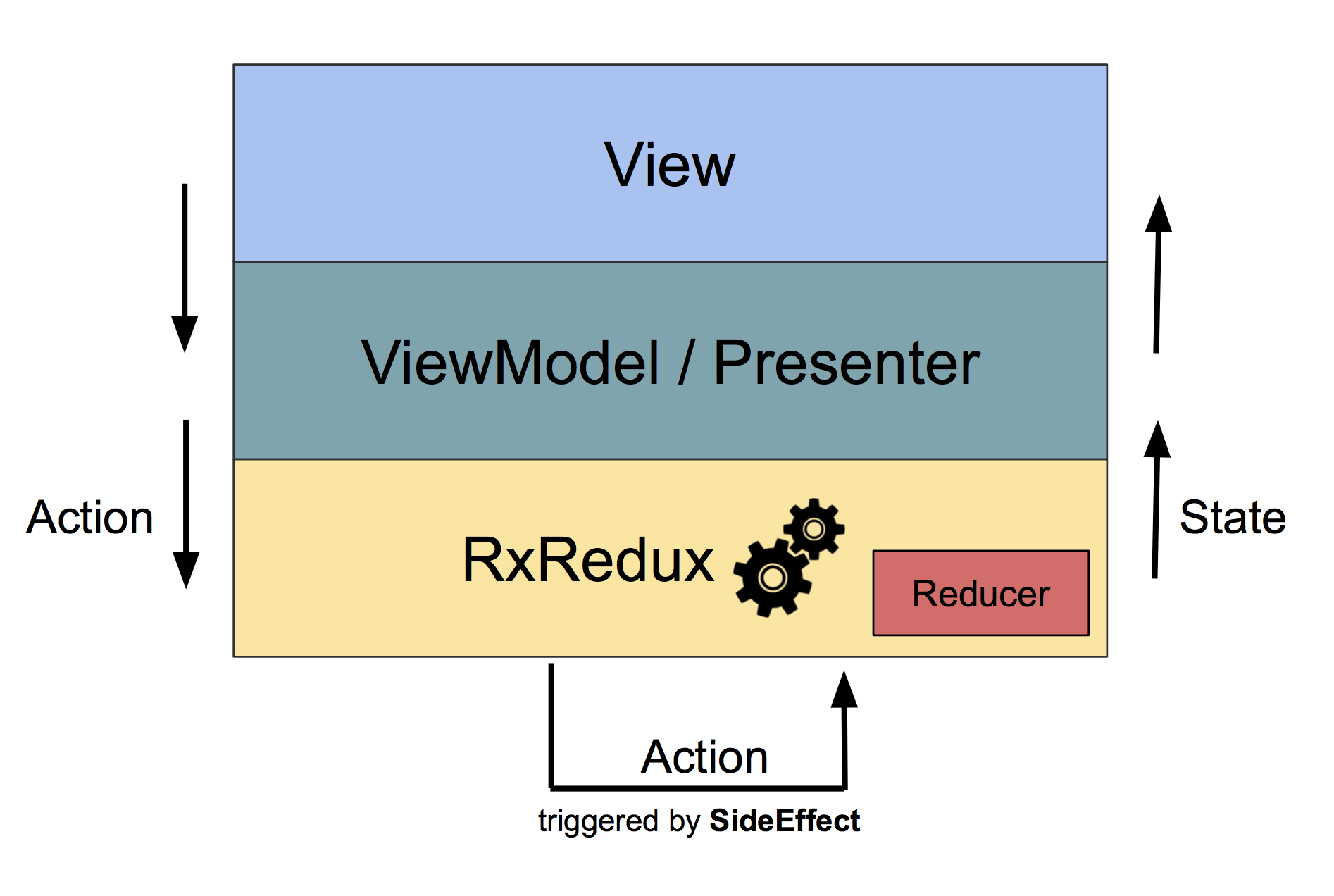
Dependency
Dependencies are hosted on Maven Central:
implementation 'com.freeletics.rxredux:rxredux:1.0.1'
Keep in mind that this library is written in kotlin which means you also need to add kotlin-stdlib to a project using RxRedux.
Snapshot
Latest snapshot (directly published from master branch from Travis CI):
allprojects {
    repositories {
        // Your repositories.
        // ...
        // Add url to snapshot repository
        maven {
            url "https://oss.sonatype.org/content/repositories/snapshots/"
        }
    }
}
implementation 'com.freeletics.rxredux:rxredux:1.0.2-SNAPSHOT'
How is this different from other Redux implementations like Mobius
In contrast to any other Redux inspired library out there, this library is really backed on top of RxJava (Mobius just offers some extensions to use RxJava for async works).
This library offers a custom RxJava operator .reduxStore( initialState, sideEffects, reducer ) and treats upstream events as Actions.
Kotlin coroutine-based implementation
If you are already using Kotlin coroutines or planning to use it in your project - check CoRedux. This library implements Redux store, using same approach as RxRedux, but uses Kotlin coroutines instead of RxJava.
Redux Store
A Store is basically an observable container for state.
This library provides a kotlin extension function .reduxStore<State, Action>(initialState, sideEffects, reducer) to create such a state container.
It takes an initialState and a list of SideEffect<State, Action> and a Reducer<State, Action>
Action
An Action is a command to "do something" in the store.
An Action can be triggered by the user of your app (i.e. UI interaction like clicking a button) but also a SideEffect can trigger actions.
Every Action goes through the reducer.
If an Action is not changing the state at all by the Reducer (because it's handled as a side effect), just return the previous state.
Furthermore, SideEffects can be registered for a certain type of Action.
Reducer
A Reducer is basically a function (State, Action) -> State that takes the current State and an Action to compute a new State.
Every Action goes through the state reducer.
If an Action is not changing the state at all by the Reducer (because it's handled as a side effect), just return the previous state.
Side Effect
A Side Effect is a function of type (Observable<Action>, StateAccessor<State>) -> Observable<Action>.
So basically it's Actions in and Actions out.
You can think of a SideEffect as a use case in clean architecture: It should do just one job.
Every SideEffect can trigger multiple Actions (remember it returns Observable<Action>) which go through the Reducer but can also trigger other SideEffects registered for the corresponding Action.
An Action can also have a payload. For example, if you load some data from backend, you emit the loaded data as an Action like data class DataLoadedAction (val data : FooData).
The mantra an Action is a command to do something is still true: in that case it means data is loaded, do with it "something".
StateAccessor
Whenever a SideEffect needs to know the current State it can use StateAccessor to grab the latest state from Redux Store. StateAccessor is basically just a function () -> State to grab the latest State anytime you need it.
Usage
Let's create a simple Redux Store for Pagination: Goal is to display a list of Persons on screen.
For a complete example check the sample application incl. README
but for the sake of simplicity let's stick with this simple "list of persons example":
data class State {
  val currentPage : Int,
  val persons : List<Person>, // The list of persons
  val loadingNextPage : Boolean,
  val errorLoadingNextPage : Throwable?
}

val initialState = State(
  currentPage = 0,
  persons = emptyList(),
  loadingNextPage = false,
  errorLoadingNextPage = null
)
sealed class Action {
    object LoadNextPageAction : Action() // Action to load the first page. Triggered by the user.

    data class PageLoadedAction(val personsLoaded : List<Person>, val page : Int) : Action() // Persons has been loaded
    object LoadPageAction : Action() // Started loading the list of persons
    data class ErrorLoadingNextPageAction(val error : Throwable) : Action() // An error occurred while loading
}
// SideEffect is just a type alias for such a function:
fun loadNextPageSideEffect (actions : Observable<Action>, state: StateAccessor<State>) : Observable<Action> =
  actions
    .ofType(LoadNextPageAction::class.java) // This side effect only runs for actions of type LoadNextPageAction
    .switchMap {
        // do network request
        val currentState : State  = state()
        val nextPage = state.currentPage + 1
        backend.getPersons(nextPage)
          .map { persons : List<Person> ->
                  PageLoadedAction(
                      personsLoaded = persons,
                      page = nextPage
                  )
           }
          .onErrorReturn { error -> ErrorLoadingNextPageAction(error) }
          .startWith(LoadPageAction)
    }
// Reducer is just a typealias for a function
fun reducer(state : State, action : Action) : State =
  when(action) {
    is LoadPageAction -> state.copy (loadingNextPage = true)
    is ErrorLoadingNextPageAction -> state.copy( loadingNextPage = false, errorLoadingNextPage = action.error)
    is PageLoadedAction -> state.copy(
      loadingNextPage = false,
      errorLoadingNextPage = null
      persons = state.persons + action.persons,
      page = action.page
    )
    else -> state // Reducer is actually not handling this action (a SideEffect does it)
  }
val actions : Observable<Action> = ...
val sideEffects : List<SideEffect<State, Action> = listOf(::loadNextPageSideEffect, ... )

actions
  .reduxStore( initialState, sideEffects, ::reducer )
  .subscribe( state -> view.render(state) )
The following video (click on it) illustrates the workflow:
Let's take a look at the following illustration: The blue box is the
View(think UI). ThePresenterorViewModelhas not been drawn for the sake of readability but you can think of having such additional layers between View and Redux State Machine. The yellow box represents aStore. The grey box is thereducer. The pink box is aSideEffectAdditionally, a green circle representsStateand a red circle represents anAction(see next step). On the right you see a UI mock of a mobile app to illustrate UI changes.NextPageActiongets triggered from the UI (by scrolling at the end of the list). EveryActiongoes through thereducerand allSideEffectsregistered for this type of Action.Reduceris not interested inNextPageAction. So whileNextPageActiongoes through the reducer, it doesn't change the state.loadNextPageSideEffect(pink box), however, cares aboutNextPageAction. This is the trigger to run the side-effect.So
loadNextPageSideEffecttakesNextPageActionand starts doing the job and makes the http request to load the next page from backend. Before doing that, this side effect starts with emittingLoadPageAction.ReducertakesLoadPageActionemitted from the side effect and reacts on it by "reducing the state". This meansReducerknows how to react onLoadPageActionto compute the new state (showing progress indicator at the bottom of the list). Please note that the state has changed (highlighted in green) which also results in changing the UI (progress indicator at the end of the list).Once
loadNextPageSideEffectgets the result back from backend, the side effect emits a newPageLoadedAction. This Action contains a "payload" - the loaded data.
data class PageLoadedAction(val personsLoaded : List<Person>, val page : Int)
- As any other Action
PageLoadedActiongoes through theReducer. The Reducer processes this Action and computes a new state out of it by appending the loaded data to the already existing data (progress bar also is hidden).
Final remark:
This system allows you to create a plugin in system of SideEffects that are highly reusable and specific to do a single use case.
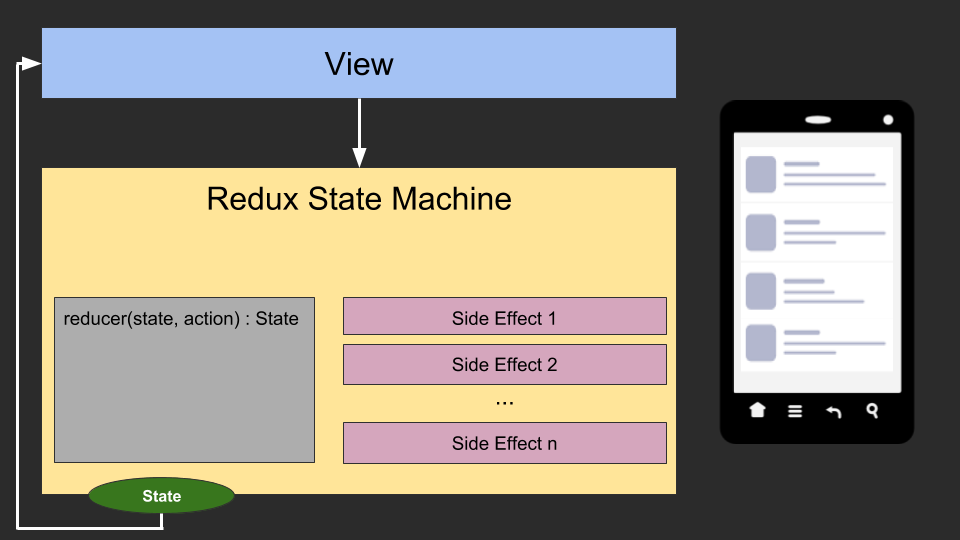
Also SideEffects can be invoked by Actions from other SideEffects.
For a complete example check the sample application incl. README
FAQ
I get a StackoverflowException
This is a common pitfall and is most of the time caused by the fact that a SideEffect emits an Action as output that it also consumes from upstream leading to an infinite loop.
val sideEffect: SideEffect<State, Int> = { actions, state ->
    actions.map { it * 2 }
}

val inputActions = Observable.just(1)

inputActions
    .reduxStore(
        initialState = "InitialState",
        sideEffects = listOf(sideEffect)
    ) { state, action ->
        ...
    }
The problem is that from upstream we get Int 1.
But since SideEffect reacts on that action Int 1 too, it computes 1 * 2 and emits 2, which then again gets handled by the same SideEffect 2 * 2 = 4 and emits 4, which then again gets handled by the same SideEffect 4 * 2 = 8 and emits 8, which then getst handled by the same SideEffect and so on (endless loop) ...
Who processes an Action first: Reducer or SideEffect?
Since every Action runs through both Reducer and registered SideEffects this is a valid question.
Technically speaking Reducer gets every Action from upstream before the registered SideEffects.
The idea behind this is that a Reducer may have already changed the state before a SideEffect start processing the Action.
For example let's assume upstream only emits exactly one Action (because then it's simpler to illustrate the sequence of workflow):
// 1. upstream emits events
val upstreamActions = Observable.just( SomeAction() )

val sideEffect1: SideEffect<State, Action> = { actions, state ->
    // 3. Runs because of SomeAction
    actions.filter { it is SomeAction }.map { OtherAction() }
}

val sideEffect2: SideEffect<State, Action> ={ actions, state ->
    // 5. Runs because of OtherAction
    actions.filter { it is OtherAction }.map { YetAnotherAction() }
}

upstreamActions
    .reduxStore(
        initialState = ... ,
        sideEffects = listOf(sideEffect)
    ) { state, action ->
        // 2. This runs first because of SomeAction
        ...
        // 4. This runs again because of OtherAction (emitted by SideEffect1)
        ...
        // 6. This runs again because of YetAnotherAction emitted from SideEffect2)
    }.subscribe( ... )
So the workflow is as follows:
- Upstream emits
SomeAction reducerprocessesSomeActionSideEffect1reacts onSomeActionand emitsOtherActionas outputreducerprocessesOtherActionSideEffect2reacts onOtherActionand emitsYetAnotherActionreducerprocessesYetAnotherAction
Can I use val and fun for SideEffects or Reducer?
Absolutely. SideEffect is just a type alias for a function (actions: Observable<Action>, state: StateAccessor<State>) -> Observable<out Action>.
In kotlin you can use a lambda for that like this:
val sideEffect1: SideEffect<State, Action> = { actions, state ->
    actions.filter { it is SomeAction }.map { OtherAction() }
}
of write a function (instead of a lambda):
fun sideEffect2(actions : Observable<Action>, state : StateAccessor<State>) : Observable<Action> {
    return actions
        .filter { it is SomeAction }.map { OtherAction() }
}
Both are totally equal and can be used like that:
upstreamActions
    .reduxStore(
        initialState = ... ,
        sideEffects = listOf(sideEffect1, ::sideEffect2)
    ) { state, action ->
        ...
    }
    .subscribe( ... )
The same is valid for Reducer. Reducer is just a type alias for a function (State, Action) -> State
You can define your reducer as lambda or function:
val reducer = { state, action -> ... }

// or

fun reducer(state : State, action : Action) : State {
  ...
}
Is distinctUntilChanged considered as best practice?
Yes it is because .reduxStore(...) is not taking care of only emitting state that has been changed
compared to previous state.
Therefore, .distinctUntilChanged() is considered as best practice.
actions
    .reduxStore( ... )
    .distinctUntilChanged()
    .subscribe { state -> view.render(state) }
What if I would like to have a SideEffect that returns no Action?
For example, let's say you just store something in a database but you don't need a Action as result
piped backed to your redux store. In that case you can simple use Observable.empty() like this:
fun saveToDatabaseSideEffect(actions : Observable<Action>, stateAccessor : StateAccessor<State>) {
    return actions.flatmap {
        saveToDb(...)
        Observable.empty<Action>()  // just return this to not emit an Action
    }
}
How do I cancel ongoing SideEffects if a certain Action happens?
Let's assume you have a simple SideEffect that is triggered by Action1.
Whenever Action2 is emitted our SideEffect should stop.
In RxJava this is quite easy to do by using .takeUntil()
fun mySideEffect(actions : Observable<Action>, stateAccessor : StateAccessor<State>) =
    actions
        .ofType(Action1::class.java)
        .flatMap {
            ...
            doSomething()
        }
        .takeUntil(actions.ofType(Action2::class.java)) // Once Action2 triggers the whole SideEffect gets canceled.
Do I need an Action to start observing data?
Let's say you would like to start observing a database right from the start inside your Store. This sounds pretty much like as soon as you have subscribers to your Store and therefore you don't need a dedicated Action to start observing the database.
fun observeDatabaseSideEffect(_ : Observable<Action>, _ : StateAccessor<State>) : Observable<Action> =
    database // please notice that we dont use Observable<Action> at all
        .queryItems()
        .map { items -> DatabaseLoadedAction(items) }