zeptun

A userspace network engine for TUN devices, written in Zig with no dependencies. It turns the packets an operating system routes into a tunnel interface back into TCP, UDP and ICMP flows, and forwards them through a SOCKS5 proxy, directly, or to the embedding application.
Features
- IPv4 and IPv6, dual stack, fragment reassembly.
- TCP through a userspace terminator, through kernel NAT, or both at once.
- UDP with full-cone NAT by default, plus address and address-port modes.
- Segmentation offload in both directions: TSO, USO,
UDP_SEGMENTandUDP_GRO, through SOCKS5 as well. - Multi-queue TUN with elastic workers: queues are attached and detached under load, and live connections migrate between them without loss.
- SOCKS5 with a warm connection pool, pipelined handshakes, optimistic data, UDP ASSOCIATE and UDP over TCP.
- Fake-IP DNS, DNS hijacking, and DNS handover to systemd-resolved.
- Automatic routing: policy rules, prefix include and exclude lists, UID, interface and Android package rules, strict route, nftables auto-redirect.
- ICMP echo forwarding, ICMP time exceeded for expired packets, and upstream ICMP errors translated back to the client.
- The interface can live in its own network namespace while upstream sockets stay outside.
- io_uring or epoll on Linux, kqueue on BSD and macOS, IOCP on Windows.
- C ABI, TOML and JSON configuration, per-flow verdict callback.
- Linux, Android, Windows, macOS, iOS and FreeBSD.
Benchmarks
Measured by the benchmark workflow on a GitHub-hosted runner, against four other engines over the same SOCKS5 server.
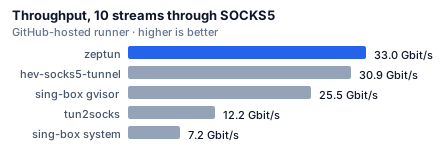
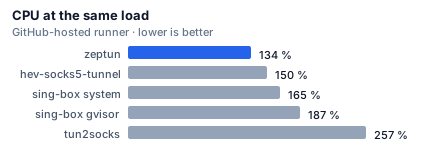
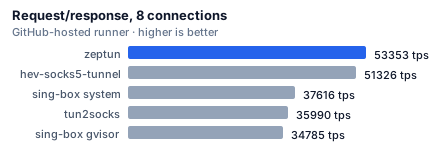
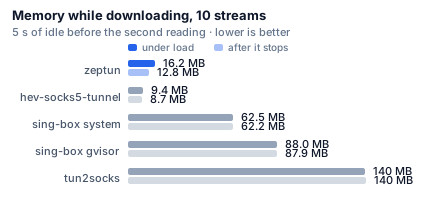
The second memory bar is read after the load stops: the packet pool hands idle pages back to the kernel instead of holding them for the life of the process.
Method, runner specification, latency, UDP, memory and the raw tables: docs/bench.
Build
Zig 0.16.0 is the only requirement.
Unix
git clone https://github.com/Noisemux/zeptun
cd zeptun
make
sudo make install
make install places zeptun in /usr/local/bin, libzeptun.a and zeptun.h beside it, conf/zeptun.toml in /etc/zeptun if no configuration exists yet, and a systemd unit in /usr/local/lib/systemd/system.
Android
ANDROID_NDK_HOME=/path/to/ndk sh scripts/build_android.sh
This builds libzeptun.so and libzeptun.a for armeabi-v7a, arm64-v8a, x86 and x86_64, then libzeptun-jni.so from src/jni/zeptun_jni.c. All load segments are aligned to 16 KB, as Android 15 and later require. Without the NDK the script stops after the Zig libraries.
iOS and macOS
sh scripts/make_xcframework.sh
This produces zig-out/Zeptun.xcframework with the iOS device, iOS simulator and macOS slices. Package.swift exposes it to SwiftPM.
Windows
zig build -Dtarget=x86_64-windows-gnu -Doptimize=ReleaseFast
make wintun
The tunnel uses Wintun, which is vendored in third-part/wintun with its licence and header, so no download is needed: make wintun copies the right wintun.dll next to the executable (WINTUN_ARCH=arm64 for arm64). The released Windows archives already contain it.
Library
zig build -Doptimize=ReleaseFast
This writes zig-out/lib/libzeptun.a, the shared library and zig-out/include/zeptun.h. Other targets: make TARGET=aarch64-linux-musl, or zig build cross for the whole matrix.
Use
Configuration
preset = "desktop"
log_level = "warn"
stats_interval_s = 0

[tun]
name = "zeptun0"
mtu = 8500
queues = 0
address = ["172.19.0.1/30", "fdfe:dcba:9876::1/126"]

[stack]
mode = "userspace"
udp_nat = "endpoint_independent"
icmp = "auto"

[handler]
kind = "socks5"

[handler.socks5]
server = "127.0.0.1:1080"
udp_mode = "udp"
pool_size = 4

[route]
auto_route = true
exclude = ["192.168.0.0/16"]

[dns]
fake_ip = false
hijack = false
systemd_resolved = true
conf/zeptun.toml carries every key with its default. The same document is accepted as JSON. Unknown keys are rejected instead of ignored.
| Section | Keys |
|---|---|
| top level | preset (desktop, server, mobile), log_level, log_file, pid_file, stats_interval_s, post_up_script, pre_down_script |
[tun] |
name, fd, mtu, queues, offload, multi_queue, persist, napi, jumbo, txqueuelen, configure, netns, guid, address |
[stack] |
mode (userspace, hybrid, system), tcp_rx_window, tcp_tx_buffer, tcp_mss_clamp, tcp_initial_cwnd, congestion, sack, timestamps, window_scaling, tcp_connect_timeout_ms, tcp_idle_timeout_ms, tcp_delayed_ack_ms, tcp_early_accept, udp_idle_timeout_ms, udp, udp_nat, icmp, max_tcp_sessions, max_udp_sessions, nat_port_base, nat_port_limit |
[handler] |
kind (socks5, direct, passthrough), tcp_fastopen, preserve_dscp |
[handler.socks5] |
server, username, password, udp, udp_mode (udp, tcp), udp_address, pipeline, optimistic_data, pool_size, pool_idle_ms |
[handler.direct] |
fwmark, bind_interface |
[route] |
auto_route, table, rule_priority, fwmark, include, exclude, include_file, exclude_file, strict, allow_app, auto_redirect, redirect_port, include_uid, exclude_uid, include_interface, exclude_interface, include_package, exclude_package, android_user |
[io] |
backend (auto, io_uring, epoll), workers, elastic (auto, on, off), rx_parallel, tx_slots, multishot_rx, busy_poll_us, pin_cpus, monitor_network |
[dns] |
fake_ip, fake_ranges, cache_size, ttl, address, hijack, upstream, systemd_resolved |
[memory] |
budget_bytes, buffers_per_worker |
Run
sudo zeptun run -c /etc/zeptun/zeptun.toml
Every key has a flag as well, so the file is optional:
sudo zeptun run --tun zeptun0 --mtu 8500 --socks5 127.0.0.1:1080 --auto-route
With --auto-route the engine installs the addresses, routes and policy rules itself and removes them when it stops, on Linux, macOS, FreeBSD and Windows. Upstream sockets carry a firewall mark, so proxy traffic never re-enters the tunnel. Without it nothing outside the interface is touched.
zeptun help lists every flag. The ones that matter most:
| Flag | Default | Meaning |
|---|---|---|
--stack |
userspace |
userspace, hybrid or system |
--queues |
CPUs | upper bound for TUN queues and worker threads |
--elastic |
auto |
attach and detach queues by load; off keeps them all attached |
--mtu |
1500 | use 8500 or more with offloads |
--socks5 ADDR:PORT |
proxy address; also --socks5-user, --socks5-pass, --socks5-udp-mode, --socks5-pool |
|
--handler |
socks5 |
socks5, direct or passthrough |
--auto-route |
off | install addresses, routes and policy rules |
--auto-redirect |
off | Linux: redirect TCP into a kernel socket with nftables |
--strict-route |
off | refuse traffic for an address family the tunnel does not carry |
--exclude CIDR |
keep a prefix off the tunnel; also --route, --route-file, --exclude-file |
|
--netns NAME |
create the interface inside a network namespace | |
--udp-nat MODE |
endpoint-independent |
address and address-port restrict the NAT |
--fake-ip |
off | answer A and AAAA from a private pool and dial by domain |
--dns-hijack |
off | capture DNS sent to any address |
--systemd-resolved |
auto |
hand DNS to the tunnel through resolvectl |
--icmp |
auto |
forward, local or drop echo requests |
--io |
auto |
io_uring or epoll |
--stats N |
0 | print counters every N seconds |
Container
docker run --rm --device /dev/net/tun --cap-add NET_ADMIN --cap-add NET_RAW \
  -e SOCKS5_ADDR=172.17.0.1 -e SOCKS5_PORT=1080 ghcr.io/noisemux/zeptun
services:
  tun:
    image: ghcr.io/noisemux/zeptun
    cap_add:
      - NET_ADMIN
      - NET_RAW
    devices:
      - /dev/net/tun:/dev/net/tun
    environment:
      TUN: zeptun0
      MTU: 8500
      IPV4: 172.19.0.1/30
      IPV6: fdfe:dcba:9876::1/126
      HANDLER: socks5
      SOCKS5_ADDR: a.b.c.d
      SOCKS5_PORT: 1080
      SOCKS5_USERNAME: user
      SOCKS5_PASSWORD: pass
      SOCKS5_UDP_MODE: udp
      AUTO_ROUTE: 1
      EXCLUDED_ROUTES: a.b.c.d/32
      LOG_LEVEL: warn

  client:
    image: alpine
    tty: true
    network_mode: "service:tun"
    depends_on:
      - tun
docker/entrypoint.sh turns the environment into /run/zeptun.toml. Set CONFIG to point at your own file instead, or pass arguments to run any subcommand.
API
C
#include <zeptun.h>

ZeptunConfig config;
zeptun_config_init(&config, ZEPTUN_PRESET_DESKTOP);
config.handler_kind = ZEPTUN_HANDLER_SOCKS5;
config.auto_route = 1;
snprintf(config.socks5_server, sizeof config.socks5_server, "127.0.0.1:1080");

Zeptun *tun = NULL;
if (zeptun_create(&config, &tun) != ZEPTUN_OK) return 1;
zeptun_start(tun);
...
zeptun_stop(tun);
zeptun_destroy(tun);
| Function | Purpose |
|---|---|
zeptun_config_init(config, preset) |
fill the configuration struct with the defaults of a preset |
zeptun_create(config, out) |
create an engine from the struct |
zeptun_create_from_toml(text, len, out) |
create an engine from a TOML document |
zeptun_create_from_json(text, len, out) |
the same document as JSON |
zeptun_start(tun) |
spawn the workers and return once the tunnel is up |
zeptun_run(tun) |
run one worker on the calling thread until zeptun_stop |
zeptun_stop(tun) |
stop the engine from any thread, including from a callback |
zeptun_destroy(tun) |
join the workers, remove routes and free the engine |
zeptun_set_device_fd(tun, fd) |
use an existing TUN file descriptor |
zeptun_set_adapter_guid(tun, guid) |
pin the Wintun adapter GUID on Windows, so the adapter keeps one identity across reinstalls |
zeptun_set_read_callback(tun, cb, ctx) |
receive the packets that leave the engine |
zeptun_write_packets(tun, packets, count) |
inject packets into the engine |
zeptun_set_protect_callback(tun, cb, ctx) |
approve every upstream socket before it connects |
zeptun_set_flow_callback(tun, cb, ctx) |
decide per flow: proxy, direct, drop or reject |
zeptun_stats(tun, stats) |
lock-free snapshot of the counters |
zeptun_memory(tun, memory) |
packet pool usage and how much memory has been returned to the kernel |
zeptun_network_changed(tun, index) |
tell the engine that the default route moved |
zeptun_strerror(code) |
message for an error code |
Callbacks run on worker threads and must not block. Every setter except zeptun_stop, zeptun_stats, zeptun_memory and the packet functions must be called before zeptun_start.
Kotlin
libzeptun-jni.so registers its methods on the class dev.zeptun.Zeptun:
package dev.zeptun

import android.net.VpnService

object Zeptun {
    external fun nativeStart(service: Any?, fd: Int, config: String?): Int
    external fun nativeStop()
    external fun nativeVersion(): String
    external fun nativeCounter(index: Int): Long

    init {
        System.loadLibrary("zeptun-jni")
    }
}

class ZeptunService : VpnService() {
    fun start(fd: Int, config: String) {
        val rc = Zeptun.nativeStart(this, fd, config)
        if (rc != 0) throw IllegalStateException("zeptun start failed: $rc")
    }

    override fun onDestroy() {
        Zeptun.nativeStop()
        super.onDestroy()
    }
}
nativeStart takes the descriptor from VpnService.Builder.establish() and an optional TOML document; null uses the mobile preset. The service object is held as a global reference and its protect(int) method is called for every upstream socket. Change ZEPTUN_JNI_CLASS in src/jni/zeptun_jni.c to register on another class.
Swift
import Zeptun

var config = ZeptunConfig()
zeptun_config_init(&config, UInt32(ZEPTUN_PRESET_MOBILE))
config.device_kind = UInt32(ZEPTUN_DEVICE_FD)
config.tun_fd = tunnelFileDescriptor
On iOS take the descriptor from NEPacketTunnelProvider, or use ZEPTUN_DEVICE_EXTERNAL with the packet callbacks to stay inside the NetworkExtension API.
Stacks
| Mode | TCP | UDP | Notes |
|---|---|---|---|
userspace |
own terminator | own sessions | works everywhere, keeps no kernel state, required for elastic queues |
system |
kernel sockets behind NAT | kernel sockets | Linux only, lowest CPU for bulk transfer |
hybrid |
kernel NAT with a userspace fallback | own sessions | default where the system stack exists |
Elastic queues start with a single worker and add a queue only while it raises throughput, then release it when the load drops. Connections and sessions move between workers without dropping a packet, so the idle footprint stays small on a busy machine.
Testing
| Command | Scope |
|---|---|
zig build test |
unit tests and the deterministic TCP simulation |
zig build test-netns |
unit tests inside a user and network namespace with real TUN devices |
zig build test-ffi |
tests/ffi_smoke.c compiled with -Wall -Wextra -Werror against libzeptun.a |
zig build test-integration |
189 end-to-end checks through a real TUN device between two namespaces |
zig build bench |
hot-path microbenchmarks with a regression gate |
Full documentation lives in the wiki: Building, Configuration, Command line, Routing, Stacks, C API, Android, Apple, Container, Benchmarks, Testing.
The integration suite covers every stack mode, both io backends, one and four queues, direct and SOCKS5, offloads on and off, UDP over TCP, fake-IP, strict routing, auto-redirect, elastic queue rotation under load, and the network namespace mode. The TCP simulation drives the real terminator against a model peer over lossy, reordering links and verifies every byte, leaving no buffers, timers or completions behind.
Platform support
| Platform | Device | Event loop | Routing |
|---|---|---|---|
| Linux | /dev/net/tun, multi-queue, vnet header |
io_uring or epoll | rtnetlink, policy rules, nftables |
| Android | VpnService descriptor, or /dev/tun with root |
epoll | package and UID rules with root |
| Windows | Wintun | IOCP | IP Helper, WFP filters |
| macOS, iOS | utun, NetworkExtension | kqueue | route socket |
| FreeBSD | tun | kqueue | route socket |
License
MIT