ghostlock-oneplus
Kernel exploit for Android devices with locked bootloader. Achieves temporary root + KernelSU installation without unlocking bootloader or modifying boot image. Runtime auto-detection of kernel version with multi-device offset table.
Vulnerability
CVE-2026-43499 — Futex PI (Priority Inheritance) Use-After-Free
Affects Linux kernel 5.7 ~ 7.1. Fixed in stable 6.1.175, 6.6.140, 6.12.86. Most Android devices remain unpatched as of September 2026.
The pselect6 syscall copies fd_set data onto the kernel stack. When combined with the futex PI waiter mechanism, a freed stack frame can be reclaimed as an rt_mutex_waiter structure. The rb-tree rebalance during PI chain walk then writes controlled values to arbitrary kernel addresses.
Supported Devices
Verified Working
| Device | SoC | Kernel | GKI Branch | SHIFT |
|---|---|---|---|---|
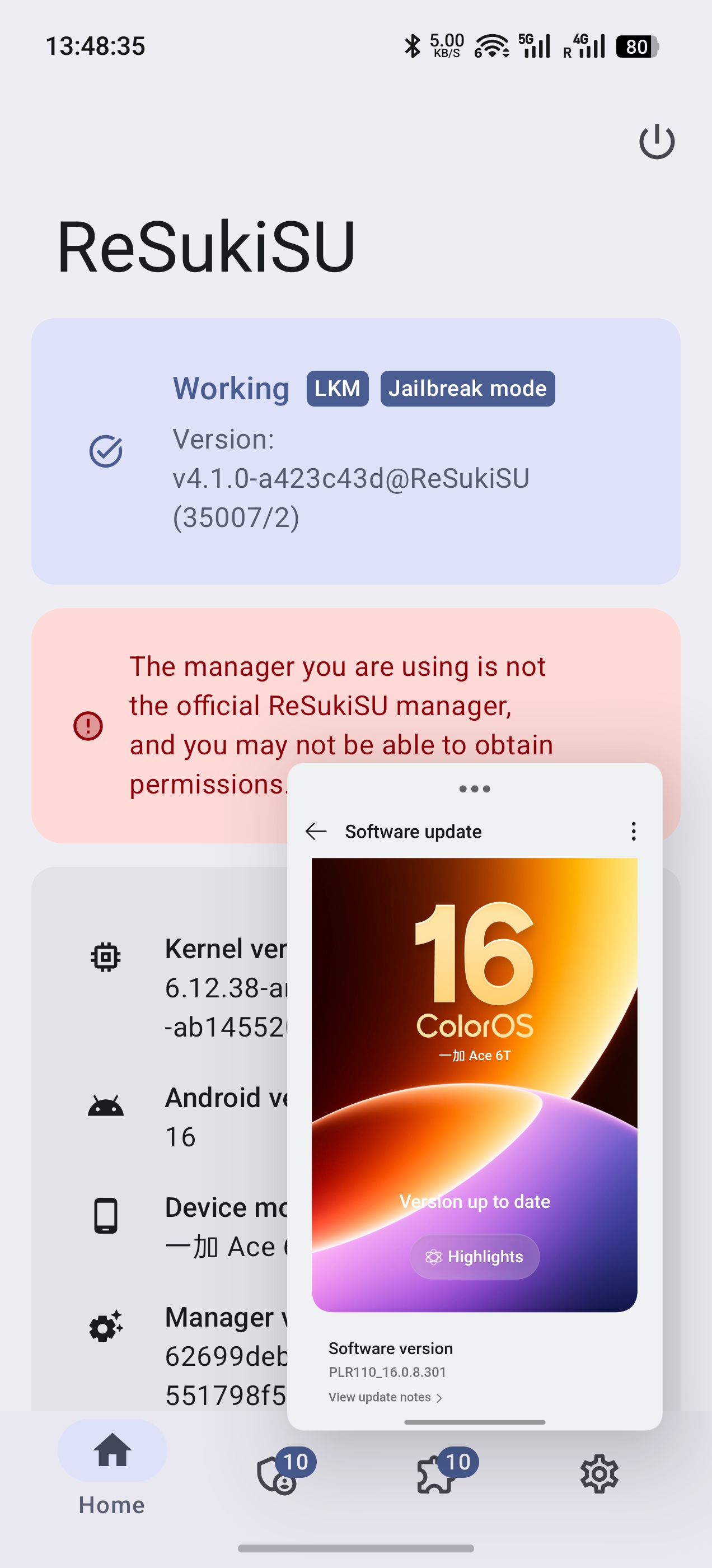
| OnePlus Ace 6T (PLR110) | SM8845 | 6.12.38 | android16-5 | 0 |
| OnePlus 15 (CPH2745/2747/2749) | SM8850 | 6.12.23 | android16-5 | 0 |
| OnePlus 15 (PLK110) | SM8850 | 6.12.58 | android16-6 | 0 |
| Xiaomi 17 (pudding) | SM8850 | 6.12.23 / 6.12.69 | android16-5 / android16-6 | 0 |
| OnePlus 13 (IN2060) | SM8750 | 6.6.89 | android15-8 | -2 |
| OPPO Pad 4 Pro | SM8750 | 6.6.89 | android15-8 | -2 |
Offsets Extracted (pending device test)
| Device | SoC | Kernel | Notes |
|---|---|---|---|
| OnePlus 15T (PLZ110) | SM8845 | 6.12.38 | Same kernel as Ace 6T |
| OPPO Reno10 Pro+ (CPH2521) | SM8475 | 5.10.236 | 5.10 compact waiter, waiter word=0 |
| Sony Xperia 1 IV (nagara) | SM8450 | 5.10.218 | 5.10 compact waiter, waiter word=0 |
| OPPO Find X9 Pro (PLG110) | D9400 | 6.12.23 | MediaTek, android16-5 |
| Vivo X200 Ultra (V2454A) | SM8750 | 6.6.89 | C ashmem, traditional hooks |
| Vivo X Fold3 Pro (PD2337) | SM8650 | 6.1.124 | 6.1 compact waiter, waiter word=3 |
| Vivo T4 | SM8650 | 6.1.145 | 6.1 compact waiter, waiter word=3 |
Not Feasible
The pselect stack overlay requires the freed rt_mutex_waiter to land within the user-controllable stack_fds region (words 0–14). Where it lands is determined by compiler PGO/LTO profiles, not the kernel version. See Stack Layout.
| Device | SoC | Kernel | Root Cause |
|---|---|---|---|
| OPPO Find X9 Ultra | SM8750 | 6.12.58 | PGO eliminates do_futex → waiter word=14 |
| OnePlus 15 (PLK110) | SM8850 | 6.12.69 | PGO inlines do_futex → waiter word=20 |
| OnePlus 12 | SM8650 | 6.1.141 | PGO inlines do_futex → waiter word=13/19 |
| OnePlus 13R / Ace 5 | SM8650 | 6.1.x | OPLUS 6.1: waiter word=13 |
| realme RMX5070 | SM6650 | 6.1.141 | OPLUS 6.1: waiter word=13 |
| OPPO Pad 5 (OPD2502) | MT6878 | 6.1.134 | OPLUS 6.1: waiter word=13 |
| Motorola Edge 60 Fusion | MT6878 | 6.1.145 | Non-OPLUS 6.1: same result |
| iQOO Neo 10 CN | SM8650 | 6.1.84 | do_futex frame 0xD0 → waiter word=-11 |
| OPPO PKW110 | — | 5.15.180 | do_futex frame 0x140 → waiter word=-29 |
| iQOO Z9 5G | — | 5.15.178 | do_futex frame too large |
| CPH2763 (OPPO) | — | 6.1.115 | OPLUS 6.1: PGO inlined, waiter word=24 |
| iQOO 12 | SM8650 | 6.1.145 | 6.1: waiter word=9, task/lock in zeroed area |
Note on 6.1 feasibility: OPLUS 6.1 kernels are consistently infeasible due to PGO inlining
do_futex. However, some non-OPLUS 6.1 kernels (vivo) retain the standard call chain and are feasible (vivo T4, X Fold3 Pro). Feasibility must be checked per-device.
Exploit Flow
Two root paths, selected automatically based on device capabilities:
Path A: UMH Root (preferred, C ashmem devices)
Requires off_ashmem_misc_fops != 0 (C ashmem with static miscdevice in BSS).
PI write (mode=4)  →  redirect miscdevice fops to fake fops
                   →  configfs r/w → pipe physrw (1-byte precise kernel r/w)
                   →  SELinux enforcing = 0 (single byte, no policycap corruption)
                   →  UMH: inject work_struct into system_unbound_wq
                   →  root script → ksud late-load → KSU installed
Available on: OnePlus 13, OPPO Pad 4 Pro, 5.10/6.1 C ashmem devices. Not available on Rust ashmem (6.12 GKI) — heap-allocated miscdevice.
Path B: Direct PI Write (fallback)
Write 1 (mode=1)  →  SELinux enforcing = 0 (8-byte write, corrupts adjacent bytes)
Write 2 (mode=2)  →  task->cred = init_cred (uid=0, all capabilities)
Root shell         →  ksud late-load → KSU → SELinux policy fix
After W1+W2, the exploit patches the SELinux policy binary's config field (|= 0xC0000000 for ANDROID_NETLINK_ROUTE + GETNEIGH) and reloads via /sys/fs/selinux/load to restore network connectivity.
Bootstrap Mode (phone standalone)
App (seccomp) → Write 1 → mini-adb TCP → adb shell: full exploit → root
Auto-Boot
The boot-time launcher is provided by the separate GhostLock Anchor app.
Stack Layout Feasibility
With NFDS=320, core_sys_select allocates a 256-byte stack_fds buffer on the kernel stack:
stack_fds:  0    5    10   14 | 15   20   25   29
            ├─in─┤─out─┤─ex──┤ ├res_in┤res_out┤res_ex┤
            ◄── USER CONTROLLED ──►│◄── KERNEL ZEROED ──►
The exploit places fake waiter fields (task, lock) in the fd_set input bitmaps. For 6.12 nested waiter (14 words): max feasible waiter word = 3. For 5.10/6.1 compact waiter (10 words): max feasible waiter word = 7.
The waiter position depends on the call chain depth:
| Pattern | Call Chain | Feasible |
|---|---|---|
| android16-5 (6.12) | sys_futex → do_futex → fwrpi | ✅ waiter word=2 |
| android16-6 (6.12.58) | sys_futex → do_futex → fwrpi | ✅ waiter word=2 |
| android16-6 (6.12.69 OPLUS) | sys_futex → fwrpi (PGO inlined) | ❌ waiter word=20 |
| android16-6 (X9 Ultra) | sys_futex → fwrpi (PGO inlined) | ❌ waiter word=14 |
| android15-8 (6.6) | sys_futex → do_futex → fwrpi | ✅ waiter word=2 (SHIFT=-2) |
| vivo 6.1 | sys_futex → do_futex → fwrpi | ✅ waiter word=3 |
| OPLUS 6.1 | sys_futex → fwrpi (PGO inlined) | ❌ waiter word=13+ |
| 5.10 OPLUS | sys_futex → do_futex → fwrpi | ✅ waiter word=0 |
kernel_phys_load
All kernel writes use the linear-map alias. The bootloader picks kernel_phys_load, which varies per SoC:
| SoC | kernel_phys_load |
|---|---|
| SM8845 (Ace 6T, 15T) | 0xa8000000 |
| SM8750 (OnePlus 13, OPPO Pad 4 Pro) | 0xa8000000 |
| SM8650 (vivo T4, X Fold3 Pro) | 0xa8000000 |
| SM8850 (OnePlus 15, Xiaomi 17) | 0xc7800000 |
A wrong value fails silently. Read it on a rooted unit:
su -c 'grep -i "Kernel code" /proc/iomem' # c7810000-... → 0xc7800000
Override at runtime: KPHYS=0xc7800000 /data/local/tmp/a/e
PSELECT_SHIFT
/data/local/tmp/a/e                        # Default (shift=0)
PSELECT_SHIFT=-2 /data/local/tmp/a/e       # OnePlus 13 (6.6)
KIMAGE_TEXT_BASE
5.10 kernels use 0xffffffc008000000 (VA_BITS=39, different from 6.x default 0xffffffc080000000). This is handled automatically via the kimage_text_base field in the device offset entry.
Build
make NDK_ROOT=/path/to/android-ndk
Or directly:
NDK=/path/to/android-ndk
"$NDK/toolchains/llvm/prebuilt/linux-x86_64/bin/aarch64-linux-android35-clang" \
  -O2 -Wall -Isrc/core -Isrc/devices -DTARGET_CONFIG_H=\"target.h\" \
  src/core/main.c src/core/util.c src/core/slide.c \
  src/core/fops.c src/core/pipe_physrw.c src/core/root.c \
  src/core/miniadb.c src/core/umh_root.c \
  -o ./ghostlock -fPIE -pie -pthread
Prerequisites
ksud (required for KSU installation)
GhostLock provides temporary root. KernelSU installation requires ksud which bundles kernelsu.ko for each KMI version.
| Method | Steps |
|---|---|
| ReSukiSU APK (recommended) | Install ReSukiSU or this fork. Bundles libksud.so. |
| CI release | Download from ReSukiSU CI |
Setup
adb shell mkdir -p /data/local/tmp/a
adb push ./ghostlock /data/local/tmp/a/e
adb shell chmod 755 /data/local/tmp/a/e
adb shell /data/local/tmp/a/e
Run after boot completes and ADB is ready.
Adding New Devices
Only boot.img is needed — no root, no device access required.
1. Extract kernel and kallsyms
See kallsyms tools guide for the full workflow, or:
python tools/extract_target.py --kallsyms kallsyms.txt
python tools/extract_btf.py kernel
2. Determine feasibility
Check if do_futex is PGO-inlined by searching the kernel binary for all branch instructions targeting futex_wait_requeue_pi. If __arm64_sys_futex calls it directly (bypassing do_futex), the device is likely not feasible.
3. Create device entry
Add src/devices/<name>/offsets.h with the extracted offsets and include it in src/devices/offsets.h. Use the appropriate struct offsets macro:
| Kernel | Waiter Layout | Macro |
|---|---|---|
| 6.12.x | Nested (14 words) | STRUCT_OFFSETS_6_12 |
| 6.6.x | Nested (14 words) | STRUCT_OFFSETS_6_6 |
| 6.1.x (vivo) | Compact (10 words) | STRUCT_OFFSETS_6_1 |
| 5.10.x | Compact (10 words) | STRUCT_OFFSETS_5_10 |
For 5.10/6.1 compact waiter devices, also set .kimage_text_base=0xffffffc008000000ULL.
Files
| File | Description |
|---|---|
src/core/main.c |
Exploit entry, W1/W2, UMH path, bootstrap, root script, SELinux policy fix |
src/core/fops.c |
pselect route, PI write, CFI stage, compact waiter support |
src/core/util.c |
Heap spray, KernelSnitch, slab drain, payload setup |
src/core/pipe_physrw.c |
Pipe buffer physical memory r/w |
src/core/umh_root.c |
UMH root via workqueue injection |
src/core/miniadb.c |
Mini ADB client (TCP + RSA auth) |
src/core/target.h |
Memory layout, struct field defaults (6.12) |
src/core/runtime_struct_offsets.h |
Per-device struct field override |
src/devices/offsets.h |
Device offset tables + STRUCT_OFFSETS_* macros |
tools/extract_target.py |
Offset extraction from kallsyms |
tools/extract_btf.py |
Struct offset extraction from BTF |
tools/kallsyms/ |
End-to-end kallsyms recovery workflow |
License
For authorized security research and educational purposes only.