wenyi


Carry stories across languages.
A desktop app for translating books and long-form writing, with the whole work in view.
Whole-book understanding · Consistent terminology · Evidence-based review


Quick start · Language support · Documentation
English | 简体中文

Thank you to PackyCode for sponsoring Wenyi.

|
PackyCode provides access to leading AI models through one API endpoint and one API key, with automatic failover and dedicated routes for Codex and Claude Code. |
Why Wenyi
| Typical approach | Wenyi |
|---|---|
| Segments translated in isolation, unaware of surrounding content | Whole-book prescan with chapter digests and rolling context |
| Glossary managed manually or as an afterthought | Real-time term extraction with conflict detection, fed back into subsequent batches |
| Single-pass translation, fragile to interruptions | Batch checkpoints and chapter status tracking: reopen the project and resume saved progress |
| Raw model output, no systematic quality process | Translate → polish → evidence-driven whole-book review |
Wenyi is designed for long-form texts — novels, social-science monographs, narrative nonfiction, and more.
Core features
- Local Desktop app — import books, translate, proofread, and save exports in one application. Projects stay in an independent local workspace; packaged releases include the Python engine, with no separate Python, PostgreSQL, Redis, or Docker setup. See the Desktop guide.
- Visual proofreading — English and Chinese interfaces, live translation progress, paragraph editing with revision history, and whole-book review with evidence and publication results. See the interface preview.
- Native file and credential support — drag files into a new project, choose export destinations with the system save dialog, and save API keys in the OS credential store when available.
- Whole-book understanding — prescans the source before translation, creating per-chapter digests and a book-level synopsis injected into every batch
- Real-time glossary — extracts proper names, terms, and recurring expressions as translation progresses; detects conflicting translations and surfaces them for resolution
- Multi-stage quality — optional polishing (strong model) and an evidence-driven whole-book AI review
- Resumability — completed batches and chapter progress are saved; reopen the application and continue from saved checkpoints
- Multiple LLM providers — DeepSeek, OpenAI, OpenRouter, OrcaRouter, Google Gemini, Ollama, vLLM, and generic OpenAI-compatible endpoints; keep three convenient tiers or select models per operation, mix connections, and share request limits. See model routing.
- Native EPUB preservation — writes translated text back into the original XHTML templates and attempts to preserve styles, images, TOC, and anchors
- Bilingual output — optional source-and-translation edition with visually subdued source text, including dark mode support.
Interface preview
Desktop and Web share these workspace pages. The screenshot below shows the translation overview in the Web Chinese interface; English is available in Settings.
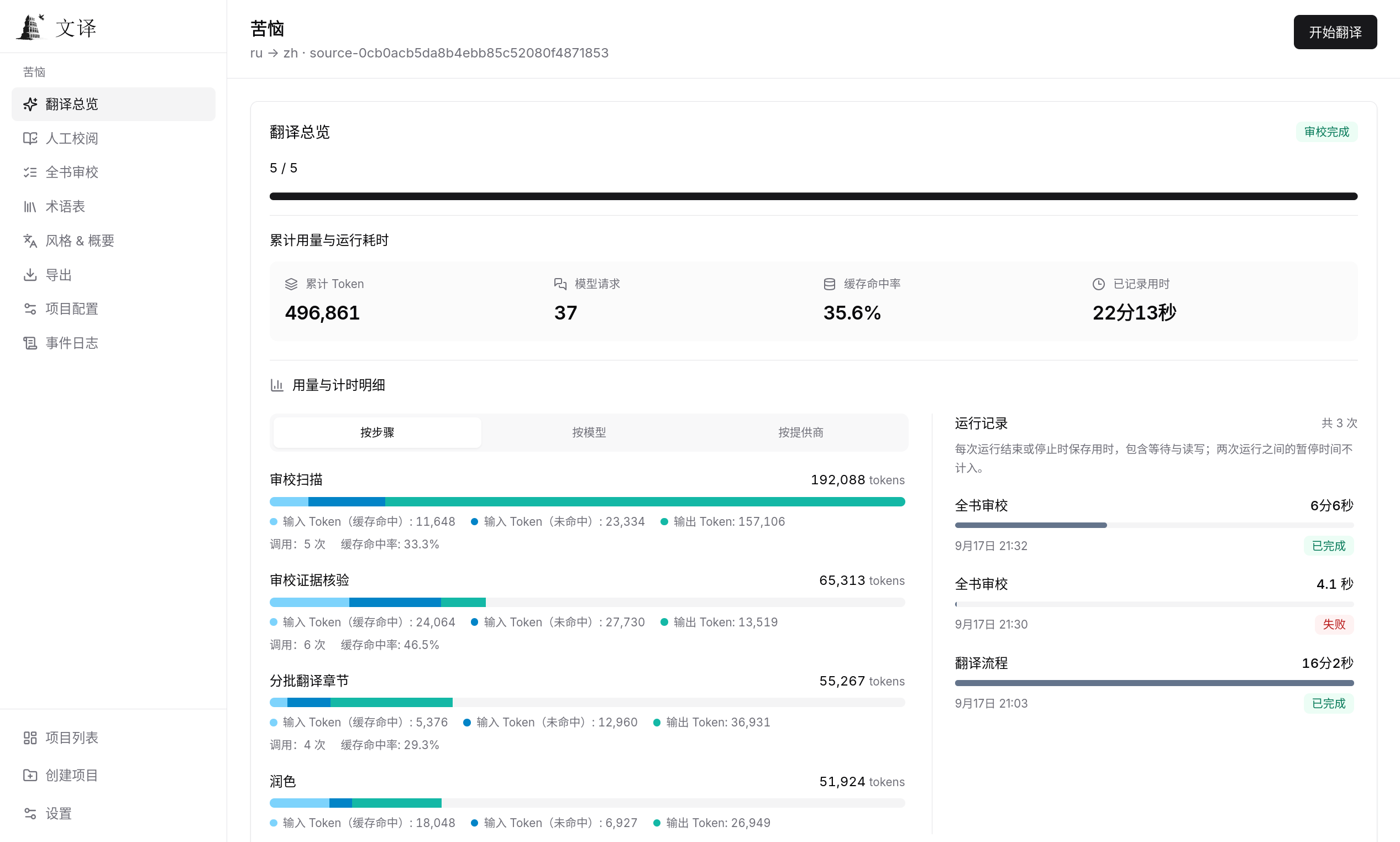
Translation overview: usage by step, cache hit rates, and run durations.
Quick start
With Python 3.10+ and uv installed, run from the repository root:
uv sync --locked
export DEEPSEEK_API_KEY="YOUR_DEEPSEEK_API_KEY"
uv run wenyi translate book.epub
This shell example uses the default DeepSeek provider. Supply your own key and review config.yaml before translating. For Windows commands, other providers, and resume/export options, see the CLI guide.
Prefer a graphical app? See the Desktop quick start for downloads and setup.
Supported formats
| Input | Output |
|---|---|
| EPUB, FB2, TXT, Markdown, HTML, PDF, DOCX | EPUB (monolingual / bilingual), TXT, HTML, Markdown, DOCX |
| SRT (movie / series subtitles) | SRT (monolingual / bilingual) |
- PDF input defaults to MinerU and requires its API key for the initial conversion; the resulting HTML is cached and reused. The BabelDOC bridge is optional for layout-preserving PDFs. See PDF configuration.
- EPUB output attempts to preserve the original book's styles, images, table of contents, and anchors. Vertical layout is converted to horizontal for Chinese reading.
- SRT projects use a lightweight subtitle workflow without a glossary, polishing, or whole-book review.
- DOCX uses the full book pipeline. Headings, simple tables, lists, and common run/paragraph styles are preserved where possible; translated Chinese uses Song (宋体).
Language support
Choose languages when creating a project, including directions such as Chinese → English or English → Japanese. Built-in profiles cover Chinese, English, Japanese, Korean, French, German, Spanish, Italian, Portuguese, Russian, Vietnamese, and selected variants. Multilingual translation remains experimental; real-model long-form quality needs further evaluation.
Translation pipeline
Wenyi combines whole-book understanding, batch translation, optional polishing, review, and export. See the translation pipeline for the flowchart and stage details.
Documentation
Client guides
- Desktop guide — installation/builds, API keys, native import and save, local data, and troubleshooting
- CLI guide — local installation, commands, translation, resume, and export
- Web deployment — optional self-hosted browser workspace with its own project data
Shared reference
- Configuration — providers, languages, pipeline switches, segmentation, paths
- Translation pipeline — whole-book analysis, terminology, context, polishing, review
Development
- Architecture — module responsibilities, shared services, and platform boundaries
- Contributing — development, testing, and contribution guidelines
Public-domain translation examples are shared through wenyi-bookcase. Do not publish copyrighted text, private books, or workspace data containing sensitive information without permission.
Limitations
- Multilingual translation is experimental. Prompt instructions use English, while generated descriptive metadata follows the translation target.
- Polishing and final review are the most expensive stages. Shadow fixing may trigger multiple full-book review passes and additional Fixer calls.
- PDF input defaults to MinerU and requires an API key for the initial conversion. The BabelDOC bridge is optional for layout-preserving PDFs.
- SRT translation does not include a glossary, polishing, or whole-book review.
- Translation quality is bounded by the capabilities of the chosen LLM model.
- Very long books may produce large workspaces; storage requirements grow with book length.
Community
- Discord server
- QQ group: 1055065098
- GitHub Issues — bug reports and feature requests
- GitHub Discussions — ideas and questions
Star history
License
AtomGit (China)
Wenyi is also hosted on AtomGit: https://atomgit.com/BigDawnGhost/wenyi