design-extract


Built by Manav Arya Singh (@Manavarya09)


Atlas Cloud — powers OpenAI-compatible --smart classification. For AI coding workflows, try the Atlas Cloud coding plan.
Bloome — deploys your AI clone to handle every audience conversation, running in the cloud, 24/7.
Try designlang on Bloome.
designlang points a headless browser at any URL and reads the design system off the live DOM. One command emits 17+ files — DTCG tokens, Tailwind config, shadcn theme, Figma variables, motion tokens, typed component anatomy, brand voice, page-intent labels, and a paste-ready prompt pack for v0 / Lovable / Cursor / Claude Artifacts.
It also goes where extractors don't: layout patterns, responsive behavior across 4 breakpoints, hover / focus / active states, WCAG contrast scoring, multi-page consistency, drift checks against a live source-of-truth, visual-diffs, and a shareable graded report card.
Quick start
npx designlang https://stripe.com                      # extract everything
npx designlang dna stripe.com                          # place it in the measured design space: neighbours + percentiles ← v13.1
npx designlang site stripe.com                         # whole-site: one canonical system + consistency grade ← v12.23
npx designlang fidelity stripe.com --clone localhost:3000  # score a clone vs the original (visual + motion) ← v12.24
npx designlang gallery                                 # static shareable gallery of measured clones      ← v12.24
npx designlang studio                                  # live token editor: edit, preview, export, share ← v12.19
npx designlang verify stripe.com                       # fidelity score: rebuild from tokens vs live ← v12.18
npx designlang pair stripe.com linear.app              # fuse two designs (visuals A × voice B)    ← v12.8
npx designlang brand stripe.com                        # full brand-guidelines book (13 chapters)  ← v12.7
npx designlang theme-swap stripe.com --primary "#ff4800"  # recolour around your brand        ← v12.6
npx designlang pack stripe.com                         # one polished design-system directory ← v12.4
npx designlang remix stripe.com --as cyberpunk         # restyle in another vocabulary       ← v12.3
npx designlang remix stripe.com --all                  # emit all 6 vocabs at once           ← v12.3
npx designlang grade https://stripe.com --badge        # report card + SVG badge             ← v12.2
npx designlang battle stripe.com vercel.com            # head-to-head graded fight           ← v12.2
npx designlang clone https://stripe.com                # working Next.js starter
npx designlang --full https://stripe.com               # screenshots + responsive + interactions
Drop a live design-score badge in any README:

Watch it read — live Extraction Theatre (v13)
Don't take the output on faith — watch it happen. On designlang.app/watch you paste a URL and a real headless Chromium opens the page and reads its entire design system in real time: a split stage with the live browser on the left and the design system — palette, type, spacing, motion — assembling itself on the right as each token lifts off the page.
It's driven by the actual extraction (the browser's CDP screencast streamed frame-by-frame alongside the real token events), recorded so a shared link replays the exact run. No install, no account. Every gallery card can be watched the same way, and the gallery now spans 37 real-graded design systems.
Whole-site design system (site)
Most extractors read a single URL. designlang site crawls a site's canonical
pages (home, pricing, docs, blog, about, product…) and synthesizes one
de-duplicated system. Every token is elected by coverage — the share of pages
that use it — so what's genuinely site-wide is separated from one-off,
page-local choices. Near-identical colours are merged in OKLab. It's fully
deterministic and free; no API key.
npx designlang site stripe.com --max-pages 8
You get, alongside the standard pack emitted from the canonical system:
| File | What it is |
|---|---|
*-site-system.json |
canonical unified tokens + coverage + drift |
*-site-coverage.md |
every token tagged 🟢 site-wide / 🟡 section / 🔴 page-local, with the pages using it |
*-site-consistency.md |
a 0–100 consistency grade, per-category breakdown, and the off-system outliers to consolidate |
Measured clone fidelity (fidelity + gallery)
Cloning tools all claim "pixel-perfect" — none of them measure it. designlang fidelity does. Point it at the original and your clone (often a local dev
server) and it returns one honest number, both halves of the clone:
- Visual — full-page screenshots of each, pixel-diffed.
- Motion —
extractMotion()on both, compared across feel, durations, easings, springs, keyframe kinds, scroll-linked motion, and choreography/ stagger. (Most clones reproduce static pixels and drop the motion entirely; this is where they lose.)
The two blend into a 0–100 score + letter grade, and — the part competitors don't ship — a ranked correction plan: the exact next edits that will raise the score, hardest-hitting first. Measure → fix → re-run until it converges.
npx designlang fidelity https://stripe.com --clone http://localhost:3000
npx designlang fidelity https://stripe.com --clone http://localhost:3000 --min 90   # CI gate
Generating the clone with designlang clone? Add --fidelity and it grades the
clone's token basis against the live site the moment it's built — writing
FIDELITY.md + a correction plan straight into the project, no separate step:
npx designlang clone https://stripe.com --fidelity
You get fidelity.md (score + motion table + correction plan), fidelity.json,
a shareable fidelity-card.svg (88% · B · stripe.com), and a fidelity-diff.png
loss heatmap.
Then publish them. designlang gallery scans your reports and builds a
deployable static site — an index of score cards plus a permalink page per clone
(each with an OG card, so a shared link unfurls the number).
npx designlang gallery --title "Our clones" --base-url https://clones.example.com
A measured design space (dna)
Every extractor on the market answers what a design uses. None of them answers
where it sits. designlang grade returns a letter — but a letter with no
reference frame is a thermometer with no scale on it.
designlang dna reduces a design to 30 deterministic features across five
axes — colour, type, space, shape, motion — and ranks it against a corpus of
real design systems:
npx designlang dna raycast.com
  Design DNA · https://raycast.com
  30 features, 100% measurable

  vs 8 systems (default)

  color    65th percentile
  type     56th percentile
  space    42th percentile
  shape    79th percentile
  motion   67th percentile

  Nearest
  0.14  https://railway.app
  0.15  https://linear.app
  0.19  https://notion.so
Distance is the mean absolute difference across the features both designs have,
so 0.14 reads as "the average feature is 14% of its range apart" — a number you
can reason about, unlike a Euclidean distance in 30 dimensions.
The report goes past similarity to what makes a design look the way it does: the features furthest from the middle of the corpus, in plain language ("corner radius — 100th percentile, far above the corpus").
Bring your own reference frame — your products, your competitors, a target look:
npx designlang dna-corpus acme.com acme.com/pricing competitor.com
npx designlang dna acme.com/new-page --corpus ./corpus.json
Three things it refuses to do, because a design score that overclaims is worse than no score at all:
- A missing measurement stays missing. Features the page never exposed are
null, never a substituted midpoint, and distance skips them instead of comparing against an invented value. - Every number carries its evidence. Distances report how many features backed them, percentiles name the corpus and its size, and the report warns when coverage was partial.
- The space is versioned. Feature order and normalization are frozen per vector version, and a corpus built by different rules is rejected rather than silently compared against.
Install
npm i -g designlang                         # global
designlang install-browser                  # one-time: the Chromium designlang drives
npx skills add Manavarya09/design-extract   # as an agent skill (40+ agents)
npm install no longer downloads a browser, so it works in CI, Docker and
behind proxies. install-browser fetches the Chromium matching the bundled
Playwright (add --with-deps on bare Linux). Without it, designlang falls back
to an installed Google Chrome.
Use in Claude Code (plugin)
designlang ships as a Claude Code plugin — eleven slash commands that wrap the CLI. Install it from inside Claude Code:
/plugin marketplace add Manavarya09/design-extract
/plugin install designlang@designlang
The first command registers this repo as a plugin marketplace; the second
installs the designlang plugin from it. Restart Claude Code if prompted, then
the commands are available:
| Command | What it does |
|---|---|
/extract <url> |
full design language → DTCG, Tailwind, Figma, motion, voice |
/site <url> |
crawl a whole site → one canonical design system + consistency grade |
/grade <url> |
shareable HTML report card + SVG badge |
/battle <a> <b> |
head-to-head graded comparison |
/remix <url> --as <vocab> |
restyle in 6 vocabularies (brutalist, swiss, art-deco, cyberpunk, soft-ui, editorial) |
/pack <url> |
one downloadable design-system bundle |
/theme-swap <url> |
OKLCH-correct recolour around a new brand primary |
/brand <url> |
full editorial brand-guidelines book (13 chapters) |
/pair <a> <b> |
fuse two designs across configurable axes |
/studio |
live token editor — preview, dark mode, export, share |
/verify <url> |
rebuild from tokens, pixel-diff vs live, fidelity score |
/fidelity <url> --clone <url> |
score a clone vs the original (visual + motion) + correction plan |
/gallery [dir] |
build a static shareable gallery of measured clones |
/dna <url> |
place a design in the measured design space — nearest systems, per-axis percentiles, outliers |
Prefer raw MCP tools? The CLI ships an MCP server that extracts live URLs:
claude mcp add designlang -- npx -y designlang mcp
extract_design(url)returns a job id; pollget_job_status, then pass the id toget_tokens,get_colors,get_typography,get_components,get_findings,compute_drift(against a baseline job) orexport(dtcg, tailwind, shadcn, figma, css, design-md). Add--output-dir <dir>to also serve an extraction already on disk as resources.
Atlas Cloud for --smart
designlang --smart can now use Atlas Cloud through its OpenAI-compatible chat API, so low-confidence classifiers can stay zero-dependency while routing to Atlas-hosted models.
export ATLASCLOUD_API_KEY="<atlascloud-api-key>"
export ATLASCLOUD_MODEL="deepseek-ai/deepseek-v4-pro"

npx designlang https://stripe.com --smart
- Atlas Cloud envs:
ATLASCLOUD_API_KEY,ATLASCLOUD_MODEL, optionalATLASCLOUD_API_BASE - Alias envs also work:
ATLAS_CLOUD_API_KEY,ATLAS_CLOUD_MODEL,ATLAS_CLOUD_API_BASE - Existing
OPENAI_API_KEYandANTHROPIC_API_KEYflows keep working unchanged
What you get
Each run writes 17+ files to ./design-extract-output/. The headline outputs:
| File | What it is |
|---|---|
*-design-language.md |
19-section markdown — feed any LLM to recreate the design |
*-design-tokens.json |
W3C DTCG tokens (primitive + semantic + composite layers) |
*-tailwind.config.js |
Drop-in Tailwind theme |
*-shadcn-theme.css |
shadcn/ui globals.css variables |
*-figma-variables.json |
Figma Variables import (light + dark) |
*-variables.css |
CSS custom properties |
*-anatomy.tsx |
Typed React stubs for every detected component + variants |
*-motion-tokens.json |
Durations, easings, springs, scroll-linked flag; with --motion-runtime also choreography (stagger) + scroll recipes + observed durations |
*-voice.json |
Brand voice — tone, pronoun posture, CTA verbs |
*-prompts/ |
Paste-ready prompts for v0, Lovable, Cursor, Claude Artifacts |
*-mcp.json |
Disk-backed MCP server payload |
*-grade.html |
v12.1 Shareable Design Report Card (letter grade + evidence) |
*-grade.svg |
v12.2 Shields.io-style design-score badge (drop into any README) |
*-battle.html |
v12.2 Head-to-head graded battle card from designlang battle |
*-remix.<vocab>.html |
v12.3 Site restyled in another vocabulary — brutalist / swiss / art-deco / cyberpunk / soft-ui / editorial |
Multi-platform (--platforms web,ios,android,flutter,wordpress,all) adds ios/, android/, flutter/, and a WordPress block theme. --emit-agent-rules adds Cursor / Claude Code / generic agent rule files.
Why designlang vs anything else
Other tools give you the paint. designlang reads the architecture:
- Layout system — grids, flex containers, container widths, gaps — not just tokens.
- Responsive — crawls 4 breakpoints and reports what changes (
--responsive). - Interaction states — programmatically hovers and focuses, captures the deltas (
--interactions,--deep-interact). - Motion language — durations, easing families, spring detection, scroll-linked flag,
feelfingerprint (springy / smooth / mechanical / mixed). - Runtime motion (
--motion-runtime) — drives the page (load / scroll / hover / focus) and readsdocument.getAnimations()to capture what actually animates: real durations, choreography/stagger sequences, and scroll recipes (parallax / reveal / pin). Folded into*-motion-tokens.jsonand previewable live in the studio's Motion tab. - Component anatomy — slot trees with variant × size × state matrices, emitted as typed
.tsx. - Brand voice — tone, pronoun posture, heading style, CTA verb inventory.
- Page intent + section roles —
landing/pricing/docsetc., with semantic regions (hero,feature-grid,pricing-table,cta…). - Multi-page consistency — auto-discovers canonical pages, reconciles shared vs per-route tokens.
- WCAG — every fg/bg pair scored, with a remediation palette suggesting nearest passing colors.
- Drift + lint + visual-diff —
designlang drift,lint,visual-diffall CI-ready, exit non-zero on failure. - Live-site sync — treat the deployed site as source of truth (
designlang sync). - MCP server —
designlang mcpexposes tokens, regions, components, and contrast pairs to any MCP-aware agent.
designlang grade https://stripe.com         # ← v12.1: shareable report card
designlang clone https://stripe.com         # → working Next.js app
designlang apply https://stripe.com -d ./app   # auto-detect framework, write tokens
designlang brands stripe.com vercel.com linear.app   # N-brand matrix
designlang drift https://yourapp.com --tokens ./src/tokens.json
designlang lint ./src/tokens/design-tokens.json     # CI-ready linter
designlang visual-diff https://staging.app https://app   # single-file HTML diff
designlang mcp                              # stdio MCP server for Cursor / Claude Code
designlang doctor                           # sanity-check the local install
All features
| Feature | Flag / Command | Description |
|---|---|---|
| Base extraction | designlang <url> |
Colors, typography, spacing, shadows, radii, CSS vars, breakpoints, animations, components |
| Layout system | automatic | Grid patterns, flex usage, container widths, gap values |
| Accessibility | automatic | WCAG 2.1 contrast ratios for all fg/bg pairs |
| Design scoring | automatic | 7-category quality rating (A-F) with actionable issues |
| Gradients | automatic | Gradient type, direction, stops, classification |
| Z-index map | automatic | Layer hierarchy, z-index wars detection |
| SVG icons | automatic | Deduplicated icons, size/style classification, color palette |
| Font files | automatic | Source detection (Google/self-hosted/CDN/system), @font-face CSS |
| Image styles | automatic | Aspect ratios, shapes, filters, pattern classification |
| Dark mode | --dark |
Extracts dark color scheme + light/dark diff |
| Auth pages | --cookie, --cookie-file, --header |
Extract from authenticated/protected pages; cookie files in JSON / Playwright storageState / Netscape formats |
| Self-signed / dev TLS | --insecure |
Ignore HTTPS/SSL certificate errors |
| User-Agent override | --user-agent <ua> |
Set a custom User-Agent string |
| Chrome extension | chrome-extension/ |
One-click handoff from any tab, MV3, activeTab only |
| Multi-page | --depth <n> |
Crawl N internal pages; emits shared-vs-per-route token reconciliation (*-tokens-shared.json, *-tokens-routes/<slug>.json, *-routes-report.md) |
| Screenshots | --screenshots |
Capture buttons, cards, inputs, nav, hero, full page |
| Responsive | --responsive |
Crawl at 4 viewports, map breakpoint changes |
| Interactions | --interactions |
Capture hover/focus/active state transitions |
| Auto-interact | --deep-interact |
Scroll, open menus/modals/accordions, hover CTAs before extraction |
| Runtime motion | --motion-runtime |
Capture real motion via document.getAnimations() — durations, stagger/choreography, scroll recipes |
| Everything | --full |
Enable screenshots + responsive + interactions + deep-interact + motion-runtime |
| Apply | designlang apply <url> |
Auto-detect framework and write tokens to your project |
| Clone | designlang clone <url> |
Generate a working Next.js starter with extracted design |
| Score | designlang score <url> |
Rate design quality with visual bar chart breakdown |
| Grade (v12.1) | designlang grade <url> |
Shareable HTML "Design Report Card" — letter grade, 8 dimensions, evidence, strengths + fixes |
| Battle (v12.2) | designlang battle <A> <B> |
Head-to-head graded battle card with verdict, dimension table, palette comparison |
| Badge (v12.2) | designlang grade --badge |
Shields.io-style SVG badge — design · B · 87 — drop into any README. Live endpoint: designlang.app/badge/<host>.svg |
| Remix (v12.3) | designlang remix <url> --as <vocab> |
Restyle the audited page in another vocabulary (brutalist / swiss / art-deco / cyberpunk / soft-ui / editorial). --all emits all 6 |
| Pack (v12.4) | designlang pack <url> |
Bundle every output (tokens / components / Storybook / starter / prompts) into one polished design-system directory |
| Theme-swap (v12.6) | designlang theme-swap <url> --primary <hex> |
Recolour the extracted design around a new brand primary. OKLCH hue rotation, neutrals preserved, type/spacing/motion untouched |
| Brand book (v12.7) | designlang brand <url> |
Full editorial brand-guidelines document (13 chapters: cover, about, logo, colour, type, spacing, shape, iconography, motion, components, voice, a11y, tokens, how-to-use). Print-ready, dark-mode toggle, hand-off-ready |
| Pair (NEW v12.8) | designlang pair <urlA> <urlB> |
Fuse two designs across 7 axes (colours/type/spacing/shape/motion/voice/components). Defaults to "visuals from A, voice + type from B". --brand also emits a brand book of the fused identity |
| Design DNA (NEW v13.1) | designlang dna <url> |
Reduce a design to a 30-feature vector (colour / type / space / shape / motion) and rank it against a corpus of real design systems — nearest neighbours, per-axis percentiles, outlier features |
| DNA corpus (NEW v13.1) | designlang dna-corpus <urls...> |
Build your own reference frame — your products, your competitors — for dna to measure against |
| Watch | designlang watch <url> |
Monitor for design changes on interval |
| Diff | designlang diff <A> <B> |
Compare two sites (MD + HTML) |
| Multi-brand | designlang brands <urls...> |
N-site comparison matrix |
| Sync | designlang sync <url> |
Update local tokens from live site |
| History | designlang history <url> |
Track design changes over time |
| MCP server | designlang mcp |
Expose extraction as MCP resources + tools |
| Multi-platform | --platforms <csv> |
Emit iOS / Android / Flutter / WordPress outputs |
| Agent rules | --emit-agent-rules |
Cursor, Claude Code, generic agent rule files |
| Stack fingerprint | automatic | Framework + Tailwind + analytics detection |
| CSS health | automatic | Specificity, !important, unused CSS, keyframes |
| A11y remediation | automatic | Nearest palette color passing AA / AAA for every failing pair |
| Semantic regions | automatic | nav / hero / pricing / testimonials / cta / footer classification |
| Reusable components | automatic | DOM subtree + style-vector clustering with variants |
| DTCG tokens | default | W3C Design Tokens v1 with semantic + composite layers (--tokens-legacy for pre-v7) |
Full CLI Reference
designlang <url> [options]

Options:
  -o, --out <dir>         Output directory (default: ./design-extract-output)
  -n, --name <name>       Output file prefix (default: derived from URL)
  -w, --width <px>        Viewport width (default: 1280)
  --height <px>           Viewport height (default: 800)
  --wait <ms>             Wait after page load for SPAs (default: 0)
  --dark                  Also extract dark mode styles
  --depth <n>             Internal pages to crawl (default: 0)
  --screenshots           Capture component screenshots
  --responsive            Capture at multiple breakpoints
  --interactions          Capture hover/focus/active states
  --deep-interact         Auto-interact pass (scroll, menus, modals, accordions, hover CTAs)
  --motion-runtime        Capture runtime motion via getAnimations() (durations, choreography, scroll recipes)
  --full                  Enable all captures (implies --deep-interact + --motion-runtime)
  --cookie <cookies...>   Cookies for authenticated pages (name=value)
  --cookie-file <path>    Load cookies from JSON / storageState / Netscape cookies.txt
  --header <headers...>   Custom headers (name:value)
  --user-agent <ua>       Override the browser User-Agent string
  --insecure              Ignore HTTPS/SSL certificate errors (self-signed, dev, proxies)
  --selector <css>        Only extract from elements matching this CSS selector (e.g. ".pricing-card")
  --system-chrome         Use the system Chrome install instead of the bundled Chromium (skips 150MB download)
  --json                  Print full extraction as JSON to stdout (for piping into other tools)
  --framework <type>      Only generate specific theme (react, shadcn)
  --platforms <csv>       Additional platforms: web,ios,android,flutter,wordpress,all (additive)
  --emit-agent-rules      Emit Cursor / Claude Code / CLAUDE.md / agents.md rule files
  --tokens-legacy         Emit pre-v7 flat design-tokens.json shape (backward compat)
  --no-history            Skip saving to history
  --verbose               Detailed progress output

Commands:
  apply <url>                       Extract and apply design directly to your project
  clone <url>                       Generate a working Next.js starter from extracted design
  score <url>                       Rate design quality (7 categories, A-F, bar chart)
  grade <url>                       Generate a shareable HTML Design Report Card (--format html|md|json|svg|all, --badge, --open)
  battle <urlA> <urlB>              Head-to-head graded battle card (--format html|md|json|all, --open)
  remix <url>                       Restyle in another vocabulary (--as brutalist|swiss|art-deco|cyberpunk|soft-ui|editorial, --all, --list, --open)
  pack <url>                        Bundle every output into one design-system directory (--with-clone, --open)
  theme-swap <url> --primary <hex>  Recolour around a new brand primary (--from, --format html|md|json|tokens|all, --open)
  brand <url>                       Generate a full editorial brand-guidelines book (--format html|md|json|all, --open)
  pair <urlA> <urlB>                Fuse two designs across 7 axes (--colors-from, --typography-from, --spacing-from, --shape-from, --motion-from, --voice-from, --components-from, --brand)
  watch <url>                       Monitor for design changes on interval
  diff <urlA> <urlB>                Compare two sites' design languages
  brands <urls...>                  Multi-brand comparison matrix
  sync <url>                        Sync local tokens with live site
  history <url>                     View design change history
  install-browser                   Download the Chromium designlang drives (--with-deps on bare Linux)
  mcp                               Launch stdio MCP server: extract live URLs as jobs (--output-dir <dir> also serves one on disk)
  lint <file>                       (v9) Audit a local token file (.json/.css) — CI-ready
  drift <url> --tokens <file>       (v9) Check local tokens for drift against a live site
  visual-diff <before> <after>      (v9) Side-by-side HTML diff of two URLs
  fidelity <original> --clone <url> Score a clone vs the original — visual pixel-diff + motion fidelity → one grade + ranked correction plan (--min, --motion-runtime)
  gallery [dir]                     Build a shareable static gallery of measured clones (--title, --base-url)
Example output
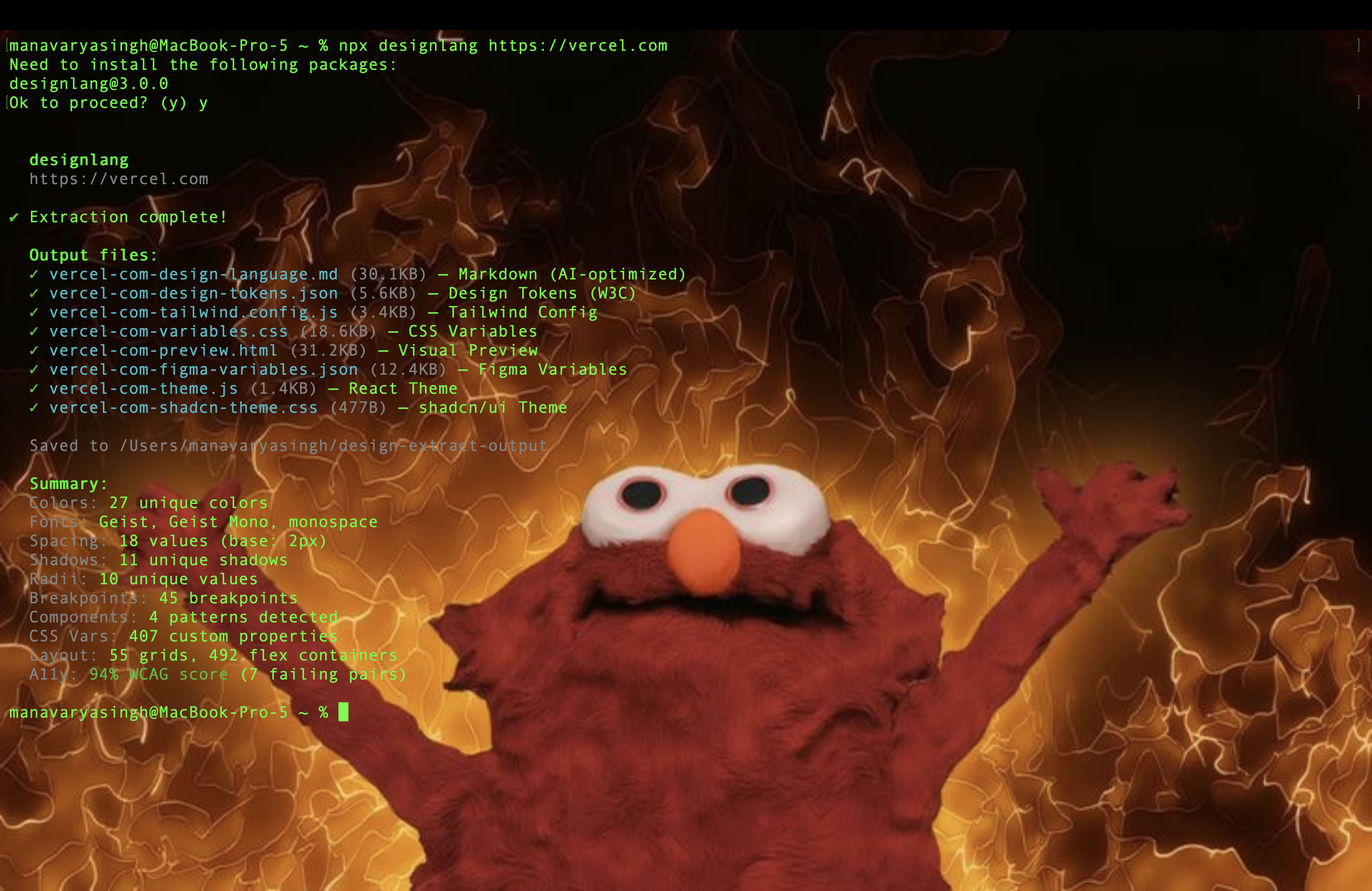
designlang https://vercel.com --full →
Colors: 27 · Fonts: Geist + Geist Mono · Spacing: 18 (base 2px)
Shadows: 11 · Radii: 10 · CSS vars: 407 · Layout: 55 grids / 492 flex
Responsive: 4 viewports, 3 breakpoint changes · Interactions: 8 transitions
A11y: 94% WCAG · Score: 68/100 (D) · 4 issues

→ 17 files written to ./design-extract-output/
→ Run `designlang grade https://vercel.com` for a shareable report card
How it works
- Crawl — Headless Chromium via Playwright, waits for network idle and fonts
- Extract — One
page.evaluate()walks up to 5,000 DOM elements, collecting 25+ computed properties, inline SVGs, font sources, and image metadata - Process — 17 extractor modules parse, deduplicate, cluster, and classify the raw data
- Format — 12+ formatter modules emit the output files
- Score — Accessibility extractor calculates WCAG contrast ratios for all color pairs
- Capture — Optional: screenshots, responsive viewport crawling, interaction state recording
Install Everywhere
designlang ships surfaces beyond the CLI:
| Surface | Path | Description |
|---|---|---|
| CLI | npx designlang <url> |
Main entry point. |
| VS Code extension | vscode-extension/ |
"Extract design from URL" command + auto-inject into workspace. |
| Raycast extension | raycast-extension/ |
Extract, score, and "copy CLI command" from Raycast. |
| Figma plugin | figma-plugin/ |
Paste a URL inside Figma, get a full Variables collection. |
| GitHub Action | github-action/ |
"Design regression guard" — diffs tokens on every PR and comments. |
| Chrome extension | chrome-extension/ |
One-click handoff from any tab (MV3, activeTab only). |
| Doctor | designlang doctor |
One-screen health check of the local install — Node, playwright, Chromium binary, output dir, network. Exits 1 if anything fails. |
| MCP server | npx designlang mcp |
Exposes the extracted design as MCP resources + tools for Cursor, Claude Code, Windsurf, etc. See docs/MCP-REGISTRY.md. |
| Claude Code plugin | .claude-plugin/ |
Five slash commands inside Claude Code — /extract, /grade, /battle, /remix, /pack. |
Claude Code plugin
Drop designlang straight into Claude Code as a plugin. Every CLI command becomes a slash command:
/plugin install Manavarya09/design-extract
Then inside any Claude Code session:
| Slash command | What it does |
|---|---|
/extract <url> |
Full extraction → DTCG tokens, Tailwind, Figma vars, motion, voice |
/grade <url> |
Shareable HTML "Design Report Card" (+ --badge for an SVG) |
/battle <urlA> <urlB> |
Head-to-head graded battle card |
/remix <url> --as <vocab> |
Restyle in brutalist / swiss / art-deco / cyberpunk / soft-ui / editorial |
/pack <url> |
Bundle every output into one design-system directory |
Manifest: .claude-plugin/plugin.json · marketplace: .claude-plugin/marketplace.json · commands: commands/ · skills: skills/.
Agent skill (other ecosystems)
Works with Cursor, Codex, and 40+ AI coding agents via the skills ecosystem:
npx skills add Manavarya09/design-extract
In Cursor / Codex / etc., use /extract-design <url>.
Contributing
See CONTRIBUTING.md. PRs welcome!
License
MIT - Manav Arya Singh !!