router




LRouter is an Android router for modularized projects, built for modern Android toolchains.
It focuses on four practical goals:
- routing between pages and modules
- parameter passing and injection
- module-level initialization
- lightweight decoupling through simple DI
LRouter was created as a modern alternative to ARouter for projects running on recent AGP and Gradle versions.
Why LRouter
ARouter helped a lot of Android modularization projects, but it has become harder to use in modern environments:
- AGP 8+ removed
Transform, which breaks the old plugin-based approach. - Dex scanning at startup is expensive if you do not use compile-time registration.
- ARouter is built around Java annotation processing, which is less friendly to Kotlin-first projects.
- Kotlin projects benefit much more from
KSPthan fromKAPT.
LRouter keeps the mental model familiar for ARouter users, while updating the implementation strategy for modern Android builds.
Highlights
- ARouter-like API surface for lower migration cost
- KSP-based code generation
- Optional ASM-based auto-registration for release builds
- Activity and Fragment routing
@Autowiredparameter injection- interceptor support with stable priority ordering
- per-module initializer support
- simple DI for cross-module decoupling
- route table export task
Compatibility
Minimum requirements:
- AGP 7.4+
- Gradle 8+
- JDK 17
- Kotlin project with KSP enabled
Environment verified in this repository:
- AGP
8.13.2 - Gradle
8.13 - JDK
17 - Kotlin
2.3.20 - KSP
2.3.6
Notes:
debugusesServiceLoaderby default for a better incremental build experience.releasecan optionally enableASMregistration to reduce runtime initialization cost.- Every Android module that uses LRouter must apply the
aleyn-routerplugin.
Installation
Add JitPack in settings.gradle:
dependencyResolutionManagement {
    repositoriesMode.set(RepositoriesMode.FAIL_ON_PROJECT_REPOS)
    repositories {
        ...
        maven { url "https://jitpack.io" }
    }
}
Add the plugin dependency in the root build.gradle:
buildscript {
    dependencies {
        classpath com.github.aleyn97.router:plugin:last-version
    }
}

plugins {
    // ...
    id 'com.google.devtools.ksp' version "x.y.z-x.y.z"
}
Apply the plugin in every module that uses LRouter:
plugins {
    // ...
    id 'aleyn-router'
}
The plugin adds the core runtime and KSP processor automatically.
Initialization Modes
LRouter supports two registration modes:
ServiceLoaderBest for development. Keeps incremental builds friendly. It uses a small amount of reflection internally.ASMUses bytecode instrumentation for auto-registration. Better for release builds, but not ideal for incremental development.
Typical setup:
buildTypes {
    release {
        minifyEnabled false
        proguardFiles getDefaultProguardFile('proguard-android-optimize.txt'), 'proguard-rules.pro'
        routerConfig { openASM = true }
    }

    debug {
        minifyEnabled false
        // routerConfig { openASM = false }
    }
}
Quick Example
Annotate an Activity or Fragment:
@Route(path = "/Main/Main")
class MainActivity : BaseActivity()

@Route(path = "/Main/Home")
class MainFragment : BaseFragment()
Navigate:
LRouter.navigator("/Main/Home")
That is enough for a basic route.
Basic Usage
Parameter Injection
Call LRouter.inject(this) in your base activity:
abstract class BaseActivity : AppCompatActivity() {

    override fun onCreate(savedInstanceState: Bundle?) {
        super.onCreate(savedInstanceState)
        LRouter.inject(this)
    }
}
Pass parameters:
LRouter.build("/Main/Main")
    .withString("nickname", "Aleyn")
    .withInt("age", 18)
    .withAny("userInfo", UserInfo(/* ... */))
    .navigation()

// When using ActivityResultLauncher, pass a Context explicitly
LRouter.build("/Main/Main")
    .withActivityLaunch(activityLaunch)
    .navigation(this)
// Fragment: .navigation(requireContext())
Inject them with @Autowired:
@Route(path = "/Main/Main")
class MainActivity : BaseActivity() {

    @Autowired("nickname")
    var name = ""

    @Autowired
    var age = 0

    @Autowired
    lateinit var userInfo: UserInfo
}
Primitive values, String, and serializable objects are stored directly in Bundle.
Other objects, plus collections such as List and Map, are passed as JSON and parsed back using the declared type. Generic collections and nested objects are supported.
Getting a Fragment
LRouter.build("/Main/Home").getFragment()
// or
LRouter.build("/Main/Home").asFragment<Fragment>()
Navigation Callbacks
Listen to multiple navigation events:
LRouter.build("/Main/Home").navCallback(
    onInterrupt = {},
    onLost = {},
    onFound = {},
    onArrival = {},
)
Or use focused callbacks:
LRouter.build("/Main/Home").navInterrupt {
    // navigation interrupted
}

LRouter.build("/Main/Home").navFound {
    // route found
}

LRouter.build("/Main/Home").navLost {
    // route missing
}

LRouter.build("/Main/Home").navArrival {
    // navigation succeeded
}
Global callback:
LRouter.setNavCallback(object : NavCallback {
    override fun onLost(navigator: Navigator) {
        Log.d(TAG, "onLost: ${navigator.path}")
    }

    override fun onFound(navigator: Navigator) {
        Log.d(TAG, "onFound: ${navigator.path}")
    }

    override fun onArrival(navigator: Navigator) {
        Log.d(TAG, "onArrival: ${navigator.path}")
    }

    override fun onInterrupt(navigator: Navigator) {
        Log.d(TAG, "onInterrupt: ${navigator.path}")
    }
})
Per-route callbacks override the global one.
Interceptors
Interceptors support priority. The default is 0; larger values run earlier.
@Interceptor
class RoomInterceptor : LRouterInterceptor {

    override fun intercept(navigator: Navigator): Navigator {
        if (navigator.path == "/Room/Home") {
            return navigator.newBuilder()
                .replaceUrl("/First/Home")
                .build()
        }
        return navigator
    }
}
Return null to interrupt navigation completely.
Module Initialization
LRouter supports per-module initialization, similar in spirit to androidx.startup, but without forcing all initialization wiring into the main app module.
@Initializer(priority = 1, async = false)
class AppModelInit : LRouterInitializer {

    override fun create(context: Context) {
        Log.d("AppModelInit", "create: AppModelInit")
    }
}
If one module must wait for another to finish initialization, make sure both initializers run on the same execution mode, either both sync or both async.
Dependency Injection
LRouter includes a lightweight DI mechanism for cross-module decoupling. It is intentionally simple. If your project needs a more full-featured DI framework, you can still use Dagger, Hilt, Koin, or another dedicated solution.
Main annotations:
@Singleton@Factory@Qualifier@InParam
Example:
@Singleton
class AppProviderImpl : IAppProvider {

    private var count = 0

    override fun getAppInfo(): String {
        count++
        return "this is APP Provider $count"
    }
}
Usage:
class YouActivity : BaseActivity() {

    @Autowired
    lateinit var appProvider: IAppProvider

    private val appProvider2 by inject<IAppProvider>()

    private val roomProvider by inject<IRoomProvider>(sq("room1"))
    private val roomProvider2 by inject<IRoomProvider>(sq("room2"))
}

@Qualifier("room1")
@Singleton
class RoomProviderImpl : IRoomProvider {
    override fun getRoomName(): String = "this is APP Provider 1"
}

@Qualifier("room2")
@Singleton
class RoomProviderImpl2 : IRoomProvider {
    override fun getRoomName(): String = "this is APP Provider 2"
}
Action
Register an action:
@Route(path = "custom://action/test")
class TestAction : LRouterAction {
    override fun action(context: Context, arguments: Bundle) {
        val game = arguments.getString("Game").orEmpty()
        val role = arguments.getInt("role")

        Toast.makeText(context, "TestAction${game},${role}", Toast.LENGTH_SHORT).show()
    }
}
Execute it:
LRouter.build("custom://action/test")
    .withString("game", "CF")
    .withInt("role", 1002)
    .navigation()

// or
LRouter.navigator("custom://action/test?game=CF&role=1002")
Generate Route Table
LRouter provides a dedicated Gradle task to export the route table:
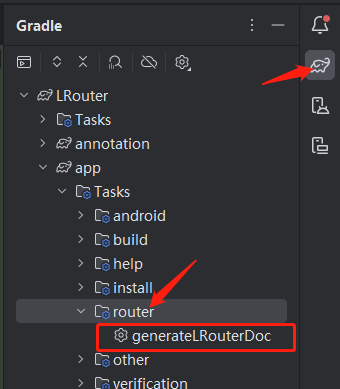
The generated files are written to the main project's build/router directory.
Migrating From ARouter
LRouter keeps the overall experience intentionally familiar for ARouter users.
Migration checklist:
- move from
KAPTtoKSP - apply
aleyn-routerin every module that uses the router - use
ServiceLoaderin development and optionally enableASMin release - for non-serializable objects and collections, rely on JSON-based parameter passing
LRouter is designed to replace ARouter in projects that have moved to newer AGP versions and can no longer depend on the old Transform-based integration model.
Optional Configuration
Disable Automatic Dependencies
If you do not want the plugin to add dependencies automatically, set this in gradle.properties:
LRouter.auto = false
Then add dependencies manually:
implementation 'com.github.aleyn97.router:core:last-version'
ksp 'com.github.aleyn97.router:processor:last-version'
Apply the Plugin Automatically for Many Modules
If your project has many modules, you may prefer to apply the plugin from the root build file:
subprojects.forEach {
    it.afterEvaluate {
        def isAndroid = (it.plugins.hasPlugin('com.android.application')
                || it.plugins.hasPlugin('com.android.library'))
        def isModule = it.name.startsWith('module') || it.name.startsWith('app')
        if (isAndroid && isModule) {
            it.plugins.apply('aleyn-router')
        }
    }
}
Adjust the matching rule to fit your own module naming convention.