erupt
English | 中文

ERUPT
ANNOTATION-DRIVEN JAVA ADMIN FRAMEWORK · AI HARNESS
one class = one admin page · zero front-end · 2–5s startup · 50+ LLM · MCP-native · A2A








[ WEBSITE ]
[ LIVE DEMO ]
[ START PROJECT ]
[ AI SKILL ]
[ DOCS ]
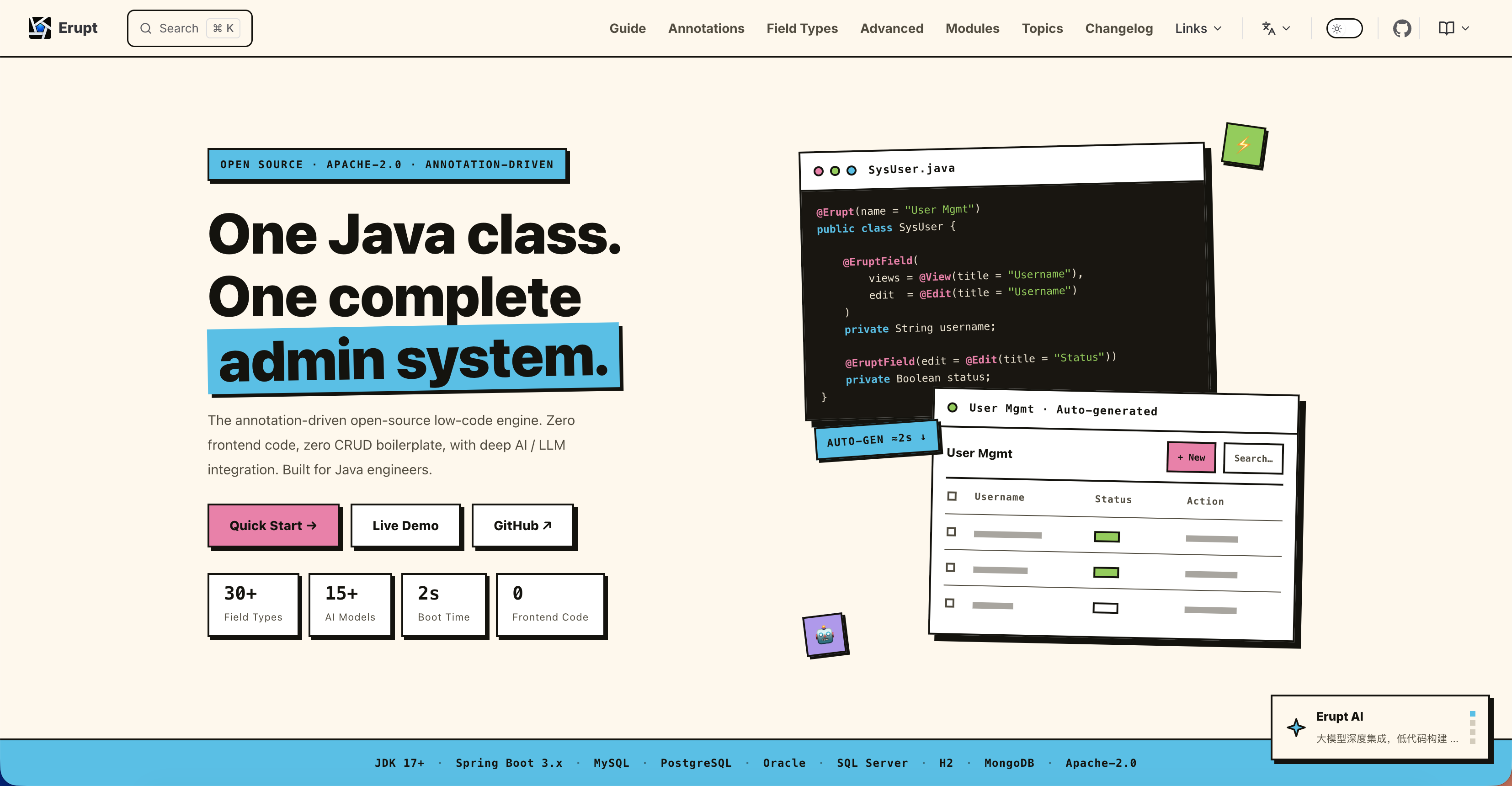
ONE CLASS = ONE PAGE |
Annotate a JPA entity. Get a full admin page. Zero controllers, zero front-end build, zero scaffolding. |
FAST STARTUP |
2–5 seconds to a running admin UI. Java 17 + Spring Boot 3.x. |
30+ COMPONENTS |
Date, slider, tree, code editor, reference table, autocomplete, map, signature, Markdown — out of the box. |
BATTERIES INCLUDED |
RBAC, audit logs, Excel import/export, OpenAPI. Every @Erupt entity is a permission-aware REST endpoint. |
AI-NATIVE |
50+ LLM providers, MCP-native tools, 700k+ skills. All configurable from the admin UI. |
MULTI-DATABASE |
JPA: MySQL · PostgreSQL · Oracle · SQL Server · DM. MongoDB via erupt-mongodb. |
ECOSYSTEM |
erupt-cloud for distributed config. Commercial Chart / Flow / Tenant / Cube modules for reporting, workflow, SaaS, BI. |
01 · QUICKSTART
A — SOURCE
Clone and run the bundled sample. H2 in-memory. No config.
git clone https://github.com/erupts/erupt.git
cd erupt
mvn spring-boot:run -pl erupt-sample -am
# → http://localhost:8080   login: erupt / erupt
B — DOCKER
All-in-one image — hub.docker.com/r/erupts/erupt. Built on erupt-spring-boot-starter-all: designer, job, monitor, magic-api, notice, AI, cloud-server, embedded H2. Zero configuration.
docker run -p 8080:8080 erupts/erupt
# → http://localhost:8080   login: erupt / erupt
Production: switch to MySQL / Redis via -e env vars — image guide →
C — MAVEN
1 · One dependency.
<dependency>
    <groupId>xyz.erupt</groupId>
    <artifactId>erupt-spring-boot-starter</artifactId>
    <version>${erupt.version}</version>
</dependency>
Bundles everything a runnable admin needs (erupt-admin + erupt-web). Want every optional module too (designer, job, generator, monitor, magic-api, websocket, notice, print, terminal, AI, cloud-server)? Use erupt-spring-boot-starter-all.
2 · Annotate a JPA entity. This IS the UI.
@Erupt(name = "User")
@Entity
public class User extends BaseModel {

    @EruptField(
        views = @View(title = "Name"),
        edit  = @Edit(title = "Name", search = @Search)
    )
    private String name;
}
3 · Run.
mvn spring-boot:run
# → http://localhost:8080   login: erupt / erupt
Paged. Searchable. Exportable. Role-gated. Add a field, refresh, it shows up.
D — STARTER
start.erupt.xyz — pick modules in your browser, download a ready-to-run project. No local setup.
E — AI SKILL
skill.erupt.xyz — build a full admin panel with zero development background. Made for non-engineering roles (ops, HR, product, finance): describe your system in one sentence inside Claude Code or a similar AI agent, and the skill handles the rest — JDK, database (H2), login, CRUD, search, Excel, permissions all included. Only entities get written; UI and APIs render from annotations at runtime, so it costs ~1/20 the tokens of writing from scratch.
git clone https://github.com/plinian/erupt-skill.git ~/.claude/skills/erupt-admin
Then tell Claude Code: "Build me a CRM admin panel" → running system.
NO INSTALL— demo.erupt.xyz (guest / guest)FULL GUIDE— docs.erupt.xyz/guide/quick-start
MORE — sliders, choice fields, custom actions, LambdaQuery
@Erupt(
    name = "Simple",
    power = @Power(importable = true, export = true),
    rowOperation = @RowOperation(
        title = "Custom Action",
        mode = RowOperation.Mode.SINGLE,
        operationHandler = OperationHandlerImpl.class
    )
)
@Table(name = "t_simple")
@Entity
public class Simple extends BaseModel {

    @EruptField(
        views = @View(title = "Text"),
        edit  = @Edit(title = "Text", notNull = true, search = @Search)
    )
    private String input;

    @EruptField(
        views = @View(title = "Date"),
        edit  = @Edit(title = "Date", search = @Search)
    )
    private Date date;

    @EruptField(
        views = @View(title = "Slider"),
        edit  = @Edit(title = "Slider", type = EditType.SLIDER, search = @Search,
            sliderType = @SliderType(max = 90, markPoints = {0, 30, 60, 90}, dots = true))
    )
    private Integer slide;

    @EruptField(
        views = @View(title = "Choice"),
        edit  = @Edit(title = "Choice", type = EditType.CHOICE, search = @Search,
            choiceType = @ChoiceType(
                fetchHandler = SqlChoiceFetchHandler.class,
                fetchHandlerParams = "select id, name from e_upms_menu"
            ))
    )
    private Long choice;
}
Type-safe queries with LambdaQuery:
List<EruptUser> list = eruptDao.lambdaQuery(EruptUser.class)
        .like(EruptUser::getName, "e")
        .isNull(EruptUser::getWhiteIp)
        .in(EruptUser::getId, 1, 2, 3, 4)
        .ge(EruptUser::getCreateTime, "2023-01-01")
        .list();
More scenarios — erupt.xyz/#!/contrast
02 · OUT OF THE BOX
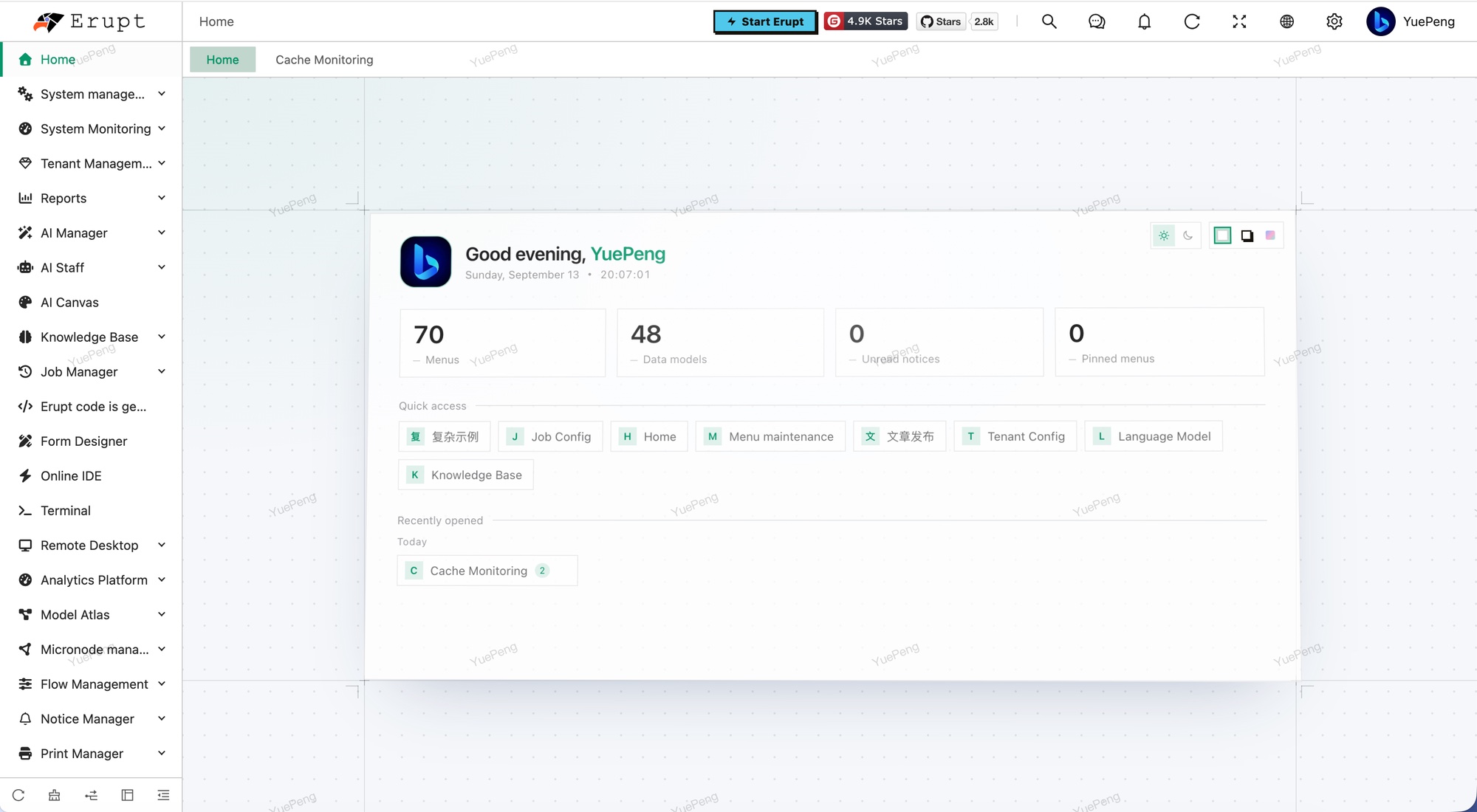
UI GENERATION |
Tables, forms, search, pagination, tree views, Gantt, card views, 20+ field components — driven by @View / @Edit / @Search. |
PERMISSIONS · UPMS |
Users, roles, menus, row-level filters, column-level visibility. SpEL on @Filter. OAuth2 / LDAP / SSO. |
OPENAPI |
Every @Erupt entity is a REST endpoint, governed by the same permission rules as the UI. |
MULTI-DATABASE |
JPA: MySQL · PostgreSQL · Oracle · SQL Server · DM. MongoDB via erupt-mongodb. |
EXCEL |
Import/export via erupt-excel. Override excelImport / excelExport on DataProxy. |
AI HARNESS |
erupt-ai — 50+ LLM providers, MCP-native tools, built-in RBAC. → 03 |
AI CLAW |
erupt-ai-claw — drive entities, shell, files, browser through natural language. → 04 |
CLUSTER |
erupt-cloud distributed config. Commercial erupt-tenant for full SaaS. → 05 |
WHICH AI MODULE?— Pickerupt-aifor raw LLM / MCP access to build your own agent. Pickerupt-ai-clawfor a turn-key admin agent (it depends onerupt-ai; add only this one).
Module catalog — erupt.xyz/#!/module · API reference — javadoc.erupt.xyz
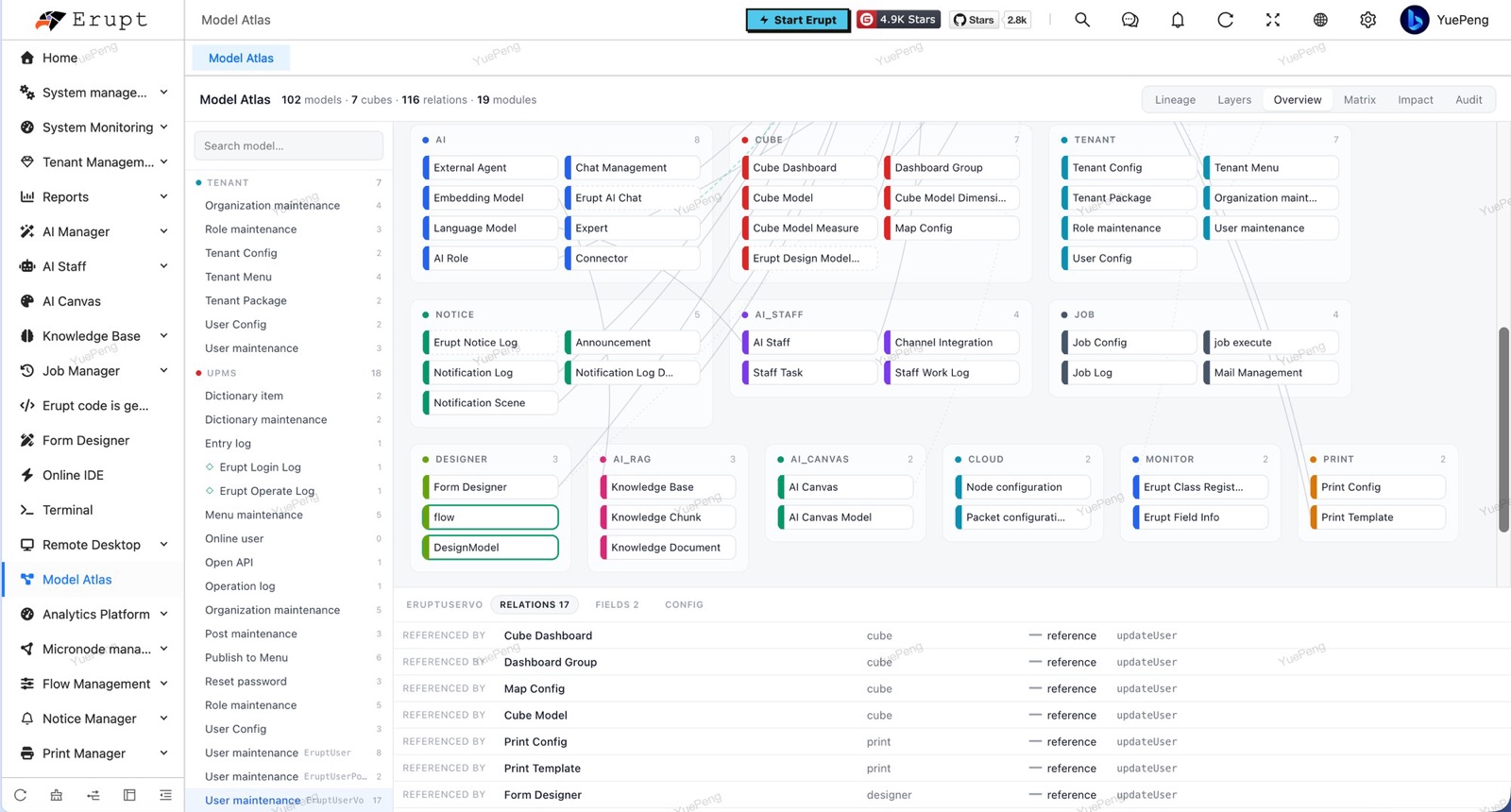
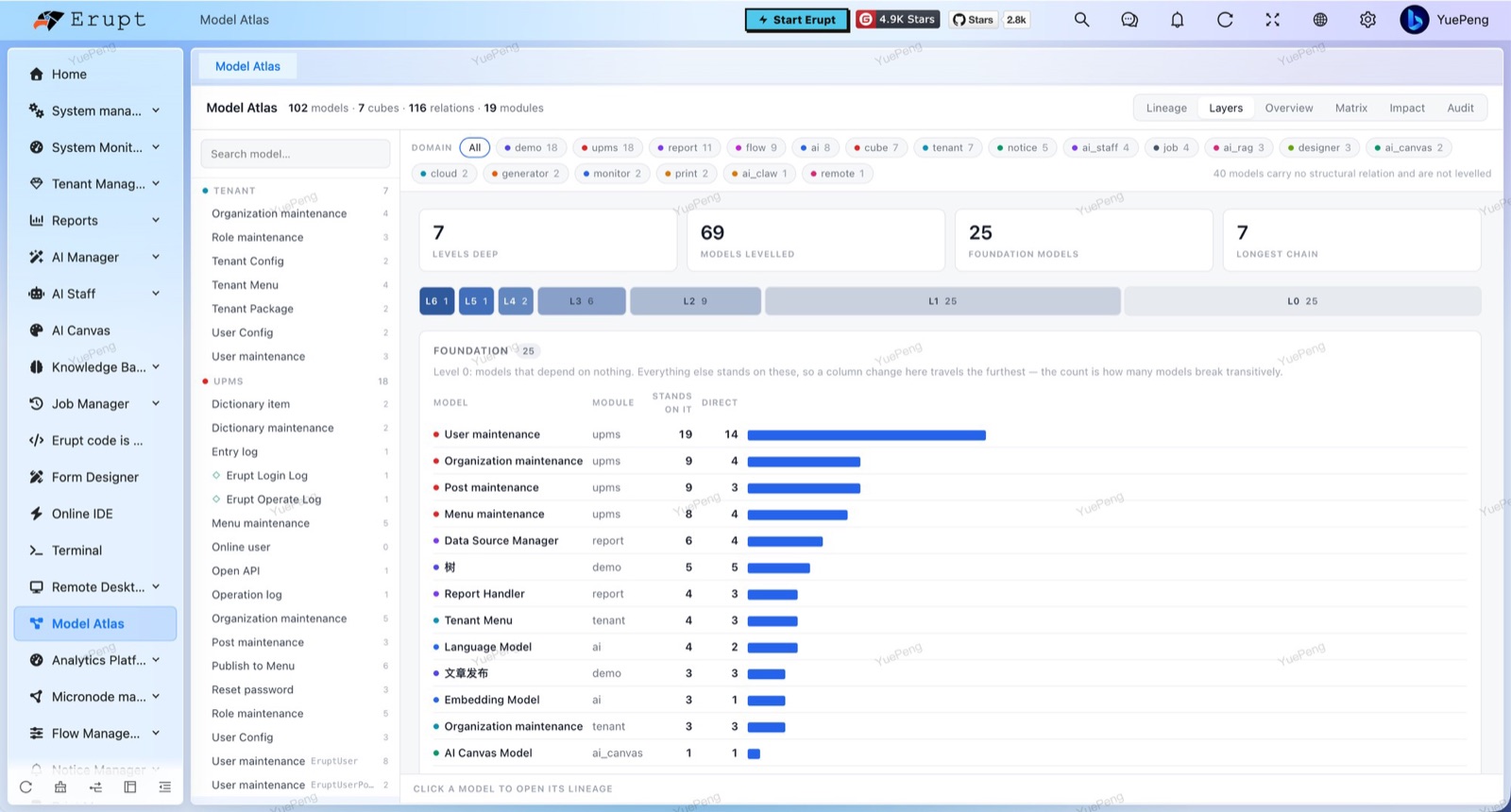
MODEL ATLAS
Every
@Eruptentity, every relation between them, drawn from the same annotations that build the UI. No extra configuration — the map exists because the model does.
OVERVIEW |
Every model grouped by module. Read the shape of the whole system at a glance. |
LAYERS |
How deep the graph runs: what everything stands on, and the few chains the depth comes from. |
LINEAGE · MATRIX · IMPACT |
One model's neighbourhood, module-to-module coupling, and what breaks if a model changes. |
FIELDS · POWER · AUDIT |
Every field of every model, declared @Power against the menu buttons behind it, and a health report: cycles, shared tables, isolated models. |
 |
 |
03 · AI HARNESS
erupt-ai— production-grade AI agents on JVM. 50+ LLM providers · MCP-native · built-in RBAC · role-aware system prompts · chat history. All configurable through the admin UI. Zero boilerplate.
WHY "HARNESS" — Shipping AI to production needs more than an SDK: governance (RBAC) + interoperability (MCP) + observability (chat history, token tracking) + operator-friendly config (admin UI). All four, out of the box.
PROVIDERS — OpenAI · Claude · Gemini · DeepSeek · Qwen · GLM · Doubao · Moonshot · MiniMax · Mistral · Grok · Fireworks · Together · OpenRouter · Requesty · OrcaRouter · Ollama (self-hosted) — hot-swappable from the admin UI, 50+ total.
MULTI-PROVIDER |
Configure multiple LLMs via UI. Switch without code changes. |
STREAMING · SSE |
Token-by-token responses, configurable timeouts. |
THINKING MODELS |
Native support for reasoning models (DeepSeek, Kimi-K2). |
MCP |
Any MCP-compatible tool server. SSE & STDIO transports. Auto-reconnect health checks. |
A2A |
Agents call agents through the standardized A2A protocol. Multi-agent workflows out of the box. |
AI TOOLBOX |
Expose any Spring Bean as an AI tool — @AiToolbox + @Tool. |
TOOL SECURITY |
Every AI tool gated by LLMRole. Whitelist or revoke per role at runtime. No restart. |
AGENTIC |
Agents with custom system prompts, hint lists, dynamic prompt handlers, MCP tools. |
CHAT HISTORY |
Per-user sessions, token tracking, soft-delete. |
LONG-TERM MEMORY |
Cross-session persistence. Key decisions auto-stored, reloaded next session. |
@AiToolbox
@Component
public class MyTools {

    @Tool("Look up order status by order ID")
    public String getOrderStatus(String orderId) {
        return orderService.getStatus(orderId);
    }
}
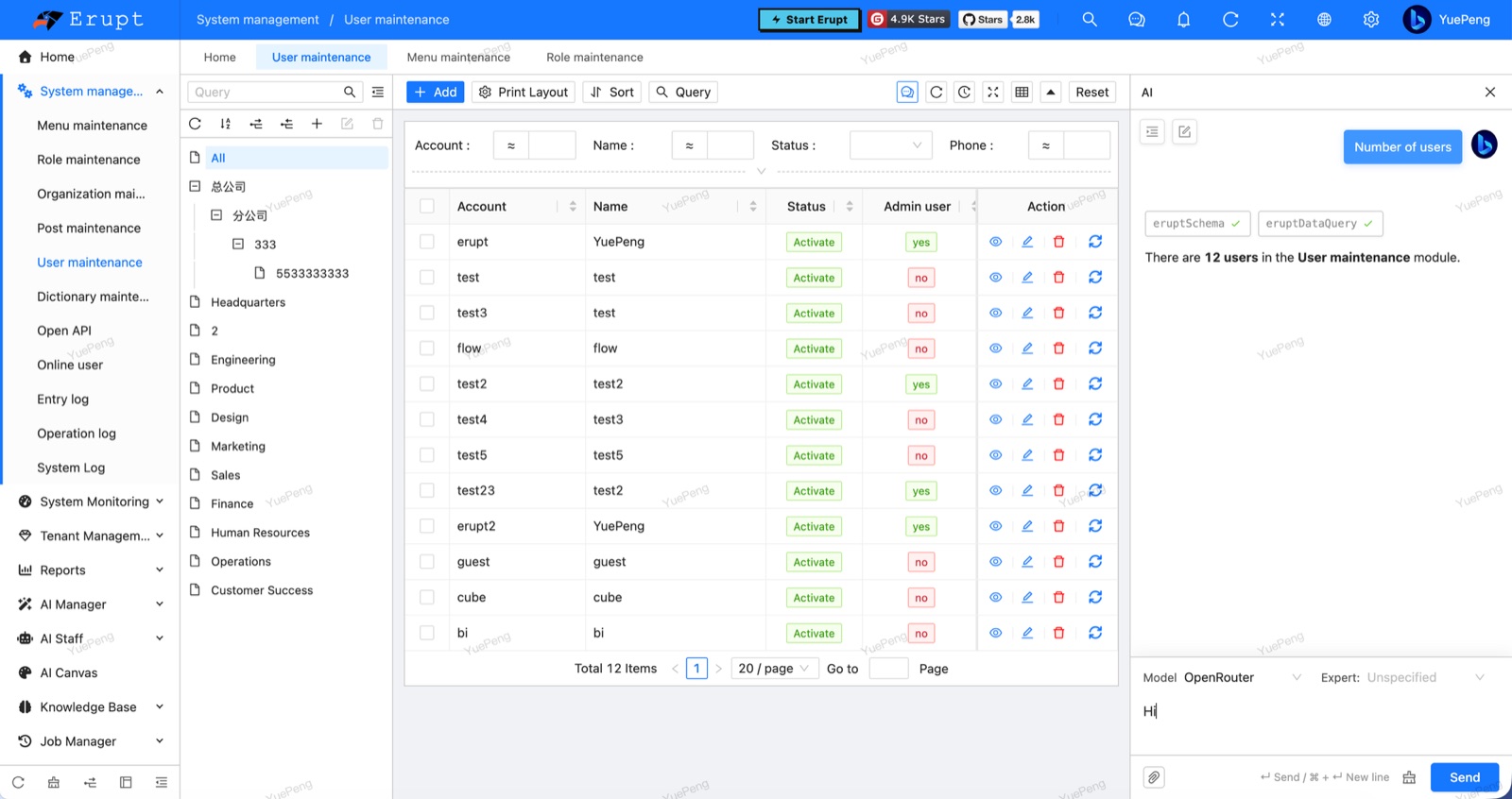
LLM providers, MCP servers, agents — all managed through the built-in admin UI. No restarts.
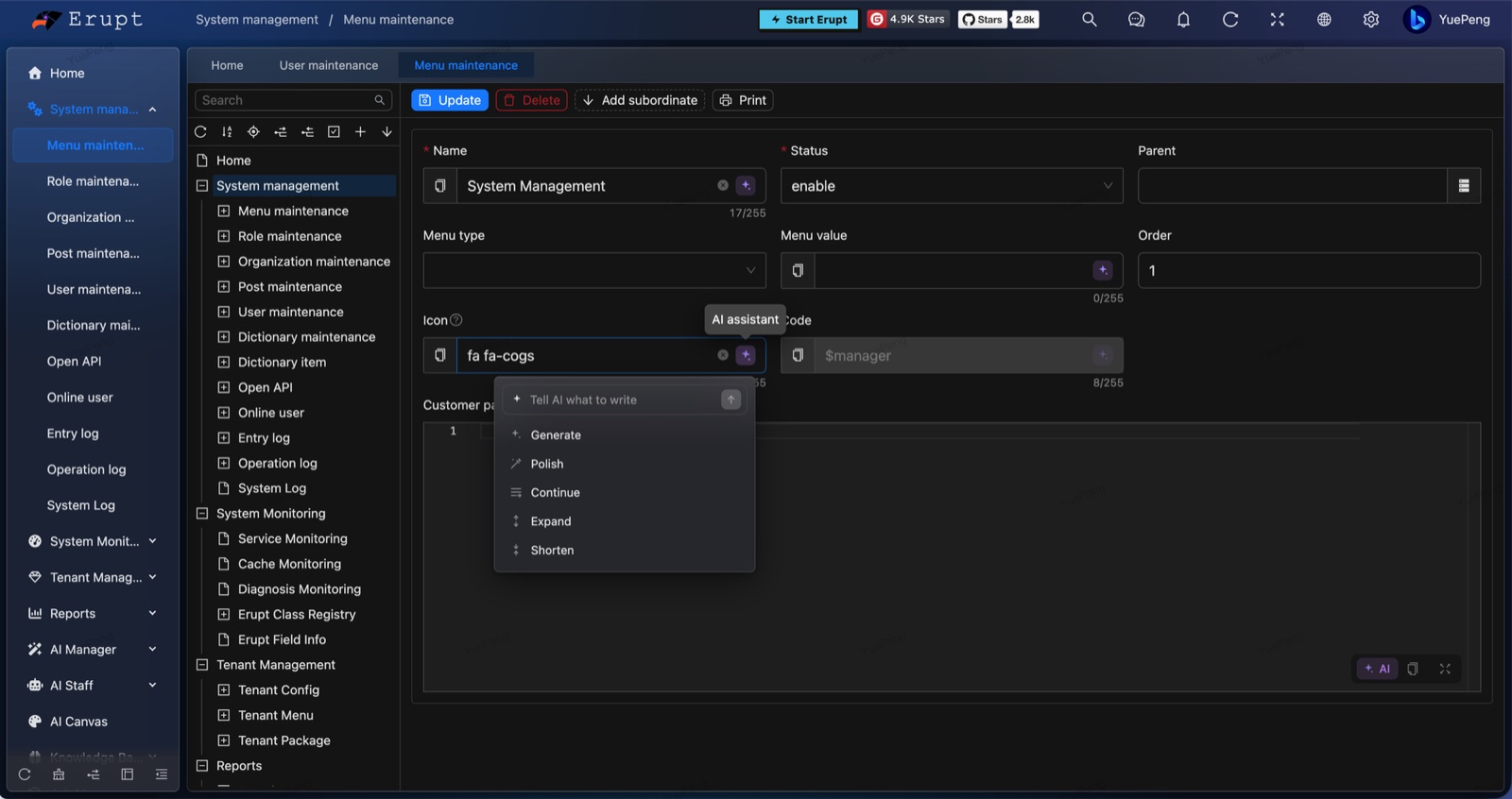
FIELD ASSISTANT
Any text field in any generated form gets an inline writing assistant. Nothing to wire up — it appears wherever the schema says the field holds text.
GENERATE · POLISH · CONTINUE · EXPAND · SHORTEN — or just tell it what to write. Streams into the field, and one click undoes it.
 |
 |
04 · AI CLAW
erupt-ai-claw— drive your server through natural language, like talking to a colleague.
MODEL OPS |
Query, create, update data across any @Erupt entity via chat. |
SHELL |
Run system commands through natural language. |
FILE I/O |
Read and write files on the server. |
BROWSER |
Interact with the browser via MCP configuration. |
SKILLS · 700K+ |
Compatible with 700k+ skills from skills.sh. AI auto-matches and executes. Dynamic skill creation supported. |
Claw shares the same role-based tool security as AI Harness — only whitelisted tools reach non-admin users. Skills live in ~/.erupt/skills/ and can also be created through chat.
05 · CLOUD
erupt-cloud— the annotation-driven admin experience for distributed Spring Boot deployments. Centralized config, service topology, per-node admin UIs — same@Eruptmodel.
┌────────────────────────────┐
│  erupt-cloud-server        │   central console
│  config · nodes · topology │
└──────────────┬─────────────┘
               │  register / pull config
   ┌───────────┼───────────┐
   ▼           ▼           ▼
┌───────┐  ┌───────┐  ┌───────┐
│ node  │  │ node  │  │ node  │   erupt-cloud-node
│ + own │  │ + own │  │ + own │   per-service admin UI
│ admin │  │ admin │  │ admin │
└───────┘  └───────┘  └───────┘
CONFIG CENTER |
Multi-dimensional: schemas, nodes, rollout policies. Instances sync on demand. |
LIGHT |
Minimal intrusion. Versions aligned with the main Erupt release train. |
TOPOLOGY |
Cluster topology, call graphs, config rollouts — one console. |
IN-CLUSTER ADMIN |
Every business service hosts its own Erupt admin. No per-subsystem scaffolding. |
AUDIT |
Every config change leaves a trace. Finer-grained rollback than version-level. |
docs.erupt.xyz/modules/erupt-cloud · erupt.xyz/#!/cloud
06 · COMMERCIAL MODULES
CORE IS FREE, FOREVER—erupt-core/erupt-annotation/erupt-web/erupt-jpa/erupt-upms/erupt-aiand other core modules are Apache 2.0 forever. No license restrictions · no project-count limits · no commercial restrictions (governance commitment →). Commercial modules are optional enterprise extensions that evolve independently.
| MODULE | USE CASE | DOCS |
|---|---|---|
ERUPT FLOW |
Workflow / approval engine | docs → |
ERUPT SAAS |
Multi-tenant infrastructure | docs → |
ERUPT CUBE |
BI platform with semantic layer | docs → |
Source-code delivery · one-time purchase · perpetual use.
07 · TELEMETRY
Erupt reports anonymous usage statistics — erupt version, installed modules, JDK, OS and database type, Spring Boot version, timezone — to guide compatibility and roadmap decisions. It never sends business data, credentials, hostnames, or anything IP-derived, and requests fail silently without ever blocking startup.
Opt out with erupt.telemetry.enabled: false or the ERUPT_TELEMETRY_DISABLED=1 environment variable; CI is skipped automatically.
08 · CONTRIBUTING
Free and open source. Code, bug reports, ideas, use cases, blog posts — all welcome.
Read the contribution guidelines, then open an issue or pull request.
IF ERUPT SAVES YOU TIME — STAR IT.It really helps the project grow.
09 · LICENSE
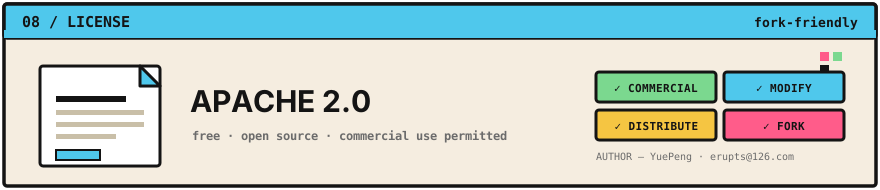
Apache 2.0 — free · open source · commercial use permitted · fork-friendly.
AUTHOR — YuePeng · erupts@126.com